
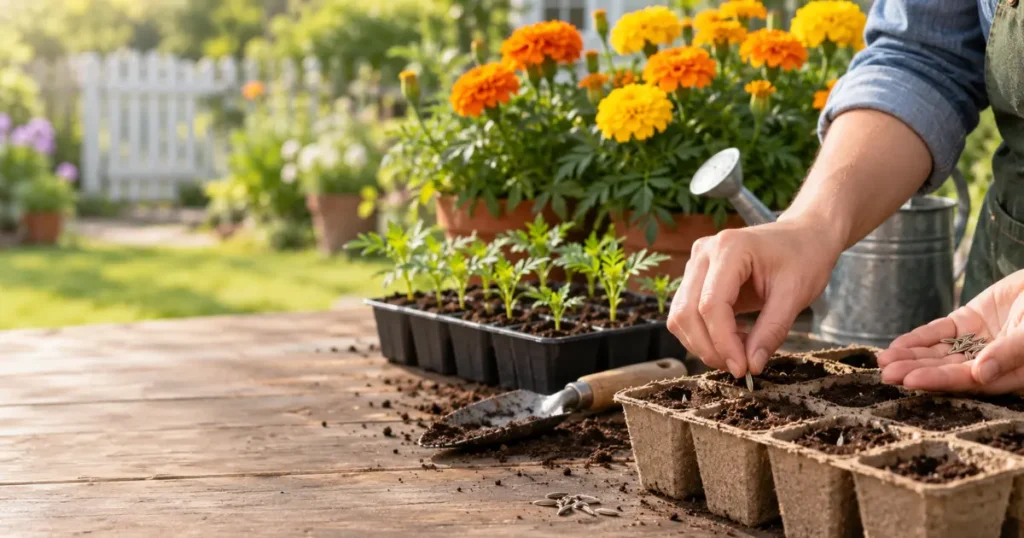
Learning how to grow marigolds from seed is a straightforward way to fill sunny garden beds with color without relying entirely on nursery transplants. Marigold seeds are large enough to handle easily, germinate relatively quickly under warm conditions, and can be started either indoors or directly in the garden.
The main decisions are timing and method. You can start seeds indoors for an earlier head start, or sow them outside once frost risk has passed and conditions have warmed sufficiently. From there, success depends on sensible sowing depth, consistent moisture during germination, strong light for seedlings, and gradual acclimation before indoor-grown plants move outside.
This guide takes you through that complete journey—from deciding when to sow to germination, seedling care, hardening off, transplanting, and the approximate time you can expect to wait for flowers.
Quick Summary
- When learning how to grow marigolds from seed, base spring timing on local frost risk and whether you are starting indoors or sowing outside.
- Iowa State University Extension recommends starting marigold seeds indoors about 6–8 weeks before the intended outdoor planting date, while University of Minnesota Extension suggests about 10 weeks; cultivar and growing conditions help determine the most useful lead time.
- For direct sowing, wait until frost danger has passed and the soil has warmed sufficiently for this warm-season annual.
- Sow marigold seeds about 1/4 inch deep and keep the seed-starting medium consistently moist, but not saturated, during germination.
- Under favorable warm conditions, seeds commonly germinate in roughly 5–8 days.
- After germination, provide strong light so seedlings stay compact instead of becoming weak and leggy.
- Harden indoor-grown seedlings gradually before transplanting them into the garden after frost danger has passed.
- Flowering time varies by marigold type: faster French and dwarf forms may bloom much sooner than larger African marigolds.
Table of Contents
ToggleWhen to Plant Marigold Seeds
There is no single calendar date that works throughout the United States.
The right time depends mainly on your local frost pattern, whether you are starting indoors or outdoors, and the particular marigold you are growing.
For beginners wondering how to grow marigolds from seed, it is more useful to count backward or forward from safe outdoor conditions than to memorize a month such as March or April.
Marigolds are warm-season annuals and are not plants to rush into cold spring conditions. University of Minnesota Extension recommends direct sowing once soil temperatures reach about 65°F, while outdoor transplants should go out after frost danger has passed.
When to Start Marigold Seeds Indoors
Authoritative recommendations differ somewhat.
Iowa State University Extension recommends sowing indoors 6–8 weeks before the intended outdoor planting date. University of Minnesota Extension suggests starting about 10 weeks before the anticipated outdoor planting date. Both recommend sowing about 1/4 inch deep.
For a home gardener, that difference is a reminder to check your seed packet as well as local conditions. A compact, fast-growing French marigold may not need as much indoor time as a larger or slower-growing cultivar.
Starting too early is not automatically better. Seedlings kept indoors for an unnecessarily long period can become crowded, stretched, or harder to manage before outdoor conditions are suitable.
Use your expected planting-out date as the anchor and work backward.
Iowa State University Extension’s marigold seed-starting guidance
When to Direct Sow Marigold Seeds Outdoors
Direct sow once the site has warmed and frost is no longer a significant threat.
University of Minnesota Extension advises direct seeding when the soil reaches about 65°F. Wisconsin Horticulture similarly recommends direct seeding into garden soil above approximately 65°F.
Avoid forcing seed into cold, waterlogged soil simply because the calendar says spring has arrived.
Local weather matters. A gardener in a warm southern region may be able to sow much earlier than someone in the northern United States.
Can You Plant Marigold Seeds in Fall?
For predictable results in climates with freezing winters, spring is usually the more reliable time to deliberately sow Tagetes marigolds.
These plants are warm-season annuals, and young seedlings are vulnerable to frost. Seeds that germinate during an unusually warm fall can be killed when temperatures drop.
Marigolds sometimes self-seed where conditions allow, so volunteer seedlings can appear later. That does not make fall sowing the most reliable method for a beginner.
In very mild or essentially frost-free climates, planting windows can differ substantially. Use local Extension guidance and the cultivar’s seed packet rather than applying a cold-winter schedule everywhere.
Should You Start Marigold Seeds Indoors or Direct Sow Them?
Both methods work.
The better choice depends on how early you want flowers, your available indoor setup, your spring weather, and how much transplanting you want to do.
Starting Marigold Seeds Indoors
Indoor sowing gives you more control over temperature, moisture, and early seedling growth.
It is especially useful when:
- your spring warms slowly;
- you want established transplants ready when frost danger passes;
- your growing season is relatively short;
- you want an earlier start on flowering;
- outdoor seedbeds are difficult to keep consistently moist.
The trade-off is that indoor seedlings need adequate light and must be hardened off before transplanting.
A warm windowsill alone is not always enough. Without sufficient light, seedlings can stretch toward the window and become thin and weak.
Direct Sowing Marigold Seeds Outdoors
Direct sowing is simpler because seedlings grow in their final location from the beginning.
Marigolds are well suited to this approach once outdoor conditions are warm enough. Iowa State includes marigolds among annuals that work well for direct seeding because they mature relatively quickly.
The disadvantages are mainly environmental. Outdoor seed can face drying soil, heavy rain, crusting soil, birds or other disturbance, weeds, and cool weather.
If you have a long enough growing season and do not need the earliest possible bloom, direct sowing can be an excellent beginner option.
What You Need to Grow Marigolds From Seed
You do not need specialized equipment.
For indoor sowing, the useful basics are:
- fresh marigold seeds;
- clean seed trays, cell packs, or small containers with drainage;
- a lightweight seed-starting mix;
- a watering bottle, mister, or other gentle watering method;
- a warm location for germination;
- strong light after seedlings emerge;
- simple plant labels if you are growing multiple cultivars.
A humidity cover can help keep the medium evenly moist during germination, but remove or vent it after seedlings emerge so humidity does not remain unnecessarily high.
For outdoor direct sowing, you mainly need prepared garden soil, seed, water, and some way to identify the seeded area while seedlings are small.
Avoid using dense garden soil in indoor seed trays. A seed-starting medium is lighter and better aerated, which makes moisture management easier around young roots.
How to Grow Marigolds From Seed Indoors
Indoor seed starting is easiest when you separate germination from seedling care. Before germination, the priorities are proper sowing depth, warmth, and consistent moisture. After emergence, light and airflow become much more important.
Step 1: Fill the Containers With Seed-Starting Mix
Fill clean containers or cells with a lightweight seed-starting medium.
Moisten the mix before sowing so it is evenly damp rather than bone dry in some places and saturated in others.
The medium should hold moisture while still allowing excess water to drain.
Gently settle it into the cells rather than packing it down firmly. Compacted growing medium can reduce the air spaces young roots need.
Step 2: Sow the Marigold Seeds
Marigold seeds are large enough to place individually.
Make a shallow depression, place the seed in the medium, and cover it to approximately 1/4 inch deep.
Both Iowa State and University of Minnesota Extension recommend approximately this depth for marigold seeds.
If your seed packet gives a different instruction for a particular cultivar, follow the packet.
You generally do not need to sow a dense cluster of seeds in each cell. Fresh, good-quality seed can be sown individually. If you are using older seed with uncertain viability, sowing an extra seed and later keeping the strongest seedling is reasonable.
Step 3: Water Without Disturbing the Seeds
After sowing, moisten the medium gently.
A harsh stream of water can expose or displace shallow seed, so use a fine spray or another gentle method.
The goal during germination is even moisture, not saturation.
Check the medium regularly. If the surface begins drying before seeds emerge, gently add moisture. If trays are constantly soaked or water sits in the bottom for long periods, reduce watering and make sure the containers drain.
Step 4: Provide Suitable Warmth and Moisture
Marigolds germinate quickly when conditions are favorable.
University of Minnesota Extension reports germination in about 5–8 days at 70–75°F, while Iowa State gives approximately 5–7 days under favorable temperature and moisture conditions.
A seedling heat mat can help in a cold room, but it is not automatically necessary if the growing area is already warm enough.
If you use a humidity dome, check the tray rather than assuming it no longer needs attention. The growing medium should remain moist without becoming waterlogged.
Step 5: Give Seedlings Enough Light After Germination
Once green seedlings emerge, light becomes a priority.
Move the seedlings into strong light promptly. Indoors, supplemental lighting is often more reliable than a window alone.
Iowa State recommends roughly 12–16 hours of light per day after germination, and another current Iowa State resource suggests 14–16 hours when seedlings are grown under supplemental lighting.
Iowa State University Extension’s indoor seed-starting guidance
Keep lights close enough to provide strong illumination without overheating or touching the seedlings. Exact distance depends on the fixture; LED intensity varies considerably between products.
Seedlings leaning sharply, stretching, or developing long weak stems are usually telling you the available light is inadequate.
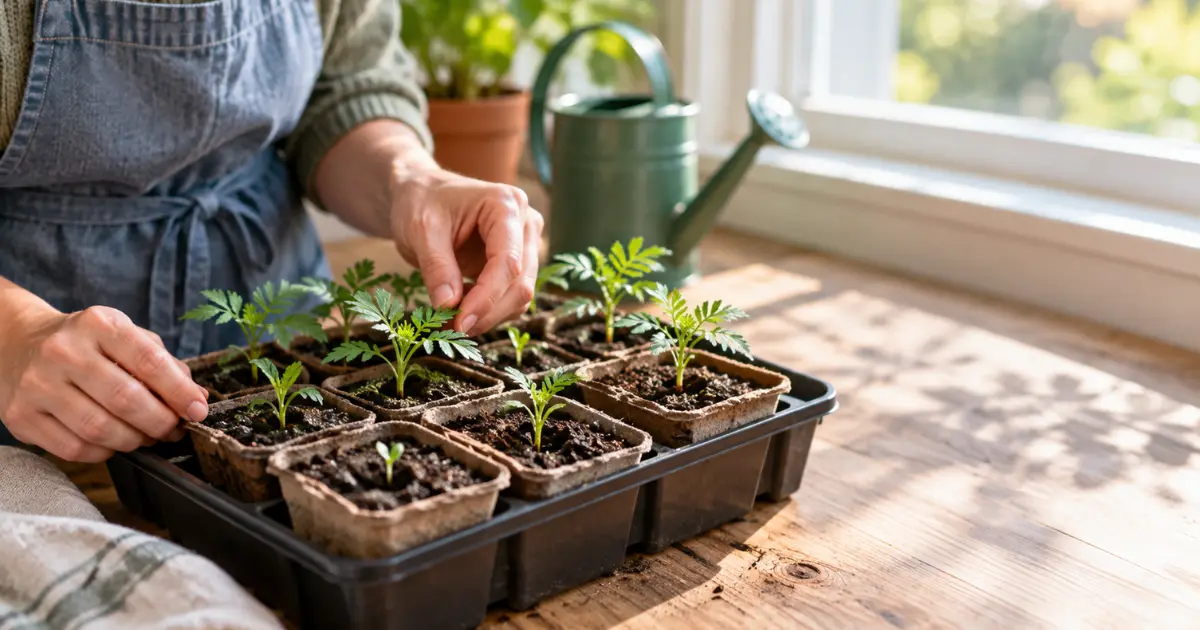
Step 6: Thin or Separate Seedlings if Needed
If more than one seedling emerges in a small cell, do not leave them competing indefinitely for light, water, and root space.
Keep the strongest plant and remove the weaker seedling, or separate seedlings when they are large enough to handle if they were started together in a flat.
When thinning a crowded cell, cutting the unwanted seedling at soil level is often safer than pulling it and disturbing the roots of the plant you want to keep.
Once seedlings have true leaves and are large enough to handle, plants started in a shared tray can be moved into individual cells or small pots if they need more room before transplanting outside.
How to Direct Sow Marigold Seeds Outdoors
If you prefer not to manage seedlings indoors, how to grow marigolds from seed can be even simpler: sow directly where you want the plants to grow after conditions have warmed.
Prepare the Planting Area
Choose a sunny garden location with reasonably well-drained soil.
University of Minnesota Extension recommends full sun for marigolds, while Wisconsin Horticulture likewise lists full sun and well-drained soil as preferred conditions.
Remove weeds from the immediate sowing area and loosen the surface soil enough to create a fine seedbed.
You do not need to heavily fertilize the area before sowing. Excess fertility, particularly excessive nitrogen, can encourage leafy growth at the expense of flowering.
If you are unsure whether your garden actually needs additional nutrients, our guide to organic fertilizer for plants explains how to choose a fertilizer based on the plant, soil, nutrient needs, and product label.
Sow the Seeds at the Proper Depth
Sow approximately 1/4 inch deep.
You can place seeds individually rather than scattering them heavily. If you sow closer than the eventual plant spacing, plan to thin seedlings after emergence.
Firm the soil gently after covering the seed so there is good contact between the seed and surrounding soil.
Avoid burying the seeds several inches deep. A seed contains only a limited energy supply, and excessive depth makes emergence more difficult.
Keep the Seedbed Appropriately Moist
After planting, water gently and thoroughly enough to moisten the shallow seed zone.
Until seedlings emerge, do not let this upper layer repeatedly dry completely.
Outdoor conditions can change quickly. A sunny, windy day can dry the surface much faster than cool, cloudy weather, so inspect the soil rather than following a fixed watering schedule.
At the same time, avoid turning the seedbed into mud. Consistently saturated soil can reduce oxygen around seeds and young roots.
Thin Seedlings as They Grow
Once seedlings are established, thin them so each plant has room to develop.
Spacing depends strongly on marigold type and cultivar.
Penn State Extension suggests roughly 8–10 inches apart for French and signet marigolds and around 12 inches for larger African marigolds. University of Minnesota similarly notes that African types generally need more room than French and signet forms.
Use the cultivar’s seed packet when it recommends a different mature spacing, particularly for unusually compact or tall varieties.
How Long Do Marigold Seeds Take to Germinate?
Under favorable warm conditions, marigold seed germination is relatively fast.
A practical expectation is approximately 5–8 days. Iowa State reports 5–7 days under favorable conditions, while University of Minnesota Extension gives 5–8 days at approximately 70–75°F.
That is germination time only.
It does not mean the plant will flower within a week.
After emergence, the seedling still needs to develop roots, true leaves, stems, and enough mature growth to begin forming flower buds.
Do Marigold Seeds Need Light to Germinate?
Marigold seeds do not need to remain exposed on the surface.
Extension recommendations consistently advise covering them. Iowa State recommends lightly covering them with about 1/4 inch of soilless medium, and University of Minnesota also recommends sowing around 1/4 inch deep.
So the practical approach is straightforward: cover the seed shallowly, then provide strong light after seedlings emerge.
Do not confuse a seedling’s need for light with the seed’s germination requirements.
Why Aren’t My Marigold Seeds Germinating?
If no seedlings appear after the normal germination window, check conditions before reseeding.
Common possibilities include:
The medium is too cold.
Warm conditions encourage faster germination. Cold soil can delay emergence.
The seed dried out.
The shallow seed zone needs reasonably consistent moisture while germination is underway.
The medium stayed saturated.
Constantly soggy conditions can reduce aeration and contribute to seed or root problems.
Seeds were buried too deeply.
Marigolds should be covered shallowly rather than planted far below the surface.
The seed is old or poorly stored.
Seed viability declines over time, especially under warm or humid storage conditions.
You checked too soon.
Temperature variation can shift the germination window. Give seeds reasonable time before assuming they have failed.
If one tray performs poorly while another succeeds under the same conditions, seed viability may deserve closer consideration.
How to Care for Marigold Seedlings
Young marigolds are relatively uncomplicated, but the period between germination and transplanting is where poor light and excessive moisture can quickly weaken an otherwise successful start.
Light
Provide strong light immediately after germination.
For seedlings grown under lights, Iowa State recommends roughly 12–16 hours of light each day. The fixture should remain close enough for effective illumination, with the exact distance depending on the type and intensity of the light.
Rotate window-grown seedlings regularly if they lean strongly toward one direction.
If stems become unusually long, pale, and thin, improve the light rather than simply burying the problem later.
Watering
Keep the growing medium appropriately moist, but do not keep seedlings continuously saturated.
Water when the medium indicates it is needed rather than automatically watering every morning.
Small cells dry more rapidly than large containers. Warm rooms, grow lights, airflow, and larger seedlings can all change how quickly water is used.
Good drainage is essential.
Airflow and Seedling Crowding
Once seedlings emerge, remove closed humidity covers and provide reasonable air movement.
Stagnant, excessively humid conditions combined with wet media and crowded seedlings can increase disease problems.
Gentle room airflow is enough. Do not aim a powerful fan directly at small seedlings until they dry rapidly or bend over.
Give individual plants space as they develop.
When to Thin Marigold Seedlings
Thin crowded seedlings while they are still young rather than waiting until roots are heavily intertwined.
If two seedlings occupy one small cell, retain the strongest and remove the other unless you intend to transplant them separately.
Plants grown together in a flat can be separated once true leaves are developing and the seedlings are sturdy enough to handle.
Handle seedlings by their leaves rather than squeezing the delicate stem whenever practical.
How to Harden Off and Transplant Marigold Seedlings
Indoor-grown seedlings should not move directly from protected indoor conditions into a full day of outdoor sun and wind.
They need time to acclimate.
When Are Marigold Seedlings Ready to Go Outside?
Wait until frost danger has passed and outdoor conditions are appropriate for this warm-season annual.
Plants should also be healthy, actively growing, and large enough to handle transplanting.
Do not judge readiness by height alone. A short, sturdy seedling with good roots is preferable to a tall, weak plant stretched by inadequate indoor light.
How to Harden Off Marigold Seedlings
Hardening off gradually exposes seedlings to stronger sunlight, wind, and outdoor temperature fluctuations.
Start in a sheltered, shaded area for a limited period, then increase outdoor exposure over successive days.
Authoritative recommendations differ slightly on duration. Iowa State says bedding plants are typically ready after about 7–10 days of gradual hardening, while Penn State advises beginning the process at least two weeks before transplanting. The important principle is gradual acclimation rather than moving seedlings abruptly from indoors to full outdoor exposure.
Bring plants back to protection if frost, severe wind, or damaging weather threatens.
Iowa State University Extension’s hardening-off guidance

How to Transplant Them Into the Garden
Choose a sunny, well-drained planting area.
If practical, transplant on a cloudy day or later in the day rather than during intense midday heat. Iowa State recommends overcast conditions or late afternoon to reduce transplant stress.
Gently remove each seedling from its container while keeping the root ball together.
Set the plant at approximately the same growing level it occupied in its container rather than burying the stem unnecessarily.
Spacing should reflect the mature cultivar. As a broad reference, Penn State suggests about 8–10 inches for French and signet marigolds and approximately 12 inches for larger African forms.
Water after transplanting to settle soil around the roots.
Continue monitoring moisture during establishment, especially during hot, dry, or windy conditions. Do not assume that mature marigolds’ relative tolerance of dry conditions means fresh transplants should be allowed to dry severely.
If you are deciding where marigolds can fit in a mixed flower bed, our guide to sunflower companion plants explains how marigolds and other plants can be arranged around sunflowers while considering spacing, sunlight, moisture, and competition.
How Long Do Marigolds Take to Grow From Seed?
Knowing how to grow marigolds from seed also means separating two very different timelines:
germination and flowering.
Germination can take only about 5–8 days under favorable warm conditions. Flowering takes considerably longer because the plant must grow through the seedling and vegetative stages first.
The exact seed-to-flower time varies markedly by type.
Penn State’s annual-seed guidance lists approximately:
- 6–8 weeks from seed to bloom for French marigolds;
- 6–8 weeks for dwarf marigolds;
- 12–16 weeks for African marigolds.
Another Penn State marigold resource notes that marigolds commonly begin flowering in roughly two months, while tall African types are slower to mature.
That gives beginners a more useful progression:
seed → germination in about a week → seedling growth → establishment → flower production
Do not treat any one week count as a guarantee. Cultivar, temperature, sunlight, transplant stress, sowing date, root conditions, and general growing conditions can all shift flowering earlier or later.
If early flowers are important, check the cultivar’s stated days or weeks to bloom when buying seed.
Common Mistakes When Growing Marigolds From Seed
Sowing Outdoors Too Early
Warm-season marigolds can stall or be damaged when planted into conditions that are still too cold.
Better approach: wait until frost risk has passed and the soil has warmed sufficiently before direct sowing.
Planting Seeds Too Deep
A shallow seed should not be buried several inches below the surface.
Better approach: aim for roughly 1/4 inch deep unless the cultivar packet specifically says otherwise.
Letting Seeds Dry During Germination
Seed that repeatedly dries while it is germinating can fail to establish successfully.
Better approach: keep the shallow seed zone consistently moist while avoiding waterlogged conditions.
Keeping the Medium Constantly Soggy
More water does not produce faster germination.
Better approach: provide moisture plus drainage and air around the roots.
Giving Seedlings Too Little Light
Weak indoor light often produces long, thin, leaning seedlings.
Better approach: move emerging seedlings into strong light promptly and use supplemental lighting where window light is insufficient.
Leaving Seedlings Overcrowded
Crowded plants compete for light, moisture, nutrients, and root space.
Better approach: thin or separate them while seedlings are still manageable.
Skipping Hardening Off
Indoor seedlings are not immediately prepared for outdoor sun, wind, and changing temperatures.
Better approach: acclimate them gradually before planting.
Transplanting During Unsuitable Weather
A hot, windy afternoon can put unnecessary stress on young roots and foliage.
Better approach: choose mild or cloudy conditions where possible, water after transplanting, and monitor the plants closely during establishment.
Frequently Asked Questions About Growing Marigolds From Seed
Are Marigolds Easy to Grow From Seed?
Yes. Marigolds are generally considered beginner-friendly because the seeds are relatively easy to handle and germinate quickly under favorable warm conditions.
The biggest avoidable problems are usually unsuitable timing, sowing too deeply, inconsistent moisture, and inadequate light after germination.
If you are looking for other beginner-friendly choices, see our guide to easy flowers to grow for beginners for more approachable options and simple care tips.
Should You Soak Marigold Seeds Before Planting?
Usually, no.
Marigold seeds generally germinate readily without pre-soaking. Sow them directly into moist seed-starting medium or prepared garden soil at the recommended shallow depth.
Unless your specific seed packet instructs otherwise, soaking adds an unnecessary extra step.
How Deep Should You Plant Marigold Seeds?
About 1/4 inch deep is a well-supported general recommendation.
Iowa State, University of Minnesota, and Penn State Extension guidance all use approximately this sowing depth.
How Many Marigold Seeds Should You Plant Together?
You do not need to sow a cluster of many seeds in one small cell.
Because marigold seeds are easy to handle, fresh seed can be planted individually. If viability is uncertain, you can sow an additional seed and thin to the strongest seedling after emergence.
Outdoors, sow individual seeds and thin later if necessary to reach the mature spacing recommended for the cultivar.
Can You Plant Marigold Seeds Directly in the Ground?
Yes.
Direct sowing works well once outdoor soil has warmed and frost risk has passed. Wisconsin and Minnesota Extension sources recommend warm soil, around or above 65°F, as a useful benchmark.
Keep the shallow seedbed moist while germination occurs.
Can You Grow Marigolds From Seed Indoors?
Yes.
Indoor sowing gives you an earlier start and greater control over germination conditions.
Iowa State recommends beginning about 6–8 weeks before outdoor planting, while University of Minnesota advises about 10 weeks. Use the seed packet, cultivar growth rate, your local planting-out date, and your indoor growing setup to refine that timing.
Why Are My Marigold Seedlings Leggy?
Insufficient light is the most common place to look first.
Seedlings stretch toward available light when the light source is too weak or too far away. Warm temperatures combined with inadequate light can make stretching even more obvious.
Move seedlings into stronger light, keep supplemental lights appropriately positioned, and avoid excessive crowding.
Do not try to compensate simply by overwatering or fertilizing the seedlings.
Conclusion
Once you understand how to grow marigolds from seed, the process is easier to manage because each stage has a clear purpose.
Start at the right time for your local conditions. Sow shallowly, keep the seed zone moist without saturating it, and provide adequate warmth for germination. Once seedlings emerge, shift your attention to strong light, sensible watering, airflow, and enough space for healthy growth.
If you started indoors, harden the seedlings gradually before moving them into the garden after frost danger has passed. If you direct sowed, thin young plants as needed and continue monitoring moisture while their roots establish.
From there, flowering time depends strongly on the marigold type and growing conditions. Faster French or dwarf cultivars may flower within several weeks, while larger African forms can take considerably longer.
The important part is not rushing the process. Give each stage the conditions it needs, and marigolds can move from seed to established flowering plants with relatively little complication.

