
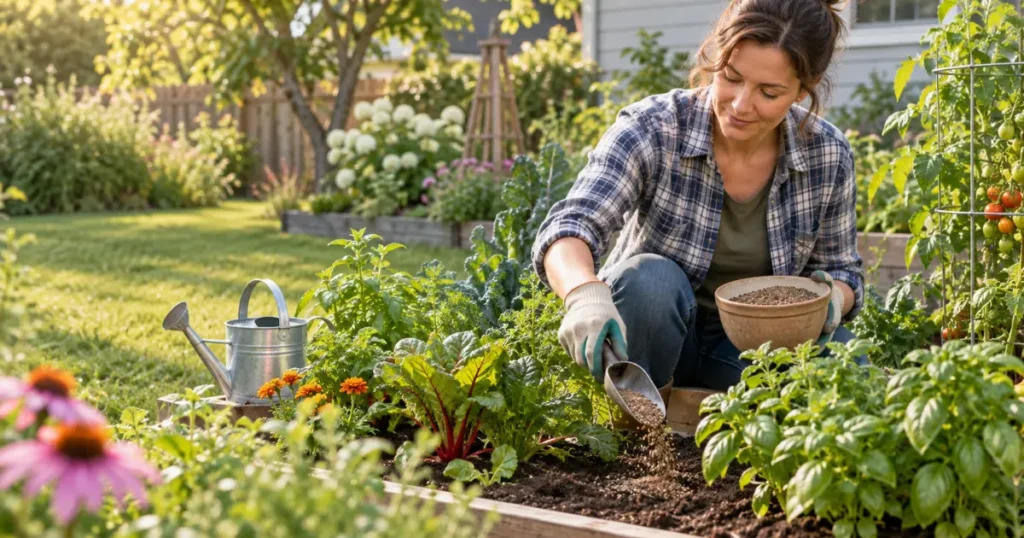
Gardener applying organic fertilizer for plants in a healthy home garden

Organic Fertilizer for Plants: A Beginner’s Guide to Choosing and Using It

Choosing an organic fertilizer for plants can feel more complicated than it first appears. Garden-center shelves may contain compost, meals made from plant or animal materials, manure-based products, liquid concentrates, and blended granular fertilizers, all with different nutrient analyses and directions.

There is no single organic fertilizer that is automatically right for every plant. Fertilizers differ in the nutrients they supply, how concentrated those nutrients are, how quickly or slowly nutrients may become available, and how the product is intended to be applied. Plants also differ in what they need, and the soil may already contain some nutrients in adequate amounts.

For beginners, the most useful principle is simple: right nutrient + right plant + right amount + right timing.

That means looking beyond words such as “organic” or “natural” on the front of a package. A good choice starts with understanding what fertilizer actually does, what the N-P-K numbers mean, and how different fertilizer materials behave.

This first part of the guide explains those foundations so you can compare organic fertilizer options more confidently without assuming that one material, formulation, or nutrient ratio is universally best.

Quick Summary

  • Organic fertilizer for plants supplies nutrients from organic or other permitted natural-source materials, but different products can behave very differently.
  • Fertilizer should match the needs of the plant and soil, rather than being chosen only because the package says “organic.”
  • The three N-P-K numbers on a US fertilizer label refer to nitrogen, phosphate, and potash in that order.
  • Compost can contribute nutrients, but gardeners often value it just as much for its organic matter and soil-conditioning benefits.
  • Organic fertilizers can be plant-based, animal-based, manure-based, blended, liquid, or dry.
  • Nutrient release varies by material and formulation; not every organic fertilizer is slow-release.
  • Liquid and dry fertilizers can both be useful, and neither form is universally better.
  • Always follow the product label because overapplication can waste nutrients, damage plants, or create environmental problems.

What Is Organic Fertilizer?

Organic fertilizer is fertilizer made from organic or other naturally derived materials that supply nutrients plants can use. Depending on the product, those materials may come from plants, animals, composted materials, or combinations of several nutrient sources.

The basic purpose is the same as with synthetic or inorganic fertilizer: to supply plant nutrients.

The difference is mainly in the source and form of those nutrients. Synthetic fertilizers are manufactured or processed into defined nutrient compounds, while organic fertilizer materials commonly begin with biological or naturally occurring sources. That distinction does not mean one category is automatically safe and the other harmful. Both can be misused, and both should be applied according to the plant’s needs and the product label.

It is also useful to distinguish fertilizer from a soil amendment without treating them as completely separate categories.

A fertilizer is used primarily because it supplies nutrients. A soil amendment is generally used to improve characteristics of the soil, such as organic matter content, structure, or water-holding behavior. Some materials do both.

Compost is a good example. It can contribute plant nutrients and may function as an organic plant fertilizer material, but gardeners often use it primarily to add organic matter and improve soil condition rather than as a concentrated fertilizer.

Another important distinction is between the everyday gardening use of the word natural and the regulatory meaning of organic in certified crop production.

A fertilizer marketed as natural is not automatically approved for USDA-certified organic production. Under USDA organic regulations, nonsynthetic substances are generally permitted unless specifically prohibited, while synthetic substances are generally prohibited unless specifically allowed. The USDA maintains the official National List of Allowed and Prohibited Substances for certified organic production.

For an ordinary home gardener, the practical lesson is to read beyond the marketing language. Look at the nutrient analysis, ingredient sources, product directions, and intended use.

How Organic Fertilizer Helps Plants

Fertilizer helps plants primarily by supplying nutrients needed for growth and normal plant function.

Those nutrients are not useful simply because they exist in the fertilizer package. They must become available in forms the plant can take up through its roots. How quickly that happens depends on the fertilizer material, environmental conditions, soil biology, moisture, temperature, and the specific nutrient source.

That is why organic fertilizer for plants should not be described as one uniform category with one release pattern.

Some organic nutrient sources may release usable nutrients relatively quickly. Others depend more heavily on biological decomposition and may release nutrients over a longer period. The release characteristics of one material should not automatically be applied to every organic fertilizer.

Utah State University Extension’s guidance on selecting and using organic fertilizers emphasizes that organic fertilizer materials differ substantially in nutrient concentration and nutrient-release characteristics.

Some organic materials can also contribute organic matter to the soil. That can be valuable, but the effect depends on the material. A concentrated meal fertilizer, for example, should not automatically be expected to affect the soil in the same way as a substantial compost application.

The most useful question is therefore not:

“Is this fertilizer organic?”

It is:

“What nutrients does this product supply, how available are they likely to be, and does my plant or soil actually need them?”

Supplying a nutrient that is already adequate does not necessarily improve plant growth. Excessive application can create new problems instead of solving the original one.

Understand N-P-K Before Choosing a Fertilizer

Most fertilizer packages sold in the United States display three prominent numbers, such as 5-4-3 or 3-2-4.

These numbers are the fertilizer analysis, commonly called N-P-K.

In order, they represent the percentage by weight of:

  1. Nitrogen (N)
  2. Phosphate (P₂O₅)
  3. Potash (K₂O)

It is common to casually refer to the second and third numbers as phosphorus and potassium, but US fertilizer labels report them in the conventional phosphate and potash forms rather than as percentages of elemental phosphorus and elemental potassium.

Understanding those numbers helps you compare products more meaningfully.

A fertilizer labeled 4-2-2 has a different nutrient concentration and balance from one labeled 2-6-4. That does not make either product inherently better. The useful product is the one whose nutrient supply is appropriate for the plant and soil.

Gardener checking an organic fertilizer label before using it on garden plants

Nitrogen (N)

Nitrogen is essential for plant growth and plays a major role in vegetative development and many basic plant processes.

Plants that are deficient in nitrogen may grow poorly, but that does not mean adding more nitrogen is always beneficial.

Excessive nitrogen can create an imbalance between vigorous leafy growth and other aspects of plant development. Applying nitrogen without knowing whether it is needed can also waste fertilizer.

The correct amount depends on the plant, soil conditions, and the fertilizer being used.

Phosphorus (P)

Phosphorus is involved in important plant processes, including energy transfer, root development, and reproduction.

It is often marketed strongly in fertilizers intended for flowering or root development, but beginners should avoid the oversimplified claim that adding more phosphorus automatically creates more flowers.

If the soil already contains enough available phosphorus, applying additional phosphorus may offer little benefit.

This is one reason soil testing can be useful before repeatedly adding fertilizers high in a particular nutrient.

Potassium (K)

Potassium contributes to many regulatory functions within plants, including processes related to water balance, enzyme activity, and overall plant functioning.

It is also associated with the plant’s ability to respond to environmental stresses, but it should not be treated as a universal “stress cure.”

As with nitrogen and phosphorus, the goal is adequate nutrition rather than the highest possible amount.

The key beginner lesson is simple: do not choose fertilizer only because the front of the package says “organic.” Check the guaranteed analysis and consider whether the nutrients supplied actually match the needs of the plant and soil.

Common Types of Organic Fertilizer for Plants

There are many examples of organic fertilizer for plants, but beginners do not need to memorize every possible material. It is more useful to understand the major categories and recognize that products within the same category can still have very different nutrient profiles.

Compost

Compost is one of the most familiar organic materials used in gardens.

Its nutrient content varies depending on what materials went into it and how the compost was produced. Unlike a concentrated fertilizer with a clearly defined nutrient analysis, compost may supply nutrients at relatively modest and variable levels.

Its value often extends beyond direct nutrient supply.

Finished compost can add organic matter and can help improve soil properties, which is why many gardeners use it primarily as a soil amendment even though it also contributes nutrients.

That does not mean compost automatically supplies everything every plant needs.

A garden may still have a nutrient deficiency or require a more targeted fertilizer even when compost is used regularly.

For more detail on applying finished compost appropriately, see:

How to Use Compost in the Garden

Plant-Based Fertilizers

Plant-based fertilizers are made from plant materials processed into forms suitable for garden use.

Representative examples include:

  • alfalfa-based fertilizer;
  • cottonseed meal;
  • kelp or seaweed-based products.

These products are not nutritionally interchangeable.

One plant-based fertilizer may contain substantially more nitrogen than another, while another may provide a broader but less concentrated nutrient contribution.

Kelp-based products, for example, should not automatically be treated as substitutes for higher-nitrogen plant meals simply because both come from plants.

Read the fertilizer analysis and product directions rather than assuming the source tells you everything about how the product should be used.

Animal-Based Fertilizers

A number of organic fertilizer materials come from animal by-products.

Common examples include:

  • blood meal;
  • bone meal;
  • fish meal or other fish-based fertilizers;
  • feather meal.

These products can differ markedly in which nutrients they contain and how those nutrients become available.

Blood meal, bone meal, and feather meal should not be treated as equivalent products merely because all are animal-derived.

A gardener choosing among them should first identify the nutrient need, then compare the guaranteed analysis and application directions.

This is especially important with concentrated materials. Organic origin does not prevent overapplication.

Manure-Based Products

Processed or composted manure-based fertilizers can provide nutrients and may also contribute organic matter.

Their nutrient content varies depending on the source material, processing, and final product formulation.

For beginners, packaged manure-based fertilizer products should be evaluated the same way as other fertilizers: check the nutrient analysis, read the label, and use the recommended amount for the intended purpose.

This is different from making broad recommendations about raw manure use, particularly in food gardens, where additional safety and timing considerations apply.

Blended Organic Fertilizers

Commercial blended organic fertilizers combine several nutrient sources into one product.

A blend might contain plant-based ingredients, animal-derived meals, mineral components, or other permitted fertilizer materials. The purpose is often to create a particular nutrient analysis or release profile.

Blends can be convenient because gardeners do not need to combine individual ingredients themselves.

However, the word blend does not tell you whether the fertilizer suits your plants.

The useful information is on the label:

  • guaranteed nutrient analysis;
  • ingredients;
  • intended plants or situations;
  • application rate;
  • frequency or timing instructions;
  • any warnings or restrictions.

Among the many examples of organic fertilizers available, the best comparison starts with what the product actually supplies rather than with the most persuasive marketing phrase on the front of the package.

Liquid vs Dry Organic Fertilizer: Which Should You Choose?

Liquid and dry organic fertilizers are simply different delivery forms. Both can be useful, and neither should automatically be considered superior.

The better choice depends on the product formulation, what the plant needs, the soil or growing medium, and how you want to apply the fertilizer.

Liquid Organic Fertilizer

Liquid organic fertilizers may be sold ready to use or as concentrates that need dilution.

They can be convenient for applying nutrients through irrigation water or directly to the root zone, depending on the product.

Nutrient availability can differ from one liquid fertilizer to another. Do not assume that every liquid formulation supplies all of its nutrients to plants immediately.

If the product is concentrated, dilution instructions matter.

Using a stronger mixture than the label recommends does not automatically improve results. Concentrated fertilizers can be misused just as other fertilizer forms can.

Follow the manufacturer’s directions for dilution, amount, and application method.

Dry or Granular Organic Fertilizer

Dry fertilizers include meals, granules, pellets, powders, and blended products intended for soil application.

Depending on the label, they may be:

  • incorporated into soil before planting;
  • applied around established plants;
  • used as a surface application;
  • watered in after application.

Nutrient release varies considerably.

Some dry organic fertilizers depend substantially on decomposition and soil biological activity, while others may provide portions of their nutrients more readily.

Do not assume that every granular organic fertilizer is automatically slow-release.

Which Is Better?

Neither liquid nor dry organic fertilizer is universally better.

Choose based on:

  • the plant you are feeding;
  • the soil or growing medium;
  • the nutrient deficiency or need you are trying to address;
  • the fertilizer’s nutrient analysis;
  • the formulation and expected nutrient availability;
  • the application method that fits the situation;
  • the directions on the product label.

How to Choose the Right Organic Fertilizer

The best choice starts with the plant and soil, not the front of the package. The right organic fertilizer for plants is the one that supplies nutrients your particular growing situation actually needs, in a form and concentration you can use correctly.

Start With Your Soil

Before adding fertilizer repeatedly, consider what is already in the soil. A garden bed may already contain adequate amounts of some nutrients, while another soil may be genuinely deficient.

When nutrient status is uncertain, a soil test can be more useful than guessing from leaf color or plant size alone. Many symptoms that look like fertilizer problems can also come from poor drainage, root damage, unsuitable pH, drought, excessive moisture, disease, or other stresses.

If yellowing foliage is what prompted you to consider fertilizer, our guide to yellow leaves on plants explains how to check the symptoms and investigate watering, drainage, light, and other possible causes before adding nutrients.

A soil test can help identify which nutrients are low, adequate, or already high. That matters because adding more of a nutrient that is already plentiful may not improve growth and can create imbalances or increase the chance of nutrient loss.

For containers, the situation is somewhat different because plants are growing in a limited volume of potting medium. Even so, the same principle applies: do not assume every plant needs the same fertilizer simply because it is growing in a pot.

Consider What You’re Growing

Plants differ in nutrient demand.

A fast-growing vegetable crop, a flowering annual, an herb, a woody shrub, and a long-lived perennial may not respond to the same fertilizer program in the same way. Container plants can also behave differently from plants rooted in garden soil because nutrients and water are managed in a smaller root zone.

Garlic is one example of a crop whose nutrient needs change during the growing season. Our guide on how to grow garlic explains why soil fertility and nutrient timing matter, especially during active leaf growth and bulb development.

This does not mean you need a completely different product for every plant. It means fertilizer choice should start with the plant’s actual needs rather than with a generic claim on the label.

If you are unsure, check reliable guidance for the specific plant and your growing conditions before applying a concentrated fertilizer. For mums specifically, see our guide on how to care for mums before deciding whether additional feeding is appropriate. For hostas, our hosta care guide explains when supplemental feeding may be useful and why healthy plants do not automatically need heavy fertilization.

Read the N-P-K Analysis

The N-P-K numbers explained earlier are one of the fastest ways to compare fertilizers.

Use the guaranteed analysis to see whether a product is relatively high or low in the nutrients you are trying to supply. Avoid assuming that larger numbers always mean a better fertilizer. Higher numbers indicate greater concentration, which also means application rates and misuse risks can differ.

If a soil test shows that one nutrient is already abundant, a fertilizer containing a large amount of that nutrient may be a poor fit even if the product is marketed for your type of plant.

Consider Nutrient Release

Organic fertilizer materials do not all release nutrients at the same rate.

Some nutrients may become available comparatively quickly. Others depend more heavily on microbial breakdown and environmental conditions before plants can use them.

Temperature, soil moisture, soil biology, and the formulation itself can all influence nutrient availability.

This matters when matching fertilizer to a plant’s growth stage. A product that releases nutrients gradually may suit one situation, while another formulation may be chosen when a more readily available nutrient source is appropriate.

Do not assume “organic” automatically means “slow.”

Read the Product Label

The product label should guide the final decision.

Check:

  • the guaranteed analysis;
  • ingredient list;
  • crops or plants the product is intended for;
  • application method;
  • recommended rate;
  • dilution instructions for concentrates;
  • timing or frequency directions;
  • precautions and storage information.

If label directions conflict with generic advice, the product-specific directions are usually the more appropriate place to start because formulations vary.

How to Apply Organic Fertilizer Correctly

Using organic fertilizer for plants correctly is less about memorizing one rate and more about following the instructions for the specific product and growing situation.

Gardener carefully applying organic fertilizer to soil around healthy garden plants

Follow the Label Rate

Application rates vary because fertilizers differ in nutrient concentration and formulation.

A concentrated meal, a blended granular fertilizer, and a liquid concentrate cannot be assumed to have interchangeable rates.

The amount may also depend on:

  • the plant;
  • its size or stage of growth;
  • whether it is in a container or the ground;
  • the area being treated;
  • the nutrient concentration of the product;
  • whether the fertilizer is being incorporated before planting or applied later.

Do not invent a standard cups-per-plant or tablespoons-per-gallon rate and use it across different products.

If the label gives a range, use the directions that match your plant and application situation.

Apply It in the Right Place

Where fertilizer goes depends on the formulation and the plant.

Some dry products are incorporated into soil before planting. Others are applied to the soil surface around established plants. Some liquids are diluted and applied to the root zone. Certain products may have other specific instructions.

Avoid placing concentrated fertilizer directly against stems, crowns, or roots unless the label specifically directs that use.

For established plants, spread or place fertilizer where roots can access nutrients without creating a concentrated pocket that may injure tissue.

Water When the Product Requires It

Some fertilizers are intended to be watered in after application so nutrients move into the root zone.

Others are applied as liquids already, or have different instructions.

Do not automatically water every product immediately simply because it is fertilizer. Follow the label and consider the soil conditions.

If the soil is already saturated, adding more water simply to follow a generic routine can create another problem.

Don’t Assume More Is Better

Overapplication can damage plants, create nutrient imbalances, waste fertilizer, and increase the chance that nutrients move away from the root zone and into the wider environment.

Some fertilizer materials can also contribute to salt injury when used improperly or excessively.

Organic origin does not eliminate these risks.

If a plant is growing poorly, applying a larger dose without diagnosing the underlying problem can make the situation worse. Check the growing conditions, soil, roots, moisture, and nutrient status before assuming the answer is more fertilizer.

When Should You Fertilize Your Plants?

There is no universal fertilizing calendar that fits every garden plant.

Timing depends on the species, its stage of growth, the soil’s nutrient status, the length of the growing season, whether the plant is newly planted or established, and the fertilizer’s release characteristics.

Some plants have their greatest nutrient demand during active growth. Others need relatively little supplemental fertilizer when soil fertility is already adequate.

Newly planted specimens may also have different needs from mature, established plants. In some situations, encouraging heavy top growth before roots are well established is not desirable.

For example, newly planted lavender has specific establishment needs, so follow appropriate guidance on how to plant lavender rather than fertilizing automatically.

Container plants may require more active nutrient management because watering can carry soluble nutrients out of the potting medium, but that still does not justify one fixed schedule for every container.

For a practical example of caring for container-grown herbs, our guide to starting an indoor herb garden explains how to manage light, watering, and feeding without assuming every herb needs the same fertilizer schedule.

Use three sources of information together:

  1. the plant’s known nutrient requirements;
  2. soil or growing-medium conditions;
  3. the fertilizer label.

If a soil test indicates that nutrient levels are adequate, additional fertilizer may not be needed at that time.

Likewise, do not assume that all plants should be fertilized every spring, every two weeks, or on another universal interval. The right timing is the timing that matches the plant, the nutrient need, and the product.

For a crop-specific example, our guide to growing potatoes in containers explains how to approach supplemental feeding alongside watering and other essential care for potatoes grown in pots or grow bags.

Organic Fertilizer vs Compost: What's the Difference?

Organic fertilizer and compost overlap, but gardeners usually use them for somewhat different primary purposes.

A fertilizer is generally selected because it supplies plant nutrients in a known or useful concentration.

Compost is commonly applied to add organic matter, improve soil condition, and contribute a broad but variable supply of nutrients.

That does not mean compost “isn’t fertilizer.” Finished compost can supply nitrogen, phosphorus, potassium, and other nutrients, and in some situations it may make a meaningful contribution to plant nutrition.

The difference is mostly functional.

A concentrated fertilizer may be chosen to address a specific nutrient need. Compost is often used because gardeners want its wider soil-amendment benefits as well as the nutrients it contains.

Compost nutrient content varies with the source materials and how it was produced. For that reason, it should not automatically be assumed to provide every nutrient a particular plant needs in the right amount.

If you want more detail on applying finished compost in beds, raised beds, containers, and other garden situations, see our practical guide.

The practical question is not whether you must choose one or the other. A garden may use compost for soil improvement and a separate fertilizer only when plant or soil nutrient needs justify it.

Is Organic Fertilizer Better Than Synthetic Fertilizer?

Neither category is universally better in every gardening situation.

The best choice depends on what you are trying to accomplish, the nutrient needs of the plant, the soil or growing medium, and how precisely you want to manage nutrient supply.

An organic fertilizer for plants may provide nutrients from plant, animal, manure-based, or other permitted natural-source materials. Some products also contribute organic matter, although the amount varies widely.

Synthetic fertilizers are manufactured to supply nutrients in defined forms and often at relatively concentrated levels. Their nutrient analysis can make it easier to know how much of a particular nutrient the product contains.

The two categories can also differ in nutrient availability and release.

Some organic materials depend substantially on biological decomposition before nutrients become available, while some synthetic nutrients are readily soluble. But those broad tendencies should not be turned into absolute rules. Formulations vary within both categories.

Convenience differs too.

A concentrated synthetic fertilizer may require smaller application quantities. An organic material may provide additional organic matter or fit a gardener’s production preferences. Either can be appropriate when it matches the plant and soil need.

Both can also be misused.

Overapplication of either type can injure plants, waste nutrients, or contribute to nutrient movement into the environment.

The useful comparison is therefore not “natural good, synthetic bad” or the reverse.

Ask:

  • What nutrient is needed?
  • How much is needed?
  • How quickly should it become available?
  • What form is practical to apply?
  • What does the label require?

Choose the fertilizer that answers those questions most appropriately.

Common Organic Fertilizer Mistakes to Avoid

  1. Fertilizing without knowing whether nutrients are needed.
    Poor growth does not automatically mean nutrient deficiency. Check soil conditions, moisture, roots, and, where useful, soil-test results before adding fertilizer repeatedly.
  2. Assuming all organic fertilizers are interchangeable.
    Compost, blood meal, fish-based fertilizer, kelp products, manure-based fertilizers, and blended granules can have very different nutrient profiles and release characteristics.
  3. Ignoring the N-P-K analysis.
    The guaranteed analysis tells you much more about what a fertilizer supplies than the word “organic” on the front of the package.
  4. Applying more than the label recommends.
    Higher application rates can damage plants, create nutrient imbalances, increase salt-related problems with some products, and waste fertilizer.
  5. Assuming organic means harmless.
    Organic fertilizers still contain nutrients in biologically active or concentrated forms. They require careful attention to rate, placement, and plant need.
  6. Expecting every organic fertilizer to work immediately.
    Nutrient release differs by material and formulation. Some products depend on biological breakdown and environmental conditions before a large portion of their nutrients becomes available.
  7. Copying another gardener’s fertilizer routine without comparing conditions.
    Two gardens can have different soil fertility, plant species, climate, irrigation, and previous fertilizer history. A product that makes sense in one garden may be unnecessary in another.

Does “Organic” Always Mean USDA-Approved?

No.

In everyday gardening language, words such as “organic” and “natural” are often used broadly. Those words alone are not proof that a fertilizer is permitted for USDA-certified organic crop production.

Certified organic production in the United States follows specific federal rules about which substances may be used.

As a general regulatory principle, nonsynthetic substances are allowed unless specifically prohibited, while synthetic substances are prohibited unless specifically allowed.

The official USDA National List of Allowed and Prohibited Substances identifies substances that are specifically permitted or prohibited under the organic standards.

This regulatory distinction mainly matters when a grower is trying to comply with certified-organic production rules.

An ordinary home gardener who is not operating under certification is not required to manage a backyard garden as though it were a certified organic farm. Even so, understanding the difference helps prevent misleading assumptions about product labels and marketing terms.

Frequently Asked Questions

What is the best organic fertilizer for plants?

There is no universally best product. The right choice depends on the plant, existing soil fertility, which nutrients are actually needed, the fertilizer’s analysis and formulation, and how it is intended to be applied.

Frequency varies by product, plant, soil, growing situation, and nutrient-release characteristics.

Follow the product label and actual nutrient need rather than using one universal schedule. Some plants or soils may need little or no additional fertilizer at a particular time.

Yes. Some organic fertilizers can injure plants when they are overapplied, too concentrated, or used incorrectly.

The risk varies by material and formulation, so do not assume every organic product has the same salt concentration or injury potential. Following label rates and placement directions is the safest general approach.

Sometimes it may be, but not in every situation.

Compost contributes nutrients, and those nutrients may be sufficient for some plants in some soils. In other cases, the soil or crop may need more of a particular nutrient than the compost supplies.

A soil test and the known needs of the plant can help determine whether additional fertilizer is justified.

Yes, if the product is appropriate for container or indoor use and is applied according to its label.

Because indoor plants grow in a limited volume of potting medium, careful dosing matters. Do not assume a garden fertilizer should automatically be used in a houseplant container at the same rate or in the same way.

Not automatically.

Plants differ in nutrient requirements and sensitivity, and fertilizers differ in composition and concentration. A product that is appropriate for one plant or growing situation may be unnecessary or too concentrated for another.

Use the product only where its nutrient profile and label directions fit the plant you are growing.

Final Thoughts

Choosing and using organic fertilizer for plants well is not about finding one perfect product.

It is about matching the fertilizer to a real need.

Start by considering the soil and the plant. Read the N-P-K analysis so you know what nutrients the product supplies. Compare the formulation and nutrient-release characteristics, then use the label to determine how, where, and when the fertilizer should be applied.

Compost, plant-based meals, animal-based materials, manure-derived products, liquids, and blended granules can all have useful roles, but none is automatically right for every garden.

The same is true of the word “organic.” It describes an important category of fertilizer materials and production approaches, but it does not mean a product is risk-free or that more is better.

Keep the central principle in mind:

right nutrient + right plant + right amount + right timing.

That approach is more useful than choosing fertilizer by marketing language alone, and it gives you a much better foundation for feeding plants without applying nutrients they do not need.

Leave a Comment

Your email address will not be published. Required fields are marked *

Scroll to Top