
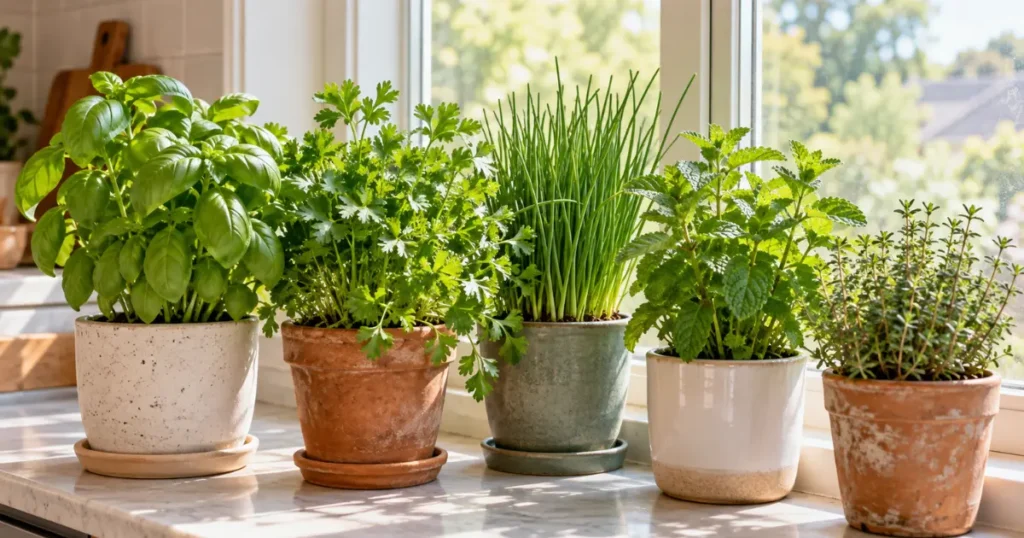
An indoor herb garden can put fresh basil, chives, parsley, thyme, mint, and other useful herbs within easy reach even when you don’t have an outdoor garden. But bringing herbs inside doesn’t remove their basic growing requirements. Light, drainage, root space, temperature, and careful watering still matter.
For many beginners, light is the biggest challenge. A kitchen windowsill may look bright to us while providing much less usable light than a sun-loving herb would receive outdoors. Watering can create a second problem: pots without adequate drainage, or containers left standing in water, can keep roots wet for too long.
The good news is that you don’t need a complicated countertop system to grow herbs successfully. Choose herbs that suit your conditions, put them where they can receive enough light, use containers with drainage and an appropriate potting mix, then learn to check the plants and growing medium before watering. This guide walks through that entire process, from choosing herbs and setting up your growing space to harvesting and troubleshooting common problems.
Quick Summary
- Choose herbs that suit indoor conditions: Chives, basil, parsley, cilantro, mint, thyme, oregano, and rosemary are among the herbs that can be grown indoors, but their light, moisture, and temperature preferences differ.
- Light is often the limiting factor: Many culinary herbs need several hours of strong light each day; supplemental lighting can help when windows cannot provide enough.
- Choose the growing location for the plants, not just convenience: Evaluate light, temperature, drafts, airflow, and watering access before deciding that a kitchen windowsill is ideal.
- Use containers with drainage holes: Decorative pots are fine, but excess water must be able to escape from the root zone.
- Use a container potting mix: A loose, well-drained growing medium is generally more appropriate indoors than ordinary garden soil.
- Check before watering: Indoor herbs do not all dry at the same rate, so use actual moisture in the potting mix rather than a fixed watering calendar.
- Feed conservatively: Fertilizer needs depend on the herb, potting mix, growth rate, and time in the container; follow product directions rather than assuming frequent feeding is necessary.
- Expect conditions to change: Winter light, indoor heating, plant maturity, and harvesting all affect an indoor herb garden over time.
Table of Contents
ToggleBest Herbs to Grow Indoors
Not every culinary herb is equally easy to maintain inside a typical home.
Penn State Extension specifically identifies chives, basil, and cilantro as useful indoor choices and notes that very large-rooted herbs can be less practical in containers. Illinois Extension also includes parsley, thyme, oregano, mint, sage, and rosemary among herbs that can be grown indoors. Penn State Extension
The best herbs for your particular space depend mainly on light, temperature, available root space, and how you want to harvest them.
Basil
Basil can be productive indoors when it receives strong light and warm conditions.
It is an annual, however, so even a healthy plant will not remain indefinitely in the same leafy stage. Eventually it flowers and completes its life cycle. University of Minnesota Extension notes that basil brought indoors still eventually flowers and dies, so restarting plants from seed or replacing older plants is normal. University of Minnesota Extension
Basil is a good option when you have:
- strong natural light or supplemental lighting;
- comfortably warm indoor temperatures;
- a pot with good drainage;
- enough space to harvest stems regularly.
It is less forgiving of cold windowsills than some cooler-tolerant herbs.
Chives
Chives are compact and practical for smaller indoor spaces.
Penn State lists them among the herbs that can tolerate somewhat lower light levels than demanding sun-lovers such as rosemary and thyme, although brighter conditions will generally support better growth. Penn State Extension
Their upright growth habit also makes them relatively easy to fit on a shelf or windowsill without spreading across neighboring pots.
Parsley
Parsley can work well as an indoor culinary herb when given sufficient light and root space.
It grows more slowly than some herbs, particularly when started from seed, so beginners who want usable leaves quickly may find a healthy nursery plant more convenient.
Parsley does not need to be treated exactly like basil. It is a different plant with a different growth cycle, which is one reason mixed herb containers should be planned around compatible needs rather than appearance alone.
Cilantro
Cilantro can be grown indoors, but it is naturally a relatively short-lived leafy crop.
It progresses from leafy growth toward flowering and coriander seed production, so an old cilantro plant cannot be kept indefinitely in its juvenile harvest stage simply because it is indoors.
For a steady supply, restarting cilantro periodically is often more practical than expecting one plant to produce continuously.
For detailed guidance on sowing, germination, temperature, succession planting, and harvesting, see our beginner’s guide on how to grow cilantro.
Cilantro also tends to appreciate cooler conditions than heat-loving basil.
Mint
Mint’s vigorous growth makes it a useful candidate for an individual indoor pot.
It generally appreciates more consistent moisture than Mediterranean herbs such as thyme and oregano. Keeping mint separate can therefore make watering easier and also prevents its spreading growth from competing with smaller herbs in the same container.
Bright light is helpful, although mint can often cope with somewhat less intense light than the most sun-demanding Mediterranean herbs.
Thyme and Oregano
Thyme and oregano are useful when you have a bright location and excellent drainage.
They generally prefer the potting medium to begin drying between waterings rather than remaining continuously wet. University of Maryland and Penn State Extension both distinguish these herbs from plants that prefer more consistently moist conditions. University of Maryland Extension
Their relatively modest size can make them practical for windowsills and small shelves.
Rosemary
Rosemary can be grown indoors, but it is not always the easiest beginner herb.
It appreciates bright light, good drainage, and reasonable airflow. Winter conditions can become challenging when homes provide weak natural light, dry heated air, or an awkward combination of cool window glass and warm room air.
Allow the upper portion of the potting medium to begin drying between waterings, but avoid repeatedly allowing the entire root ball to become severely dry.
If your indoor space is dim, rosemary is unlikely to be the best plant to start with.
Where Should You Put an Indoor Herb Garden?
The best location is the place that meets the plants’ needs, not necessarily the spot that looks most attractive.
A kitchen can be convenient because herbs are close to where you use them, but it is not automatically a good growing location. A darker kitchen with a small north-facing window may be much less suitable than a bright table or shelf in another room.
Evaluate five things:
- available light;
- temperature;
- air movement;
- exposure to heating or cooling vents;
- ease of watering and drainage.
Growing Herbs on a Windowsill
A bright windowsill can work very well, but window direction alone does not tell the whole story.
Penn State recommends a sunny southern exposure for many herbs, while University of Maryland notes that south- or west-facing windows can provide useful light. University of Maryland Extension
Actual light still depends on:
- your latitude;
- season;
- nearby trees;
- neighboring buildings;
- roof overhangs;
- window size;
- glazing or screens;
- how far the plant sits from the glass.
A southern window in Minnesota during winter is not the same growing environment as a southern window in Arizona.
Use window direction as a starting point, then watch how the plants actually respond.
A Kitchen Herb Garden
For a kitchen herb garden, look for a location that combines convenience with real growing conditions.
Keep pots away from:
- hot stovetops;
- radiators;
- heating vents;
- blasts from air-conditioning registers;
- cold exterior doors;
- places where leaves regularly touch very cold winter glass.
If the kitchen lacks enough natural light, supplemental lighting can make a nearby shelf or counter much more suitable than the windowsill itself.
Growing Herbs in an Apartment
Apartment gardeners do not need a yard, but they may have fewer high-light locations.
Start by identifying the brightest usable space rather than automatically arranging pots throughout the apartment.
A compact shelf near a bright window or under a light can often produce healthier herbs than several decorative pots scattered through dim rooms.
Accessibility also matters. A location becomes inconvenient if you have to move furniture every time you need to inspect the soil or empty a drainage saucer.
How Much Light Does an Indoor Herb Garden Need?
For many indoor herb growers, insufficient light is the most important limitation.
Most culinary herbs evolved to grow outdoors under substantially stronger light than the illumination available several feet inside a room.

University of Maryland says many indoor herbs need a sunny location and cites approximately five hours of sunlight as a useful minimum for many types. Penn State states that most herbs need around six hours of direct sunlight, although species differ. University of Maryland Extension
Do not turn those numbers into a universal rule.
Chives and cilantro can tolerate somewhat lower light than rosemary or thyme, and the intensity of one hour of summer sunlight is not equivalent to one hour of weak winter light.
Why Distance From the Window Matters
A room can look bright to human eyes even when light intensity drops sharply away from the glass.
An herb sitting directly beside a sunny window may receive enough usable light while the same plant several feet into the room becomes stretched and weak.
If you rely on natural light:
- place light-demanding herbs closest to the strongest suitable window;
- keep curtains or blinds from blocking useful light;
- rotate pots when growth consistently leans toward the window;
- reassess the arrangement as seasons change.
Illinois Extension specifically recommends rotating containers to encourage more even growth when plants lean toward their light source. Illinois Extension
Signs Your Herbs May Need More Light
Possible signs include:
- long, thin stems;
- increased distance between leaves;
- small or pale new leaves;
- plants leaning strongly toward a window;
- slow, weak growth;
- less dense foliage.
Penn State notes that inadequate light can produce thin, spindly plants with smaller leaves and reduced aroma. Penn State Extension
Do not diagnose low light from one leaf alone. Check the whole plant and its growing conditions.
Do Indoor Herbs Need Grow Lights?
Not always.
If you have strong natural light and the herbs are growing compactly, supplemental lighting may be unnecessary.
Grow lights become useful when:
- winter days are short;
- windows are shaded by buildings or trees;
- the only available exposure is relatively dim;
- plants are stretching toward the window;
- you want more consistent year-round growth.
You do not need an expensive automated garden system simply to supply supplemental light.
How Long Should Grow Lights Stay On?
The appropriate duration varies with the plant, natural light contribution, and light intensity.
Extension recommendations commonly fall within approximately 12–16 hours of artificial or supplemental light per day for herbs and young plants. University of Minnesota lists 12–14 hours for hydroponic herbs and longer periods for seedlings, while Penn State recommends 14–16 hours in its indoor-herb guidance. University of Minnesota Extension
A timer is useful because it keeps the schedule consistent.
Do not leave the lights running continuously. University of Minnesota notes that plants benefit from a dark period and specifically advises against keeping seedling lights on 24 hours a day. University of Minnesota Extension
How Close Should a Grow Light Be?
There is no universal distance because different fixtures vary enormously in output.
Older fluorescent recommendations often place lights several inches from foliage, while powerful modern LEDs may need more distance.
Follow the manufacturer’s safe positioning guidance, then observe the plants.
Move or adjust the setup if you see:
- stretching and leaning from insufficient light;
- bleaching;
- unusual leaf curling;
- excessive heat at leaf level.
The goal is sufficient usable light without stressing or overheating the foliage.
Temperature, Humidity, and Airflow
Most culinary herbs are comfortable within ordinary household temperatures, but species differences matter.
Penn State recommends roughly 65–70°F during the day and 55–60°F at night as a useful general environment for many indoor herbs, while Illinois Extension also describes the 60s°F as suitable for many species. Penn State Extension
Treat those as broad guidance, not a thermostat requirement.
Basil, for example, dislikes chilly conditions much more than chives or parsley.
Avoid Temperature Extremes
Problems often occur not because the whole room is unsuitable but because a pot sits in a stressful microclimate.
Avoid placing herbs directly beside:
- forced-air heating vents;
- radiators;
- air conditioners;
- cold exterior doors;
- frequently opened windows during freezing weather.
Penn State and Maryland Extension both advise protecting indoor herbs from drafts and temperature extremes. University of Maryland Extension
What About Humidity?
Winter heating can make indoor air dry.
Some herbs tolerate typical household humidity reasonably well, while others may develop dry leaf tips or suffer more quickly when the root system is also stressed.
Grouping plants can slightly moderate the immediate environment. A room humidifier can also help where indoor air is exceptionally dry.
Do not confuse humidity with keeping the potting mix wet. Raising air humidity and saturating roots are not equivalent solutions.
Airflow Matters Too
Plants packed tightly together can stay damp for longer and create an environment favorable to some fungal problems.
Allow reasonable spacing around pots and foliage.
You do not need a strong fan blowing continuously across a few herbs on a windowsill, but stagnant, crowded growth is worth avoiding.
Choosing Containers for Indoor Herbs
A good herb container does three things:
- gives the root system enough room;
- allows excess water to drain;
- remains practical for watering and handling indoors.
The best size depends on the herb.
A mature rosemary plant and a small clump of chives do not need identical pots. Penn State also points out that herbs with large root systems are inherently less convenient for indoor container culture. Penn State Extension
Choose according to the expected mature plant rather than buying every herb the same decorative container.
Drainage Holes Are Essential
This is one of the most important setup decisions.
University of Minnesota states that containers used for herbs need drainage holes, while Illinois and Maryland Extension likewise emphasize well-drained pots and growing media. University of Minnesota Extension
A decorative container without a drainage opening can be used as an outer cachepot, but the herb itself is safer in an inner pot that drains.
After watering, do not leave that inner pot standing in a reservoir of drainage water for long periods.
Saucers Don’t Replace Drainage
A saucer protects furniture.
It does not fix a pot with no drainage hole.
Allow excess water to move through the potting mix, collect it safely, then empty standing water where necessary.
The objective is a moist root environment when the herb needs water, followed by drainage and aeration.
Can Several Herbs Share One Container?
Yes, but only when the container is sufficiently large and the plants have compatible needs.
A mixed container may be less successful when one herb wants more consistent moisture while another performs best as the potting mix dries further between waterings.
Mint can also spread aggressively and compete with neighboring plants.
For beginners, separate pots have an important advantage: each herb can be watered, repositioned, and replaced independently.
What Potting Mix Should You Use for Indoor Herbs?
Use a growing medium designed for containers rather than filling indoor pots with ordinary garden soil.
University of Maryland recommends a lightweight, well-draining soilless potting medium for container herbs, and Illinois Extension similarly advises using quality potting mix instead of garden soil indoors. University of Maryland Extension
A good container medium balances:
- drainage;
- air around the roots;
- enough moisture retention to prevent excessively rapid drying;
- physical structure that does not compact severely after repeated watering.
Ordinary garden soil may be perfectly good in the garden but behave poorly inside a container because it can become dense, compacted, or slow draining.
You do not need an elaborate homemade recipe.
A reputable general-purpose container potting mix suitable for edible plants is a sensible starting point. Adjust only when the particular herb or your growing conditions give you a reason to do so.
How to Start an Indoor Herb Garden Step by Step
Starting small usually produces better results than buying a large collection of herbs before you know whether your growing area provides enough light.
If you’re new to gardening more generally, our guide on how to start a garden explains the fundamentals of choosing a growing space, selecting suitable plants, and establishing a manageable care routine.
Step 1: Choose a Few Suitable Herbs
Start with herbs you genuinely use in the kitchen.
Then consider whether they fit your environment.
For example:
- basil suits a warm, bright location;
- chives are compact and relatively adaptable;
- mint can handle somewhat different conditions but spreads readily;
- thyme and oregano benefit from excellent drainage and strong light;
- rosemary needs bright conditions and can be less forgiving;
- cilantro is useful but naturally progresses toward flowering.
Three healthy herbs are more useful than ten struggling ones.
Step 2: Choose the Growing Location
Check where your home actually receives useful light.
Observe the area at different times during the day rather than relying solely on the window direction.
Consider winter conditions too if you intend to grow herbs year-round.
Step 3: Decide Whether You Need Supplemental Light
If the location is too dim, add appropriate supplemental lighting rather than placing sun-loving herbs in inadequate light and trying to correct weak growth later.
Set the light so it covers the foliage evenly and can be adjusted as plants grow.
Step 4: Select Containers With Drainage
Match each pot to the herb’s current root system and expected growth.
Very small pots can dry quickly, while unnecessarily oversized containers hold a much larger volume of wet medium around a small root system.
The goal is adequate root space with predictable drainage.
Step 5: Fill With Suitable Potting Medium
Use clean, well-drained container mix.
Leave enough space below the pot rim to make watering practical without washing potting mix over the edge.
Step 6: Plant Seeds or Starter Plants
Follow species-specific seed depth and germination requirements when starting from seed.
For nursery plants, transplant at an appropriate depth for that herb without burying stems unnecessarily unless the species specifically tolerates it.
Avoid packing the medium tightly around roots.
Step 7: Water Thoroughly and Let the Pot Drain
After transplanting, water sufficiently to settle the growing medium around the roots.
Allow excess water to leave through the drainage holes.
Do not allow pots to sit indefinitely in the drainage water.
Step 8: Establish a Check-and-Observe Routine
Instead of immediately creating a rigid calendar, check:
- potting-medium moisture;
- new growth;
- light direction;
- leaf color;
- pests;
- drainage.
An indoor herb garden becomes much easier to manage when you respond to what the plants are actually doing.
Hydroponic countertop systems are another way to grow herbs indoors, but they use a distinct production system. They are not necessary for conventional indoor herb growing and are outside the scope of this container-based guide.
Should You Start Indoor Herbs From Seeds or Plants?
Both approaches can work.
The better choice varies by species and by how quickly you want to harvest.
Starting From Seed
Seeds can be economical and give you access to more cultivars.
They make particular sense for herbs that germinate readily and grow quickly.
However, seedlings usually require excellent light from the beginning. Weak light can produce thin, stretched plants before they ever become useful kitchen herbs.
Seed-starting also introduces species-specific differences in:
- germination temperature;
- planting depth;
- germination speed;
- transplant tolerance.
Follow the seed packet and species-specific guidance rather than sowing all herbs identically.
Starting With Nursery Plants
Starter plants provide an immediate head start.
They can be useful for slower-growing herbs or for beginners who want to focus first on indoor care rather than germination.
Inspect nursery plants before bringing them inside.
Look for:
- healthy new growth;
- no obvious webbing or sticky residue;
- no heavy insect infestation;
- no badly waterlogged or decaying root ball.
A pest introduced on one new herb can spread to neighboring indoor plants.
While inspecting new herbs, pay attention to unusual white markings on leaves and stems. Our guide to white spots on leaves explains how to distinguish possible fungal growth, cottony pests, mineral residue, and harmless natural markings before deciding whether treatment is necessary.
How to Water Indoor Herbs
There is no responsible answer to “How often should I water my indoor herbs?” that works for every plant and home.
Water demand changes with:
- herb species;
- pot size;
- growing medium;
- light;
- temperature;
- plant size;
- root development;
- season;
- indoor humidity.
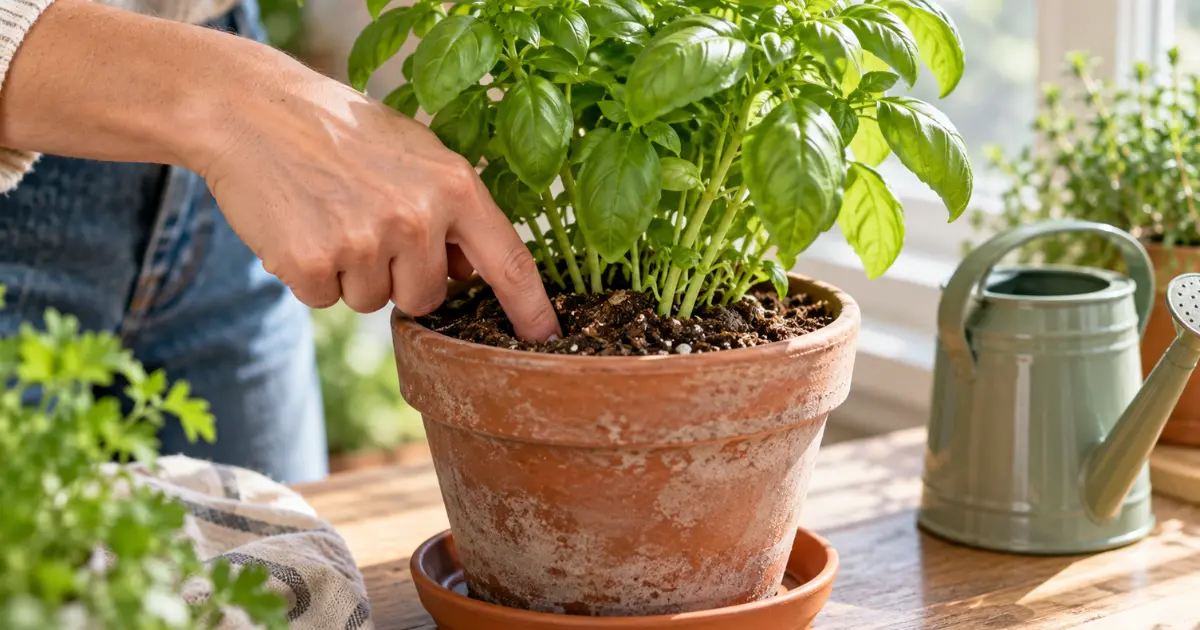
University of Minnesota advises checking indoor herb soil rather than using a calendar and warns against persistently soggy conditions. Penn State similarly recommends watering as the potting medium begins to dry, while acknowledging species differences. University of Minnesota Extension
Check Before You Water
Use the potting medium as your guide.
Feel below the immediate surface rather than reacting only to a dry-looking crust.
You can also learn to recognize the weight of a watered pot compared with the same container when it has dried somewhat.
If the medium is still appropriately moist for that herb, wait.
If the root zone is drying to the point appropriate for that species, water.
Water Thoroughly
When irrigation is needed, apply enough water to moisten the root zone rather than repeatedly adding tiny amounts to only the surface.
Allow excess water to drain from the bottom.
Then remove standing drainage water from the saucer or outer cachepot where necessary.
Different Herbs Need Different Moisture
This is one reason blanket schedules fail.
Penn State notes that herbs including oregano, sage, thyme, marjoram, and rosemary should dry somewhat between waterings, while basil should not be allowed to dry severely. Maryland also distinguishes between herbs with different moisture preferences. University of Maryland Extension
Mint and chives generally appreciate more consistent moisture than Mediterranean herbs adapted to freer-draining conditions.
What Does “Overwatering” Actually Mean?
Overwatering is not simply pouring a generous amount of water through a well-drained pot once.
The more important problem is keeping the root zone excessively wet for too long.
That can happen because of:
- watering again before the medium has dried sufficiently;
- a container without drainage;
- standing water in a cachepot;
- an oversized pot around a small root system;
- compacted growing medium;
- very weak light and slow plant water use.
Roots need oxygen as well as moisture.
How to Fertilize Indoor Herbs
Indoor container plants eventually depend on a limited volume of growing medium, so nutrients may need replenishment.
But this does not mean every herb requires frequent fertilizer.
Extension recommendations vary considerably. Penn State suggests low-dose regular feeding, while University of Minnesota recommends a much less frequent schedule for container herbs. That variation reinforces the value of considering the actual plant, growing medium, product, and growth rate instead of treating one interval as universal. Penn State Extension
A practical Garden Kindly approach is:
- Check whether the potting mix already contains fertilizer.
- Allow newly transplanted herbs to establish.
- Watch the plant’s growth.
- Use an appropriate fertilizer for edible container plants when needed.
- Follow the product label for dilution and application.
- Reduce unnecessary feeding when growth slows.
More fertilizer does not automatically produce better herbs.
If you’re unsure which fertilizer to choose or how to interpret nutrient labels, our guide to organic fertilizer for plants explains the main options and how to use them responsibly.
Illinois and Penn State Extension both caution that excessive fertilization can negatively affect herb aroma or flavor. Penn State Extension
Do not use fertilizer as the first treatment for every yellow or weak plant. Poor light, excessive moisture, dry roots, pests, or temperature stress may be the real problem.
Routine Indoor Herb Garden Care
Once the setup is functioning, routine care should be relatively simple.
Rotate Pots When Needed
Plants growing beside windows often lean toward the strongest light.
Rotate the container periodically if one-sided growth is becoming obvious.
Under evenly positioned grow lights this may be less necessary.
Keep Plants From Becoming Overcrowded
Separate plants or prune appropriately when foliage becomes so dense that air movement is poor.
Do not place containers shoulder-to-shoulder simply because there is room on the shelf.
Remove Dead or Seriously Damaged Growth
An occasional aging leaf is normal.
Remove genuinely dead material, but do not strip healthy leaves from the plant unnecessarily.
If multiple leaves suddenly decline, investigate the growing conditions instead of treating the symptom alone.
Watch for Pests
Look periodically at:
- new shoots;
- leaf undersides;
- stems;
- the surface of the potting mix.
Penn State lists aphids and fungus gnats among pests that may occur indoors and recommends cultural and mechanical controls before escalating treatment. Penn State Extension
If pests appear, identify them first.
Because culinary herbs are harvested for food, any pesticide treatment requires particular attention to the product label and whether that product is approved for use on the edible plant in question.
Adjust With the Seasons
A watering routine that works in June may be inappropriate in December.
When light levels and plant growth decline, the growing medium may remain moist much longer.
Indoor heating can simultaneously make the air drier, which is why visual impressions alone can be misleading.
Check the root zone.
How to Keep Indoor Herbs Productive
Healthy growth depends on a combination of factors rather than one trick.
The essentials are:
adequate light + appropriate moisture + enough root space + reasonable nutrition + species-appropriate harvesting
Harvest Regularly but Sensibly
Many leafy herbs respond well to appropriate harvesting because it encourages usable new growth.
But removing most of the foliage repeatedly can weaken a small plant.
How you harvest also depends on growth habit. Basil is harvested differently from chives, parsley, or rosemary.
Don’t Expect Every Herb to Live Forever
Some herbs are annuals.
Basil and cilantro, for example, naturally progress through life cycles that eventually include flowering and seed production.
Others are perennial but may become woody, oversized, or less convenient after spending a long time in the same indoor container.
Replacing or restarting a herb is not necessarily evidence that the indoor garden failed.
Repot When Roots Need More Space
Penn State recommends repotting when roots begin growing through drainage holes and notes that perennial herbs may need larger containers as they mature. Penn State Extension
Other clues can include:
- the plant drying unusually quickly;
- a very dense root mass;
- growth slowing despite otherwise suitable conditions.
Move up gradually rather than placing a small root system into an unnecessarily huge volume of potting medium.
Can You Grow Herbs Indoors Year-Round?
Yes, but indoors does not mean seasonless.
Growing inside protects plants from outdoor frost and gives you more control over the environment, but daylight still changes through the year.
During winter:
- days become shorter;
- the sun is lower;
- windows may provide less usable light;
- heating systems alter humidity;
- plants may grow more slowly;
- pots may use water more slowly.
Illinois Extension identifies low light as one of the main winter limitations for indoor herbs and recommends supplemental lighting where windows do not provide enough. Illinois Extension
Supplemental lighting can make year-round production much more consistent.
Even then, species biology still matters.
Annual herbs may need restarting. Some perennial herbs may benefit from outdoor growing during the warmer part of the year; University of Maryland notes that perennial herbs can perform better when moved outdoors in summer where practical. University of Maryland Extension
So year-round indoor herb growing means maintaining appropriate conditions and replacing plants when necessary, not keeping every original herb in unchanged production forever.
How to Harvest Indoor Herbs
Harvest when the plant has enough healthy growth to recover afterward.
Do not severely strip a newly established plant just because it has produced its first usable leaves.
For many branching herbs, cutting an appropriate section of stem encourages more useful growth than repeatedly removing isolated leaves.
Other herbs have different habits. Parsley and cilantro, for example, are commonly harvested by taking suitable outer stems rather than cutting the entire top like basil.
Illinois Extension emphasizes leaving enough growth on container herbs to support regrowth and notes that harvesting differs between annual and perennial herbs. Illinois Extension
General principles are:
- use clean scissors or pruners where appropriate;
- choose healthy growth;
- leave enough foliage to maintain the plant;
- avoid unnecessarily damaging the growing point;
- use species-specific guidance when the plant’s growth habit requires it.
Harvesting is part of care, not simply the final step.
Common Indoor Herb Garden Problems
A symptom should start an investigation, not automatically trigger a treatment.
The same yellow leaf can have multiple causes.
Weak, Leggy Growth
Start by checking light.
Long stems, wide spacing between leaves, small foliage, and strong leaning toward the window commonly point toward inadequate illumination.
Move the herb to stronger suitable light or improve supplemental lighting before reaching for fertilizer.
Yellow Leaves
Possible causes include:
- overly wet potting mix;
- root stress;
- insufficient light;
- nutrient issues;
- temperature stress;
- natural leaf aging;
- pests.
Check the moisture and growing conditions first.
If the potting mix has remained wet for a long time, adding more water because the leaves look wilted can make the problem worse.
If you’re unsure why your indoor herbs are turning yellow, our guide to yellow leaves on plants explains how to examine yellowing patterns, check moisture and drainage, and investigate light, nutrient problems, and other possible causes before changing your care routine.
Wilting
Wilting does not always mean dryness.
A severely dry root ball can cause wilting, but saturated roots can also lose their ability to function properly.
Feel the potting medium before watering.
Potting Mix Stays Wet for a Long Time
Possible explanations include:
- poor drainage;
- a pot that is too large;
- compacted medium;
- low light;
- cooler conditions;
- a plant with a small root system;
- repeated watering before the medium needs it.
Correct the cause rather than simply waiting for visible root damage.
Potting Mix Dries Extremely Quickly
Possible causes include:
- a very small container;
- a root-bound plant;
- strong sun;
- warm dry air;
- a highly porous medium;
- a large plant relative to its pot.
A larger appropriate container may be warranted if the roots have filled the existing pot.
Small Flying Insects Around the Soil
Small flies around persistently moist potting mix may be fungus gnats.
Penn State recommends moisture management and yellow sticky cards as part of control rather than immediately relying on pesticide treatment. Penn State Extension
Allowing the surface to dry appropriately can help when the herb’s moisture requirements permit it.
Sticky or Distorted New Growth
Inspect closely for aphids or other sap-feeding insects.
Check leaf undersides and tender stems.
If pests are present, isolate heavily affected pots where practical and begin with physical or cultural controls appropriate to the pest.
Common Indoor Herb Garden Mistakes
Choosing Herbs Only by Appearance
A group of attractive herbs may have incompatible light, moisture, or temperature requirements.
Choose according to growing needs first.
Assuming a Bright Room Provides Enough Plant Light
Human vision adjusts to dim indoor conditions extremely well.
Plants cannot.
Evaluate the actual window exposure and plant response.
Using Pots Without Drainage
Standing moisture around roots is one of the easiest indoor problems to prevent.
Use drainage holes.
Filling Pots With Garden Soil
A soil that performs well outdoors can compact and drain poorly in a container.
Use an appropriate potting medium.
H3: Watering Every Pot on the Same Day
Herbs use water at different rates.
Check each container.
Leaving Pots in Drainage Water
A saucer should catch runoff, not become a permanent reservoir around the root zone.
Crowding Too Many Herbs Into One Container
A mixed planter can look attractive initially but become difficult to manage as roots and foliage expand.
Overfertilizing Weak Plants
If poor light is causing leggy growth, fertilizer does not solve the underlying problem.
Diagnose first.
Expecting Constant Year-Round Growth From Every Herb
Winter light changes. Annual herbs age. Perennials mature.
Replacing plants or changing the setup can be a normal part of keeping an indoor garden productive.
Frequently Asked Questions About Indoor Herb Gardens
What Are the Best Herbs to Grow Indoors?
Good candidates include basil, chives, parsley, cilantro, mint, thyme, oregano, rosemary, and several other culinary herbs.
The best choices depend on your available light and indoor conditions. Chives and some leafy herbs can tolerate less light than strongly sun-loving rosemary or thyme.
How Do You Start an Indoor Herb Garden?
Choose a few herbs suited to your conditions, identify your strongest growing location, assess whether supplemental light is needed, select containers with drainage, fill them with suitable potting mix, then plant seeds or starter plants.
After planting, focus on light and moisture rather than complicated equipment.
Can Herbs Grow Indoors Year-Round?
Yes, many can.
However, winter light and indoor environmental conditions can slow growth, and annual herbs eventually complete their life cycles. Supplemental lighting can make winter production more consistent.
How Much Light Do Indoor Herbs Need?
Many culinary herbs perform best with around five to six or more hours of strong natural light, while species such as chives and cilantro may tolerate somewhat less. Indoor conditions vary enormously, so plant response matters more than treating one number as universal.
Can You Grow Herbs Indoors Without a Sunny Window?
Yes, if you provide suitable supplemental lighting.
A grow light can compensate for inadequate window light, but it needs appropriate intensity, positioning, and daily duration.
Do Indoor Herbs Need Grow Lights?
Not necessarily.
A sufficiently sunny window may provide enough light for some herbs. Grow lights become especially valuable during winter, in shaded apartments, or when plants show clear signs of insufficient light.
How Often Should Indoor Herbs Be Watered?
There is no universal schedule.
Check the potting medium and consider the herb, container, drainage, temperature, light, plant size, and season.
Some herbs prefer to dry more between waterings than others.
What Type of Soil Should You Use for Indoor Herbs?
Use a loose, well-drained container potting mix rather than ordinary garden soil.
The root environment needs both moisture and air, and container media are formulated to manage those conditions more effectively.
Can Several Herbs Grow in the Same Container?
Yes, provided the container is large enough and the plants have compatible light, moisture, root-space, and growth requirements.
For beginners, individual pots are often easier because each plant can be watered and moved independently.
Why Are My Indoor Herbs Turning Yellow?
There isn’t one cause.
Check for persistently wet or very dry potting mix, inadequate light, temperature stress, root problems, nutrient issues, pests, and normal leaf aging before deciding what treatment is needed.
Conclusion
A successful indoor herb garden depends much less on elaborate equipment than on matching each plant with the conditions it actually needs.
Start with a few herbs that fit your available space. Give light-demanding plants the strongest natural exposure you have or provide supplemental lighting when necessary. Use containers with drainage holes and a suitable potting medium, then check the root zone before watering instead of following a fixed schedule.
Feed conservatively, harvest without stripping plants unnecessarily, and watch how your herbs respond as indoor light and temperatures change through the year.
Most importantly, treat herbs as different plants rather than interchangeable kitchen decorations. Basil, chives, mint, thyme, cilantro, and rosemary do not all want precisely the same conditions.
Once you provide suitable light, drainage, moisture, and root space—and adjust those conditions based on what the plants show you—growing fresh herbs indoors becomes a much more manageable part of everyday gardening.