
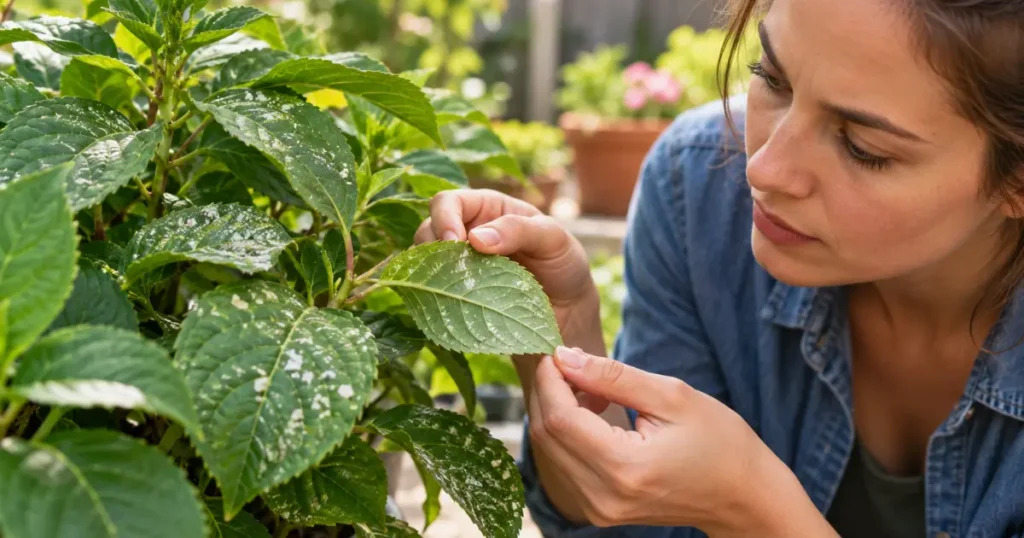
White spots on leaves being examined to identify the possible cause

White Spots on Leaves: How to Identify the Cause and Fix It

Finding white spots on leaves does not automatically mean your plant has powdery mildew—or even a disease. White markings can come from fungal growth, insects and their waxy coverings, pest-feeding damage, mineral deposits, spray residue, or sometimes a perfectly normal feature of the plant itself.

The most useful first step is therefore inspection, not treatment.

Look closely at what the white material actually looks like. Is it powdery, fuzzy, cottony, crusty, or made up of tiny pale dots? Is it on top of the leaf, underneath it, or on the stems too? Does it appear to sit on the surface, or has the leaf tissue itself lost color?

Those details help narrow the possibilities before you spray, prune, wash, or otherwise treat the plant.

The Garden Kindly approach is simple:

Observe first → identify the likely cause → then choose the appropriate response.

Quick Summary

  • White markings are a symptom, not one diagnosis: fungal growth, pests, residue, feeding damage, and normal plant features can look surprisingly similar at first glance.
  • Look at texture: powdery or flour-like patches suggest a different problem from cottony clusters, hard mineral deposits, or pale leaf tissue.
  • Check both sides of every affected leaf: some pests and other clues are much easier to find on the undersides.
  • Distinguish material from damaged tissue: a white substance sitting on a leaf is different from tissue that has become pale because cells were damaged.
  • Don’t assume powdery mildew: it is an important possibility, but mealybugs, spider mites, mineral residue, and other causes can also create a white-looking symptom.
  • Look for accompanying signs: webbing, sticky honeydew, visible insects, distortion, lesions, or stem symptoms can greatly narrow the diagnosis.
  • Avoid universal home remedies: the correct response depends on what is actually causing the problem.
  • Treat the cause, not the color: identify what produced the white spots on leaves before choosing a control or changing plant care.

Start by Looking Closely at the White Spots

Before trying to remove anything, inspect the affected foliage in good light.

White spots that initially look alike can be very different on closer examination.

Ask:

  • Are the markings powdery or flour-like?
  • Are they fuzzy or cottony?
  • Are they made up of many tiny pale dots?
  • Do they look hard, chalky, or crystalline?
  • Are they flat or raised?
  • Are they concentrated on the upper leaf surface, underneath the leaf, or both?
  • Are stems and leaf joints affected too?
  • Does the white material appear to sit on top of the leaf, or does the leaf tissue itself look bleached?
  • Are there insects, webbing, sticky residue, or distorted leaves nearby?
  • Is only one leaf affected, or is the symptom spreading across the plant?

A magnifying glass can help when the markings are extremely small, but you do not need special equipment for every diagnosis.
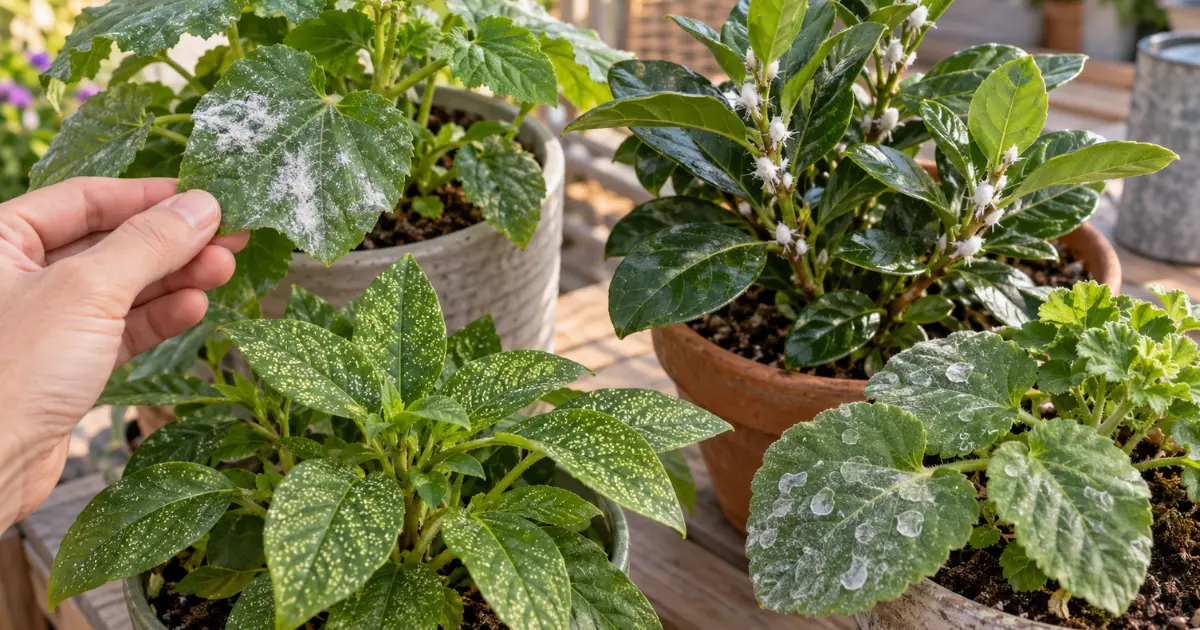
Different white spots on leaves showing powdery patches, waxy clusters, pale stippling, and surface residue

A Quick Diagnostic Guide

If you see: Powdery white patches

Look at how the coating spreads across leaves and stems. Powdery mildew becomes a stronger possibility when the growth looks superficial and flour-like.

If you see: Cottony white clusters

Inspect leaf joints, stems, undersides, and protected crevices for individual wax-covered insects such as mealybugs.

If you see: Tiny pale or white dots in the leaf tissue

Check closely for feeding damage, especially spider mites, and inspect the undersides for mites, cast skins, or webbing.

If you see: Hard or chalky white surface marks

Consider whether water, fertilizer solution, or another spray recently dried on the foliage and left mineral residue.

If you see: White markings mainly underneath leaves

Look for pests, eggs, cast skins, webbing, waxy deposits, or other structures before assuming the symptom is fungal.

If you see: Stable pale or whitish features on otherwise healthy growth

Compare them with normal foliage of the same species. Hairs, waxes, variegation, and other plant structures can sometimes be mistaken for a problem.

These are diagnostic clues, not guaranteed diagnoses.

Powdery or Flour-Like White Spots on Leaves

A white coating that resembles flour or fine powder makes powdery mildew one important possibility.

Powdery mildew is not a single fungus. Different species infect different host plants, but the characteristic symptom is generally superficial white fungal growth on leaves and sometimes stems.

University of Maryland Extension describes powdery mildew on vegetables as a white powdery coating over leaf surfaces, often beginning on older leaves and spreading as infection develops. Unlike many foliar diseases, powdery mildew does not require continuously wet foliage to become established. University of Maryland Extension

Look for:

  • discrete powdery spots that enlarge;
  • patches merging into a broader whitish coating;
  • involvement of multiple leaves;
  • similar white growth on stems in some cases;
  • later yellowing, distortion, or decline when infection becomes substantial.

Do not diagnose powdery mildew merely because something white appears on a leaf.

Cottony insects, hard-water residue, spray deposits, or pale feeding damage can look superficially similar from a distance.

Does Powdery Material Wipe Off?

Some superficial fungal growth may be disturbed when rubbed, but “it wipes off” is not a reliable diagnostic test by itself.

Mineral residue can also be superficial. So can wax produced by insects.

Avoid repeatedly rubbing delicate foliage in an attempt to diagnose the problem; leaves can be bruised or damaged.

Instead, combine texture with:

  • location;
  • spread pattern;
  • affected plant species;
  • other symptoms;
  • signs of insects.

Once powdery mildew becomes the likely diagnosis, disease-specific management is more useful than treating every white spot the same way.

Garden Kindly’s separate Powdery Mildew on Plants topic should remain the detailed resource for control and prevention rather than duplicating that entire treatment guide here.


Powdery Mildew vs. Mealybugs

Powdery mildew and mealybugs can both make a plant appear to have white powder or fuzz, but a close inspection usually reveals important differences.

Powdery Mildew

Powdery mildew typically looks more like a flat or spreading fungal coating over the plant surface.

You may see:

  • powdery patches across leaf blades;
  • multiple spots expanding into one another;
  • coating that follows the surface of a leaf;
  • similar growth on additional leaves or stems.

Mealybugs

Mealybugs are actual insects.

They are soft-bodied and covered with white wax, and colonies can form cottony-looking clusters. UC Integrated Pest Management notes that they commonly gather in protected places and appear as white, waxy or cottony masses. UC IPM

Look particularly around:

  • leaf axils;
  • undersides of leaves;
  • stems;
  • branch joints;
  • protected crevices;
  • places where leaves touch stems or one another.

Other clues can include:

  • visible individual insects;
  • sticky honeydew;
  • sooty mold growing on honeydew;
  • ants visiting the plant;
  • weakened or dropping foliage when infestations are heavy.

A fungal patch does not crawl away when disturbed. An individual mealybug may move, although slowly.

The distinction matters because a fungicide aimed at powdery mildew will not solve a mealybug infestation, and an insect treatment is unnecessary when no pest is present.

Tiny White Spots or Specks Can Be Pest Damage

Sometimes the white dots are not a white substance at all.

They are areas of damaged leaf tissue.

Spider mites are a good example.

As mites feed on plant cells, foliage can develop numerous tiny pale dots known as stippling. UC Integrated Pest Management notes that this damage may begin as light-colored spots and can progress to bronzing, yellowing, drying, and leaf loss when populations become severe. Webbing may also become visible. UC IPM

This distinction is important:

White material sitting on the leaf
is different from
leaf tissue that has become pale from feeding injury.

What to Look for With Spider Mites

Inspect the underside of the leaf closely.

Look for:

  • tiny moving dots;
  • fine webbing;
  • very small eggs;
  • pale cast skins;
  • widespread stippling on the upper leaf surface.

Do not assume that every tiny white speck is a mite.

If the dots do not move and there is no associated feeding damage or webbing, continue the diagnosis.

Other pests can also leave wax, cast skins, eggs, or pale feeding marks, so identify what is present before choosing a treatment.

Hard Water and Mineral Residue Can Mimic a Plant Problem

Not every white mark is biological.

Water containing substantial dissolved minerals can leave pale deposits after droplets evaporate. Fertilizer solutions can also leave salts behind on plant surfaces.

University of Maryland Extension describes mineral and fertilizer salt deposits as white crystallized coatings that can occur on foliage, growing medium, and containers. Hard water is one possible source. University of Maryland Extension

This becomes more plausible when:

  • spotting appeared after misting or overhead watering;
  • leaves were recently sprayed;
  • similar white deposits occur around the pot rim;
  • markings appear hard or chalky rather than fuzzy;
  • the plant otherwise looks healthy;
  • the material follows the pattern of dried droplets.

Don’t Assume Every Wipeable Spot Is Harmless

Surface residue may come away more readily than damaged leaf tissue, but wipeability alone does not establish the cause.

Some insects have waxy coatings.

Powdery fungal growth is also superficial.

Instead, ask what else is present.

If the same mineral crust appears on the container, saucer, faucet, or nearby surfaces, water residue becomes a stronger explanation.

Use gentle handling rather than scrubbing foliage aggressively.

Why You Should Check the Undersides of Leaves

If you only inspect the top surface, you can miss some of the most useful clues.

Pests frequently occupy the protected underside of leaves.

University of Minnesota Extension recommends checking leaf undersides and leaf-stem junctions when inspecting indoor plants for pests such as scales and mealybugs; whiteflies and their immature stages also commonly occur underneath foliage. University of Minnesota Extension

Turn several affected and apparently healthy leaves over.

Look for:

  • insects;
  • eggs;
  • waxy clusters;
  • webbing;
  • shed skins;
  • sticky material;
  • fuzzy or powdery growth;
  • structures that appear attached to the leaf;
  • differences between the upper and lower surfaces.

Check stems and leaf joints at the same time.

White Spots Under Leaves Do Not Automatically Mean Pests

An underside symptom is useful evidence, but it is still not a diagnosis.

Depending on the plant and situation, whitish structures underneath leaves could be:

  • insects or their wax;
  • eggs or cast skins;
  • fungal growth;
  • surface deposits;
  • normal plant hairs or waxes.

Compare affected tissue with healthy leaves from the same plant or another healthy specimen of the same species when possible.


Could the White Markings Be Normal?

Yes.

Some plants naturally have features that can look suspicious to an inexperienced gardener.

Examples include:

  • fine leaf hairs, or trichomes;
  • waxy or glaucous coatings;
  • pale veins;
  • variegated areas;
  • silvery foliage;
  • species-specific glands or surface structures.

A normal feature is more likely when:

  • similar markings occur consistently on healthy leaves;
  • new foliage develops the same pattern;
  • the plant remains vigorous;
  • the marking is symmetrical or characteristic of the species;
  • there are no associated pests, lesions, decay, or progressive decline.

Avoid treating a normal plant feature as disease.

If you are uncertain, compare the plant with reliable photographs or descriptions of healthy specimens of the same species or cultivar.


Other Diseases Can Sometimes Produce Whitish Markings

Powdery mildew is not the only disease capable of creating pale or white-looking symptoms.

Certain diseases can produce:

  • pale lesions;
  • fuzzy growth;
  • bleached centers within spots;
  • fungal structures on leaf undersides;
  • white growth associated with damaged tissue.

But disease becomes more likely when the white symptom occurs with additional distinctive changes, such as:

  • defined lesions;
  • yellow or brown margins;
  • dead tissue;
  • rapid spreading;
  • stem discoloration;
  • soft rot;
  • distorted growth;
  • substantial plant decline.

At that point, diagnose the complete symptom pattern rather than searching only for “white spots.”

This distinction also protects the broader Garden Kindly diagnostic architecture. If the dominant symptom becomes brown spots, curling, wilting, holes, or extensive tissue death, that problem deserves the appropriate symptom-specific diagnostic route.


How to Identify What Is Causing White Spots on Leaves

Instead of cycling through random treatments, use a consistent process.

Step 1: Examine the Texture

Ask whether the marking is:

  • powdery;
  • cottony;
  • crusty;
  • hard;
  • raised;
  • flat;
  • part of the leaf tissue.

Texture immediately narrows the possibilities.
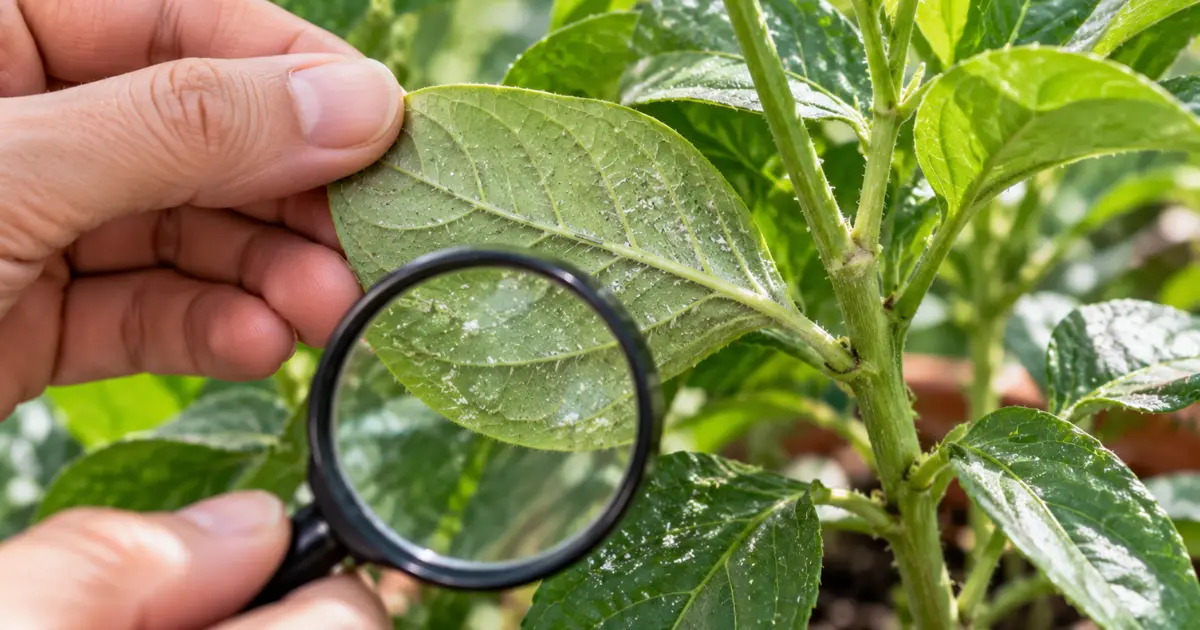
Inspecting the underside of a leaf with white spots for pests and other diagnostic clues

Step 2: Check Both Leaf Surfaces

Turn affected leaves over.

Look at the underside, veins, petiole, stems, and leaf axils.

Do the white spots exist on both sides, or only one?

Step 3: Look for Living Pests or Their Signs

Search for:

  • moving insects or mites;
  • waxy bodies;
  • eggs;
  • shed skins;
  • webbing;
  • honeydew.

Do not spray simply because pests are one possibility.

Confirm them first where practical.

Step 4: Decide Whether the White Material Is Superficial

Surface coatings suggest a different diagnostic path from tissue discoloration.

A powdery fungal growth, mineral deposit, and mealybug wax all sit largely on or above plant surfaces.

Spider-mite stippling, by contrast, is damage within the leaf tissue.

Step 5: Think About What Happened Recently

Ask:

  • Did you mist the leaves?
  • Was overhead irrigation used?
  • Did you spray fertilizer or another product?
  • Did the weather suddenly become more humid?
  • Was the plant moved indoors or outdoors?
  • Did symptoms appear soon after a new plant was introduced nearby?

Recent events can provide context without proving the diagnosis.

Step 6: Look at the Whole Plant

Do not diagnose from one spot.

Check whether the plant also has:

  • yellow leaves;
  • distorted new growth;
  • webbing;
  • sticky residue;
  • dropping foliage;
  • stem symptoms;
  • lesions;
  • wilting.

The combination is more informative than the white color alone.

If yellowing becomes the main symptom rather than the white markings, our guide to yellow leaves on plants explains how to investigate watering, drainage, light, nutrient problems, and other possible causes before choosing a solution.

Step 7: Treat Only When the Evidence Points Somewhere

If you still cannot identify the cause, observation is often safer than applying several unrelated products.

Taking clear photographs over several days can also help you see whether the pattern is expanding or changing.


How to Get Rid of White Spots on Plants

There is no universal white spot treatment.

The correct response depends entirely on the cause.

If the Marks Are Mineral or Spray Residue

Address the source.

That may mean changing how water is applied, reconsidering water quality, or preventing fertilizer solution from drying on foliage.

Avoid harsh scrubbing.

If You Confirm a Pest

Identify the pest before choosing a management method.

For many garden pests, integrated pest management begins with options such as:

  • physical removal where practical;
  • isolating affected indoor plants;
  • improving plant care;
  • preserving beneficial insects outdoors;
  • targeted treatment only when necessary.

If a pesticide is warranted, use a product labeled for the specific pest, plant, and growing location, and follow the label.

If Powdery Mildew Is the Likely Cause

Move from the broad symptom diagnosis to disease-specific guidance.

Powdery mildew management varies with:

  • plant species;
  • severity;
  • growing environment;
  • whether resistant cultivars are available;
  • whether treatment is even warranted.

Garden Kindly’s dedicated powdery-mildew guide should handle those details rather than turning this article into a second competing disease article.

If It Is Another Disease

Identify the disease or at least narrow the diagnosis before treating.

Different pathogens do not respond to one universal spray.

If the Marking Is Normal

Do nothing.

Healthy trichomes, waxes, or natural variegation do not require correction.


Be Cautious With Home Remedies

Searches for how to get rid of white spots on plants often lead to mixtures involving baking soda, vinegar, dish detergent, milk, hydrogen peroxide, essential oils, or various oils.

Do not spray one of these simply because the symptom is white.

There are several problems with that approach:

  • the cause may not be fungal;
  • concentrations can injure leaves;
  • different plant species have different sensitivities;
  • household detergents are not automatically equivalent to horticultural soaps;
  • mixing products can increase the risk of plant damage;
  • a homemade treatment can obscure symptoms before you have identified them.

Where a pesticide, fungicide, horticultural oil, or insecticidal soap is appropriate, use a product labeled for that purpose and follow its directions.

“Natural” does not mean risk-free.

Should You Remove Leaves With White Spots?

Sometimes. Not always.

Removal may make sense when:

  • disease management specifically calls for sanitation;
  • a leaf is badly damaged or dying;
  • a pest population is highly concentrated on a few leaves;
  • removing limited foliage can reduce a localized problem without substantially weakening the plant.

Removal makes less sense when:

  • the marking is harmless residue;
  • the feature is natural;
  • only a small cosmetic area is affected;
  • taking off many leaves would remove a substantial portion of the plant’s healthy photosynthetic area.

With powdery mildew on indoor plants, for example, University of Maryland Extension notes that individual infected leaves can sometimes be removed as part of management while environmental conditions such as plant spacing and airflow are addressed. University of Maryland Extension

Use clean tools when cutting is necessary and dispose of affected material appropriately for the problem you have identified.

Do not strip the plant bare simply because some leaves contain white markings.

How to Reduce Future White-Spot Problems

Prevention also depends on the cause.

There is no single practice that prevents every form of white spots on leaves.

Useful general habits include:

Inspect Plants Regularly

Look at foliage before a problem becomes widespread.

Check both leaf surfaces.

This is particularly useful when bringing new plants into a home or greenhouse.

If you grow culinary herbs indoors, our indoor herb garden guide explains how to manage lighting, drainage, watering, and routine plant inspections so you can recognize growing problems early.

Give Plants Appropriate Space

Crowded foliage can make inspection difficult and, for some diseases, create a more favorable microenvironment.

Use the mature size of the species rather than crowding plants simply to make a bed or shelf look full immediately.

Match Watering to the Plant

Some diseases are affected by moisture and humidity, but avoid universal claims that keeping every leaf dry prevents every fungal problem.

Powdery mildew, for example, behaves differently from many diseases associated with prolonged leaf wetness.

Use Treatments Only When Needed

Unnecessary pesticide use can harm beneficial organisms and does nothing for mineral deposits, natural waxes, or non-pest problems.

Identify the target first.

Keep Plants in Suitable Growing Conditions

Plants under chronic light, moisture, temperature, or root stress can be less resilient overall.

Healthy growing conditions do not guarantee that pests and diseases will never appear, but they make plant care and diagnosis much easier.

Frequently Asked Questions About White Spots on Leaves

What Causes White Spots on Plant Leaves?

Possible causes include powdery mildew, mealybugs or other wax-covered pests, spider-mite feeding damage, mineral or fertilizer residue, other diseases, and normal plant features such as hairs or waxy coatings.
How the spots look and where they occur are more informative than the color alone.

No.
Powdery mildew is an important cause of powdery white patches, but insects, feeding damage, mineral deposits, spray residue, and normal plant structures can also appear white.

Powdery mildew commonly creates superficial, flour-like white patches that may expand across leaf surfaces and sometimes stems.
Compare that appearance with cottony insect clusters, hard deposits, and tiny pale areas within the leaf tissue before deciding.

Look closely at whether the dots are objects sitting on the leaf or pale areas within the tissue.
Spider mites can cause fine stippling, for example, but tiny dots could also be residue, insects, eggs, natural structures, or other damage.
Check the undersides of affected leaves.

Possible explanations include pests, eggs or cast skins, fungal structures, deposits, or normal plant features.
The underside location is useful evidence but does not prove one specific cause.

Powdery mildew generally looks like fungal powder spreading over plant surfaces.
Mealybugs are individual soft-bodied insects covered in white wax and commonly gather in cottony-looking clusters around stems, leaf joints, and other protected areas.

Yes.
Dissolved minerals in hard water can remain behind as whitish or crystalline residue after droplets evaporate.
Similar deposits may also appear on the pot or growing medium.

Only when there is a reason.
Removal can be useful for some confirmed disease or pest situations, but harmless residue or natural plant markings do not justify removing otherwise healthy foliage.

Some surface residues or growths may be disturbed, but whether something wipes away does not identify it reliably.
Handle leaves gently and inspect the texture, location, insects, and accompanying symptoms before taking further action.

First determine the likely cause.
Mineral residue, mealybugs, spider mites, powdery mildew, and normal wax or hairs all require different responses. There is no single safe treatment for every white-looking leaf symptom.

Conclusion

White spots on leaves tell you what you can see, but not necessarily what caused the problem.

Begin by examining the appearance and texture. Check the upper and lower leaf surfaces, stems, and leaf joints. Determine whether you are looking at powdery growth, cottony insects, pale damaged tissue, hard surface residue, or a feature that may simply be normal for the species.

Then look for supporting evidence such as webbing, honeydew, visible insects, lesions, distortion, or recent changes in the plant’s environment.

Avoid spraying first and diagnosing later.

Observe the symptom → narrow the likely cause → confirm the important clues → then choose the appropriate response.

That approach is safer for the plant and far more useful than treating every white marking as powdery mildew.

Leave a Comment

Your email address will not be published. Required fields are marked *

Scroll to Top