
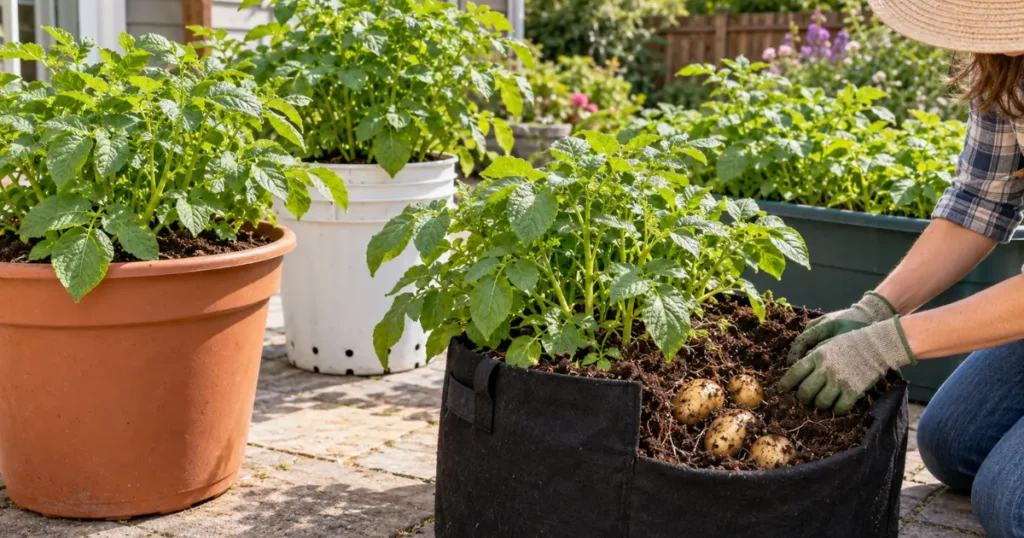
Growing potatoes in containers in a home garden

Growing Potatoes in Containers: A Beginner’s Guide From Planting to Harvest

Growing potatoes in containers is a practical option when you have limited garden space, difficult native soil, or simply want an easier way to harvest a homegrown crop. Potatoes can grow successfully in large pots, buckets, tubs, and grow bags, but the container itself does not make the crop effortless.

Good results depend on giving each potato plant enough growing-medium volume, reliable drainage, strong light, adequate but not excessive moisture, and enough room for tubers to develop. Overcrowding a small pot or repeatedly saturating the growing medium can undermine an otherwise promising crop.

This guide takes you through the complete container-growing process: choosing seed potatoes and containers, preparing the growing medium, planting, watering, feeding, adding more medium as plants develop, recognizing problems, and harvesting the finished crop.

Quick Summary

  • Use a generously sized container: Potato plants need substantial root and tuber space. Larger containers are generally easier to manage than undersized pots.
  • Drainage is essential: The container needs drainage holes so the growing medium can stay evenly moist without remaining saturated.
  • Start with certified seed potatoes: They are preferable to grocery-store potatoes because they are produced for planting and reduce avoidable disease and dormancy problems.
  • Do not overcrowd: The number of seed pieces should match the available soil volume rather than the maximum number you can physically fit into the pot.
  • Use a container growing medium: Avoid filling large pots with dense garden soil alone. The root zone needs a useful balance of moisture retention, drainage, and aeration.
  • Add more medium as plants grow: Covering the lower stems and keeping developing tubers protected from light is part of ordinary container potato care.
  • Water according to conditions: Containers can dry quickly, especially in warm or windy weather, but potato roots and tubers should not remain waterlogged.
  • Harvest timing depends on your goal: You can harvest tender new potatoes earlier or wait for foliage decline and mature tubers suitable for a more complete harvest.

This is a title

Why Grow Potatoes in Containers?

Containers make potato growing possible on patios, decks, balconies, driveways, and other sunny spaces where an in-ground vegetable bed may not be available. If you’re new to gardening, our guide to how to start a garden explains how to assess sunlight, growing space, and basic care before deciding what to grow.

They also give you greater control over the root environment. If your native soil is compacted, poorly drained, contaminated, extremely stony, or difficult to work, a container allows you to provide a purpose-built growing medium instead.

Harvest can also be simpler. Instead of digging extensively through a garden bed, you can often empty a pot or grow bag onto a tarp and sort through the growing medium for tubers.

There are trade-offs, however.

Containers:

  • hold less soil than an in-ground bed;
  • can dry faster;
  • may heat up more in strong summer sun;
  • require closer moisture monitoring;
  • restrict the volume available to roots and tubers.

So container growing is not automatically easier or more productive. It is simply a different growing system with some useful advantages.

Choosing Potatoes for Containers

You can grow many conventional potato varieties in containers, but your available space and growing season should influence the choice.

Potatoes vary in:

  • days to maturity;
  • tuber size;
  • growth habit;
  • culinary qualities;
  • disease resistance;
  • regional adaptation.

If container space is limited, varieties that produce reasonably sized tubers without requiring an exceptionally long season can be convenient. Small red, yellow, fingerling, and other specialty potatoes are popular choices, but that does not mean russets or larger potatoes are categorically unsuitable.

Your local climate matters as much as the container.

Choose a cultivar that has enough time to mature during your normal potato-growing season. If disease has been a recurring problem locally, resistant or tolerant varieties may also deserve preference.

Avoid assuming that one cultivar advertised online as the “best container potato” will necessarily outperform locally adapted alternatives.

What Size Container Do Potatoes Need?

Container size directly affects how much root space, moisture reserve, and tuber-growing volume each plant receives.

This is one area where authoritative recommendations differ, partly because container shapes and growing methods vary.

Penn State Extension likewise identifies 10- to 15-gallon opaque, food-safe containers with drainage holes as suitable for growing potatoes. Its container method begins with a relatively shallow layer of growing medium rather than filling the entire container at planting. Penn State Extension

For a beginner, the practical lessons are more important than finding one supposedly perfect dimension:

  • give each plant substantial soil volume;
  • use a container wide enough for tubers to develop around the stem;
  • provide enough height to add growing medium later;
  • reduce the number of plants when using smaller containers;
  • do not assume a taller tower always means a larger harvest.

A wider, stable 10- to 15-gallon container is generally easier to manage than trying to force several potato plants into a small flowerpot.

Do Potatoes Need an Extremely Deep Container?

They need useful depth, but deeper is not endlessly better.

Potatoes form tubers on underground stems called stolons. Adding growing medium around developing lower stems is useful, but this does not mean a plant will automatically fill an arbitrarily tall tower with potatoes from bottom to top.

Extremely tall containers can also create uneven moisture, with the surface drying while the bottom remains too wet.

Choose enough depth to provide a substantial root zone and room for later hilling rather than pursuing height for its own sake.

Drainage Is Essential for Container Potatoes

A potato container must have a way for excess water to escape.

That generally means multiple unobstructed drainage holes near the bottom.

Potatoes need reliable moisture, especially while plants and tubers are actively developing, but roots require oxygen as well. A constantly saturated container can create stressful conditions and increase the risk of tuber and root problems.

Before planting:

  1. Check that the holes are open.
  2. Position the pot so the base is not sealed flat against a surface that blocks drainage.
  3. Avoid placing the container where runoff will remain pooled around the bottom.
  4. Confirm that excess irrigation can drain safely away.

Adding rocks or gravel to the bottom does not compensate for a poorly designed container. Good drainage depends primarily on drainage openings and an appropriate growing medium.

Pots, Grow Bags, Buckets, and Tubs

You do not need a specialized commercial potato planter.

Several container types can work.

Conventional Pots

Large nursery-style or patio pots are straightforward and stable.

Rigid pots usually retain moisture longer than breathable fabric bags, although drying rate depends on material, size, weather, and growing medium.

Opaque pots are preferable to clear containers because developing tubers should remain protected from light.

Grow Bags

Fabric grow bags are lightweight and easy to store after the season.

They typically provide excellent drainage and air exchange, but those same characteristics can cause the growing medium to lose moisture more quickly during hot or windy weather.

Check them more frequently rather than assuming they should be watered on the same schedule as rigid pots.

Tubs and Large Containers

A sturdy storage-style tub or similar container can provide generous root volume if it is made from a material suitable for growing food and has adequate drainage.

Wide tubs can be especially useful when you want multiple plants without placing them too close together.

Buckets

Buckets are inexpensive and compact enough for patios and other small spaces. They deserve a closer look because the method is slightly more constrained.

How to Grow Potatoes in a Bucket

A bucket follows the same biological principles as any other potato container.

A common 5-gallon bucket can be used for a modest planting, but it offers far less growing volume than a 10- or 15-gallon tub. Based on the approximately 5 gallons of soil volume per plant recommended in container guidance, treat a 5-gallon bucket as space for one potato plant, not several competing plants.

Choose a bucket that is:

  • clean;
  • sturdy;
  • suitable for edible-crop use;
  • never previously used for hazardous chemicals;
  • opaque;
  • drilled with several adequate drainage holes.

Add a starter layer of container growing medium, position one seed potato or prepared seed piece, cover it, and water sufficiently to settle the medium.

As shoots grow, add more medium around the lower stems while keeping healthy foliage exposed.

A bucket often dries faster than a broad garden bed. Check actual moisture regularly, especially once the plant has developed a large canopy.

Because 5 gallons is relatively limited space, do not expect it to produce the same crop as a much larger container.

What Growing Medium Should You Use?

Do not fill a potato container with dense garden soil alone.

Soil that performs acceptably in the ground can compact severely inside a pot and may drain poorly once confined.

A useful container medium needs to provide:

moisture retention + drainage + aeration + physical space for roots and tubers

A commercial potting mix intended for outdoor edible containers can provide a practical base.

Compost may be incorporated where it genuinely improves organic matter and nutrient supply, but there is no need to assume every potato container needs a large percentage of compost regardless of what the potting mix already contains. If you’re considering adding compost to your potting mix, our guide to how to use compost explains how to use finished compost as a soil amendment without treating it as a complete replacement for an appropriate growing medium.

Also check whether the purchased medium already contains fertilizer.

That matters later. Adding fertilizer on top of a heavily pre-fertilized mix can supply more nutrients than the crop needs.

The finished medium should:

  • drain after irrigation;
  • remain reasonably moisture retentive;
  • resist severe compaction;
  • be loose enough for tubers to develop.

When Should You Plant Container Potatoes?

Container potatoes are normally planted during the cool part of the growing season, after conditions have moderated enough for potato growth.

Exact timing varies substantially across the United States.

Utah State University Extension advises planting potatoes roughly 14–21 days before the local last-frost date under its regional conditions and emphasizes sunny, well-drained growing conditions. Utah State University Extension

Use that as an example of the principle rather than a national date.

A container may warm sooner than heavy garden soil, but above-ground potato growth can still be damaged by hard freezes. Your useful planting window depends on local spring temperatures, frost risk, cultivar maturity, and how long hot summer conditions take to arrive.

Consult local Extension planting guidance when you need a date tailored to your region.

Start With Healthy Seed Potatoes

A seed potato is not a botanical seed. It is a tuber intended to produce a new potato plant.

For home growing, certified disease-free seed potatoes are a better starting point than ordinary potatoes from the grocery store.

Illinois Extension cautions that grocery-store potatoes may have been treated to inhibit sprouting and, even when they are already sprouting, have not necessarily been inspected and certified free of potato diseases or pests. Illinois Extension

That matters because planting material can introduce pathogens that persist beyond a single crop.

Choose seed potatoes that are:

  • firm;
  • healthy;
  • free from obvious rot;
  • free from serious damage;
  • beginning to show viable eyes or sprouts when planting time approaches.

How to Prepare Seed Potatoes for Planting

Small seed potatoes can often be planted whole.

Larger ones can be cut into planting pieces so long as each piece contains viable eyes and enough stored tuber tissue to support early growth.

A practical planting piece should have at least one healthy eye; two or more can provide additional assurance.

After cutting, allowing the cut surface to dry and form a protective layer before planting can reduce vulnerability at the wound. University of Maine Cooperative Extension also describes green sprouting, or pre-sprouting, as a technique for encouraging sturdy shoots before planting. It is useful in some situations but is not a mandatory step for every home gardener. Cooperative Extension

Is Chitting Necessary?

No.

“Chitting” or pre-sprouting means allowing seed potatoes to develop short, sturdy sprouts before they are planted.

It may give plants a head start, particularly where the growing season is relatively short, but healthy seed potatoes can still grow without a formal chitting routine.

If potatoes are already developing strong sprouts naturally, simply handle them carefully so you do not rub those shoots off during planting.

How to Plant Potatoes in Containers

Planting potatoes in containers is slightly different from filling the pot completely and planting at the final surface level.

You normally begin lower in the container so there is room to add more growing medium as the stems develop.

Planting seed potatoes in a container with proper spacing and room for more growing medium

Step 1: Add the Initial Growing Medium

Add several inches of moist, loose potting medium to the bottom of the container.

The exact starting depth varies among container methods. Extension recommendations range from approximately 4 inches to 6–8 inches of initial medium.

This variation is one reason it is better to understand the process than memorize one number.

You need:

  • enough medium beneath the seed potato for roots;
  • enough empty container above it for later additions;
  • enough drainage that the lower layer does not become saturated.

Step 2: Position the Seed Potatoes

Place the seed potatoes or pieces with healthy eyes or sprouts facing generally upward.

Do not pack several pieces together simply because there appears to be open surface area.

For container growing, soil volume is the limiting factor.

If you are using roughly 5 gallons of growing-medium capacity per plant as a practical benchmark, a 10-gallon container would usually be more sensibly planted with about two plants than with five or six.

Step 3: Cover the Seed Pieces

Cover the seed potatoes with several inches of growing medium.

Container recommendations vary here too. Some methods use roughly 3 inches of cover, while others begin with more.

Keep the seed potato covered and protected while still leaving substantial room at the top for later hilling.

Step 4: Water the Container

Water after planting if the medium needs moisture.

Apply enough to settle the growing mix and moisten the root zone, then allow excess water to drain.

Do not leave the container standing in a pool of drainage water.

Step 5: Wait for Shoots

Green shoots will emerge and begin developing leaves.

Once plants are established and growing upward, you can begin adding more medium around the lower stems.

How Much Sun Do Container Potatoes Need?

Potatoes are sun-loving plants.

Aim for a location that receives strong direct light for much of the day. Around six or more hours is a useful general target, with more often beneficial where temperatures are not excessively stressful.

A container gives you some flexibility because it can sometimes be repositioned if a patio becomes shaded as the season changes.

However, moving a very large wet container may be difficult, so choose the location carefully before filling it.

In very hot climates, the plant and the container experience two different temperature environments.

The foliage may tolerate a sunny site while a dark pot sitting on hot pavement becomes much warmer than ordinary garden soil. If containers become excessively hot, consider:

  • moving them off heat-reflective pavement;
  • using lighter-colored outer containers;
  • providing adequate moisture without waterlogging;
  • protecting the pot itself from extreme heating without heavily shading the foliage.

How to Water Potatoes in Containers

Container potatoes need consistent moisture, particularly as plants grow rapidly and tubers enlarge.

They do not need a rigid schedule.

How often you actually water depends on:

  • container volume;
  • container material;
  • growing medium;
  • rainfall;
  • sun exposure;
  • temperature;
  • wind;
  • plant size;
  • stage of tuber growth.

A small fabric grow bag in hot, windy weather can dry much faster than a large plastic tub during a cool, cloudy week.

Check the medium rather than the calendar.

Push a finger below the immediate surface or investigate slightly deeper. If the root zone is beginning to dry, water thoroughly enough to moisten it and allow some drainage.

If the medium is already clearly wet, wait.

Uneven moisture can contribute to misshapen or cracked tubers, while prolonged saturation reduces oxygen around roots and tubers. Oregon State Extension notes that fluctuations between moisture stress and rapid water uptake can contribute to tuber disorders, while prolonged wet conditions can create other physiological problems. OSU Extension Service

As the canopy becomes larger, expect water use to change.

How to Fertilize Container Potatoes

Container potatoes have access only to nutrients contained in the potting medium and anything subsequently supplied.

That makes nutrition important, but it does not justify automatically applying heavy fertilizer.

Start by checking:

  • whether the potting mix already contains fertilizer;
  • whether compost or another nutrient-rich amendment was included;
  • what the fertilizer label recommends for container vegetables;
  • how strongly the plants are growing.

Potatoes need nitrogen for healthy foliage, but excessive nitrogen can encourage lush top growth at the expense of balanced crop development.

Avoid inventing a feeding schedule based only on the fact that potatoes are sometimes described as “heavy feeders.”

If supplemental fertilizer is needed, choose one labeled for edible vegetable crops and follow its application directions. Container volume and existing fertility influence how much is appropriate. If you’re considering an organic product, our guide to organic fertilizer for plants explains how to compare nutrient labels, fertilizer types, and application directions before making a choice.

A soil or growing-medium test can provide additional guidance when you are growing repeatedly in the same large container system or encountering unexplained nutrient problems.

Hilling Potatoes in Containers

“Hilling” means adding soil or another suitable growing medium around the lower portions of a developing potato plant.

In a garden bed, soil is traditionally mounded around the stems.

In a container, you accomplish the same basic task by gradually adding more growing medium.
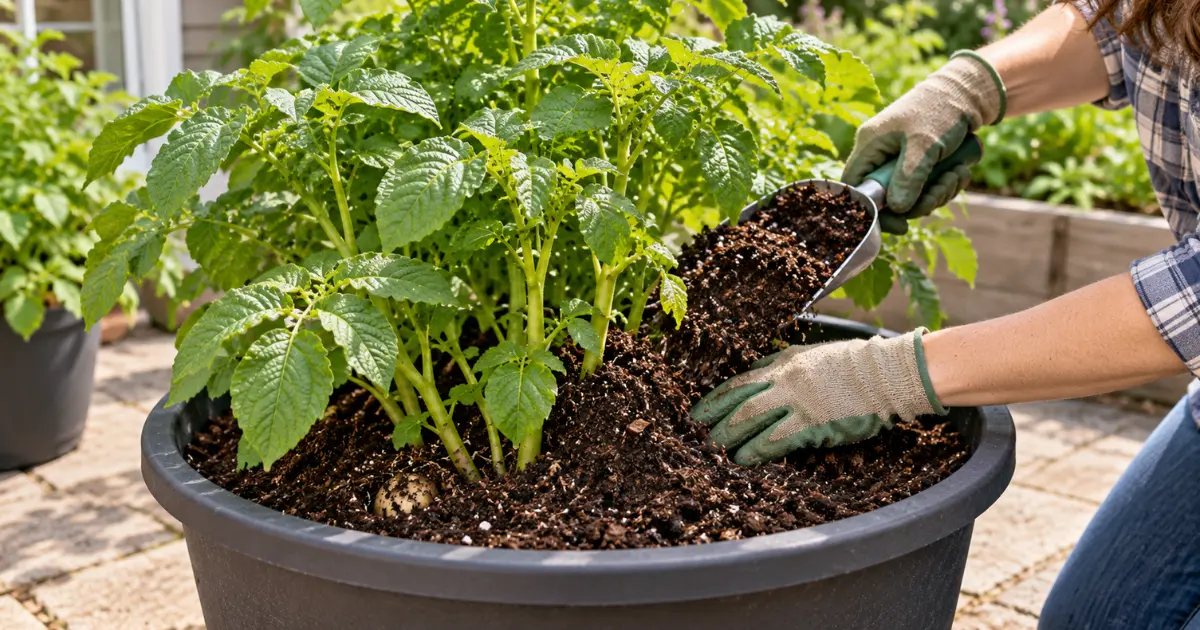
Adding growing medium around potato stems in a container while leaving healthy foliage exposed

University of Minnesota Extension explains that potato tubers form on stolons that develop from underground stem tissue and that hilling helps keep shallow tubers covered and protected from light. University of Minnesota Extension

How to Add Growing Medium

Once shoots have developed a useful amount of leafy growth:

  1. Add more growing medium around the lower stems.
  2. Keep a meaningful portion of healthy foliage exposed.
  3. Water as necessary to settle the added medium.
  4. Repeat as the plants grow until you reach a practical final fill level.

Do not dump the entire remaining potting mix over a small seedling at once.

The plant still needs exposed green foliage for photosynthesis.

Do Potato Towers Produce Potatoes All the Way Up?

Do not rely on that assumption.

Adding medium can keep lower stem tissue covered and protect developing tubers, but endlessly extending a tower does not guarantee that a plant will keep producing new layers of potatoes through several feet of added soil.

Yield remains limited by:

  • cultivar;
  • leaf area;
  • root and stolon development;
  • light;
  • water;
  • nutrients;
  • temperature;
  • available growing volume.

Think of hilling as good potato management, particularly for protecting tubers, rather than as a trick for creating unlimited vertical yield.

Keep Developing Potatoes Away From Light

Potatoes should remain covered as they develop.

If tubers become exposed at the surface, add growing medium or another appropriate light-blocking material.

Light exposure causes potatoes to turn green and is associated with increased production of naturally occurring glycoalkaloids. Colorado State University Extension advises gardeners to keep tubers covered during growth and states that green potatoes should be discarded rather than eaten. CSU Extension

This is not merely a cosmetic problem.

Check the container periodically because watering, settling medium, and plant growth can expose tubers that were previously covered.

Routine Care During the Growing Season

Once container potatoes are established, most routine care comes down to observation.

Check Moisture

Check more frequently during hot or windy weather and as the plants become larger.

Do not assume yesterday’s watering decision applies today.

Check Drainage

If water suddenly stops leaving the drainage holes, investigate.

Roots, compacted medium, or debris can interfere with drainage.

Keep Tubers Covered

Look around the stems for exposed potatoes after heavy watering or settling of the growing medium.

Cover them promptly.

Watch Foliage

Healthy potato foliage should generally appear vigorous during active growth.

Occasional leaf damage is not necessarily serious, but widespread yellowing, spotting, chewing, or rapid decline deserves closer attention.

If your potato plants develop yellow leaves unexpectedly during active growth, our guide to yellow leaves on plants explains how to examine yellowing patterns and investigate watering, drainage, nutrient issues, pests, and other possible causes before taking action. Yellowing as the crop naturally approaches maturity is different and is discussed in the harvest section below.

Keep Containers Stable

Large potato plants can form substantial tops.

Make sure tall buckets, grow bags, or lightweight pots are not at risk of tipping in wind.

Common Problems When Growing Potatoes in Containers

Lots of Leaves but Few Potatoes

Possible causes include:

  • excessive nitrogen;
  • overcrowding;
  • insufficient light;
  • heat stress;
  • immature plants;
  • cultivar characteristics.

Do not assume the answer is automatically more fertilizer.

The Container Dries Too Quickly

This is common with:

  • small pots;
  • fabric grow bags;
  • windy locations;
  • high temperatures;
  • mature plants with large leaf canopies.

A larger container may solve the problem in future seasons. For the current crop, monitor moisture more frequently and water thoroughly when needed.

The Growing Medium Stays Wet

Possible causes include:

  • insufficient drainage holes;
  • blocked holes;
  • an overly dense growing medium;
  • a very large container with too few roots;
  • cool weather;
  • repeated watering before the plant needs it.

Persistent saturation deserves correction rather than another automatic watering.

Plants Are Crowded

Several seed potatoes planted in a small pot may produce plenty of foliage initially but compete heavily for water, nutrients, and tuber space later.

There is little benefit in maximizing the number of stems if each plant lacks enough growing volume.

Potatoes Appear at the Surface

Cover them promptly.

Tubers exposed to light can green and should not remain uncovered.

Leaves Develop Spots or Unusual Damage

Potatoes can be affected by insect pests, environmental stress, and diseases.

Avoid diagnosing a specific disease from one brown spot or yellow leaf.

Look at:

  • the pattern across the whole plant;
  • recent weather;
  • moisture;
  • pest presence;
  • speed of symptom development.

If the markings are white, powdery, or cottony, our guide to white spots on leaves explains how to distinguish possible fungal growth, pests, mineral residue, and other causes before deciding whether treatment is necessary.

If a serious disease is suspected, use your local Cooperative Extension diagnostic service before treating.

When Are Container Potatoes Ready to Harvest?

Harvest stage depends on what kind of potatoes you want.

New Potatoes

“New potatoes” are immature tubers harvested while their skins are still thin and tender.

They can be taken before the plant completes its full growing cycle, often around or after flowering depending on cultivar and conditions.

These potatoes are excellent for fresh use but do not store as well as fully matured tubers.

Mature Potatoes

For a mature crop, wait until the plants naturally approach the end of their growing cycle.

Foliage typically yellows, declines, and eventually dies back.

Oregon State Extension distinguishes between small new potatoes harvested before the tops die and full-sized potatoes harvested after the tops have died back. It also emphasizes handling tubers carefully during harvest. OSU Extension Service

Do not use one number of days as a universal harvest date. Cultivar and weather make a substantial difference.

How to Harvest Potatoes From Containers

Harvest is one of the most satisfying advantages of growing potatoes in containers.

You often do not need to dig deeply with a fork or shovel.

For a pot, tub, or bucket:

  1. Allow the growing medium to be reasonably workable rather than waterlogged.
  2. Spread a tarp or other clean surface nearby.
  3. Tip the container carefully.
  4. Break apart the growing medium gently with your hands.
  5. Collect the tubers without scraping or throwing them.

With grow bags, you may be able to fold down or empty the bag gradually.

Fresh potato skins can be tender, so handle the crop carefully. Cuts and bruises reduce storage life.

Do not leave freshly harvested potatoes sitting in strong sunlight.

What to Do With Potatoes After Harvest

If you are cooking new potatoes soon after harvest, elaborate storage preparation is unnecessary.

For mature potatoes intended for storage:

  • allow surface soil to dry;
  • brush off loose dirt gently;
  • avoid washing them before storage;
  • keep them away from light;
  • separate any cut, badly bruised, diseased, or damaged tubers for prompt use or disposal.

Long-term potato curing and storage involve their own temperature, humidity, and ventilation considerations, so those details go beyond this container-growing guide.

Frequently Asked Questions About Growing Potatoes in Containers

What Size Container Do You Need to Grow Potatoes?

Around 10–15 gallons is a practical size range for many home container setups.

The important issue is soil volume per plant. Approximately 5 gallons of growing medium per plant is a useful benchmark, so reduce plant numbers in smaller pots rather than overcrowding them.

Use enough depth to provide a substantial root zone and allow additional growing medium to be added as the stems develop.
Container guidance varies, but pots roughly 2 feet or more in workable height are commonly used. Extremely tall containers are not automatically more productive.

It depends on container volume.
Rather than choosing a fixed number for every pot, plan on roughly 5 gallons of growing-medium capacity for each plant as a useful starting point.
Two plants in a generous 10-gallon container are more realistic than trying to fit five into the same space.

Yes.
A 5-gallon bucket can support a modest potato planting, but keep it to about one plant and make sure the bucket has adequate drainage.
A larger container provides more root and tuber volume and usually requires less frequent moisture correction.

Container techniques vary.
A practical approach is to begin with several inches of growing medium below the seed potato, then cover the seed piece with several more inches while leaving plenty of empty container above for later additions.
The exact initial layers are less important than keeping the seed covered, maintaining drainage, and allowing room for hilling.

Yes.
Grow bags provide excellent drainage and are convenient at harvest, but they can dry more quickly than rigid containers.
Monitor moisture carefully during hot, sunny, or windy weather.

There is no universal schedule.
Check the actual moisture in the growing medium and account for weather, container size and material, plant size, rainfall, and growth stage.
Keep the root zone reasonably moist during active growth without leaving it saturated.

Adding growing medium around the lower stems is useful and helps keep developing tubers protected from light.
Do not interpret hilling as a guarantee that tubers will form throughout an arbitrarily tall container.

For new potatoes, you can begin checking once the plant has developed substantially and reached the flowering stage.
For mature potatoes, wait for natural foliage decline and dieback.
Cultivar and growing conditions affect the actual timetable.

They may sprout, but certified seed potatoes are the safer and more reliable choice.
Potatoes sold for eating may have been treated to suppress sprouting and can carry diseases or pests that you do not want to introduce into your growing system.

Conclusion

Successful growing potatoes in containers comes down to giving the plants enough resources within a limited space.

Start with healthy seed potatoes and a generously sized container with reliable drainage. Use an appropriate container growing medium, avoid overcrowding, and place the crop where it receives strong light.

As the plants develop, check moisture rather than watering by calendar, feed according to the growing medium and product directions, and gradually add more medium where appropriate. Most importantly, keep developing tubers protected from light.

Containers will not remove every challenge associated with potato growing, but they can make the crop accessible to gardeners without a traditional vegetable bed—and when harvest time arrives, emptying the container and finding the tubers hidden inside is considerably easier than digging through a full garden row.

Leave a Comment

Your email address will not be published. Required fields are marked *

Scroll to Top