
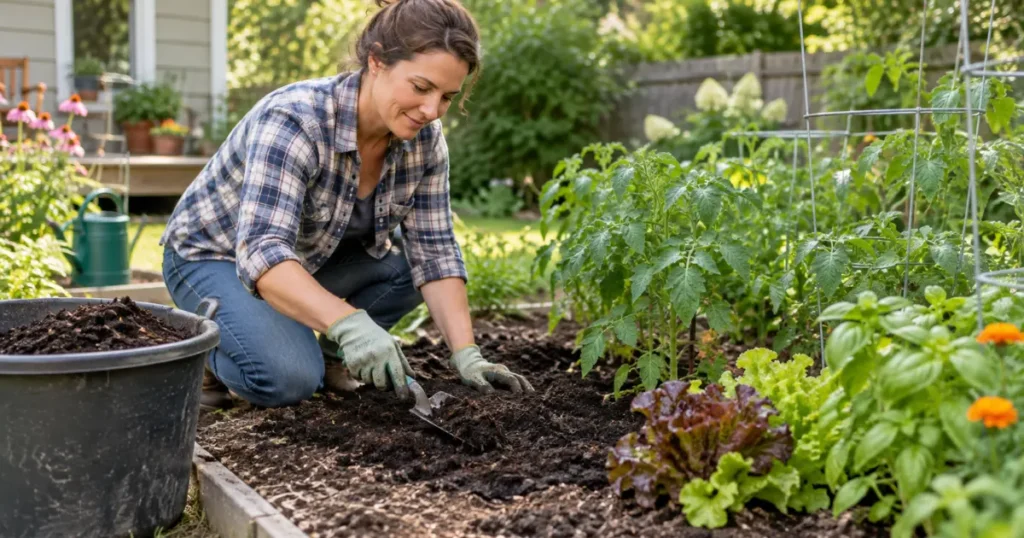
If you have a batch of dark, crumbly compost and are wondering what to do next, the answer depends on where you want to use it. Finished compost can improve garden soil, refresh established beds, support raised-bed mixes, serve as a light top dressing around plants or on lawns, and become one component of container growing media.
The key to learning how to use compost is to treat it as a soil amendment, not as a universal replacement for soil or fertilizer. The right amount and application method depend on the compost itself, your soil, the plants you are growing, and whether you are preparing a new area or maintaining an established one.
This guide shows you how to use mature compost practically without assuming that more is always better.
Quick Summary
- Use only finished, mature compost around plants; it should be dark, crumbly, earthy-smelling, and largely broken down.
- Think of compost primarily as a soil amendment and source of organic matter, not as ordinary soil or a guaranteed complete fertilizer.
- How to use compost depends on the situation: new beds can usually accept more than established beds receiving regular applications.
- You can mix compost into soil before planting or use smaller amounts as a surface top dressing around established plants.
- Do not fill raised beds or containers with pure compost as a universal practice; both need suitable growing media with appropriate physical structure.
- Keep compost away from direct contact with stems, crowns, and tree trunks when applying it around existing plants.
- Start conservatively when compost quality, nutrient content, or salt level is uncertain.
Table of Contents
ToggleBefore You Use Compost: Make Sure It Is Finished
Before learning how to use compost around plants, make sure the material is fully mature and ready for use. Finished compost should be stable, earthy-smelling, and well decomposed before it is added to garden soil or around established plants.
What Finished Compost Should Look and Smell Like
Finished compost is generally dark brown, loose and crumbly, with an earthy smell. Most of the original food scraps and soft plant materials should no longer be recognizable, although a few stubborn pieces such as small twigs may remain.
If the material still smells rotten, strongly sour, or ammonia-like, contains obvious undecomposed food, or is still changing rapidly, give it more time rather than rushing it into a garden bed. The EPA’s guidance on composting at home describes mature home compost as dark, loose, crumbly, and fresh-soil-like in smell.
For the complete beginner process of making and recognizing finished compost, see our beginner composting guide.
What Can You Use Compost For?
New Garden Beds
Incorporate finished compost into soil before planting when additional organic matter would benefit the bed.
Existing Garden Beds
Apply a lighter surface layer or incorporate modest amounts during routine bed preparation.
Vegetable Gardens
Use compost before planting and, where appropriate, as a light top dressing around established crops.
Raised Beds
Blend compost with soil or a suitable raised-bed mix rather than filling the bed entirely with compost.
Containers
Use compost as one component of an appropriate container mix rather than automatically using it alone.
Lawns
A thin, even top dressing of screened finished compost can be used on established turf.
How Much Compost Should You Use?
There is no single compost-to-soil ratio that works for every garden. How much compost to add depends on whether the area is new or established, the condition of the soil, the type and quality of compost, previous applications, and what you plan to grow.
For new garden or landscape beds, authoritative Extension guidance often allows a deeper one-time incorporation than would be sensible as an annual maintenance application. Oregon State University Extension’s compost-use guidance, for example, recommends a 3–4 inch layer for new vegetable beds incorporated into the top 8–12 inches of soil, while existing vegetable beds receive a much lighter annual layer of about ¼–1 inch.
Those numbers are useful examples, not universal prescriptions for every soil or compost. If a soil already has high organic matter or nutrient levels, or the compost is nutrient-rich or salty, less may be appropriate.
Why More Compost Is Not Always Better
Compost adds organic matter and can contribute nutrients, but repeated heavy applications can create problems. Some composts, particularly certain manure-based products, can contain relatively high nutrient levels or soluble salts. University of Maryland Extension’s guide to choosing compost emphasizes that compost characteristics differ according to source material and intended use.
The practical lesson in how to use compost is simple: treat compost as an amendment with properties of its own, not as harmless filler that can be added without limit.
If you use purchased compost, read the product information when available. If you apply compost regularly to a vegetable garden or other intensively managed soil, periodic soil testing can help you avoid repeatedly adding nutrients the soil does not need.
Start With the Garden Situation, Not One Universal Ratio
A new bed in poor mineral soil, an established vegetable plot that has received compost for years, a raised bed, and a patio container are different growing environments. They should not receive the same formula automatically.
When you are unsure how to use compost from an unfamiliar source, begin conservatively. You can add more organic matter later; correcting an excessive application is more difficult.
How to Add Compost to Garden Soil
The two main approaches are to incorporate compost into soil or leave it near the surface as a top dressing. Both can be useful, but they suit different situations.
Adding Compost to a New Garden Bed
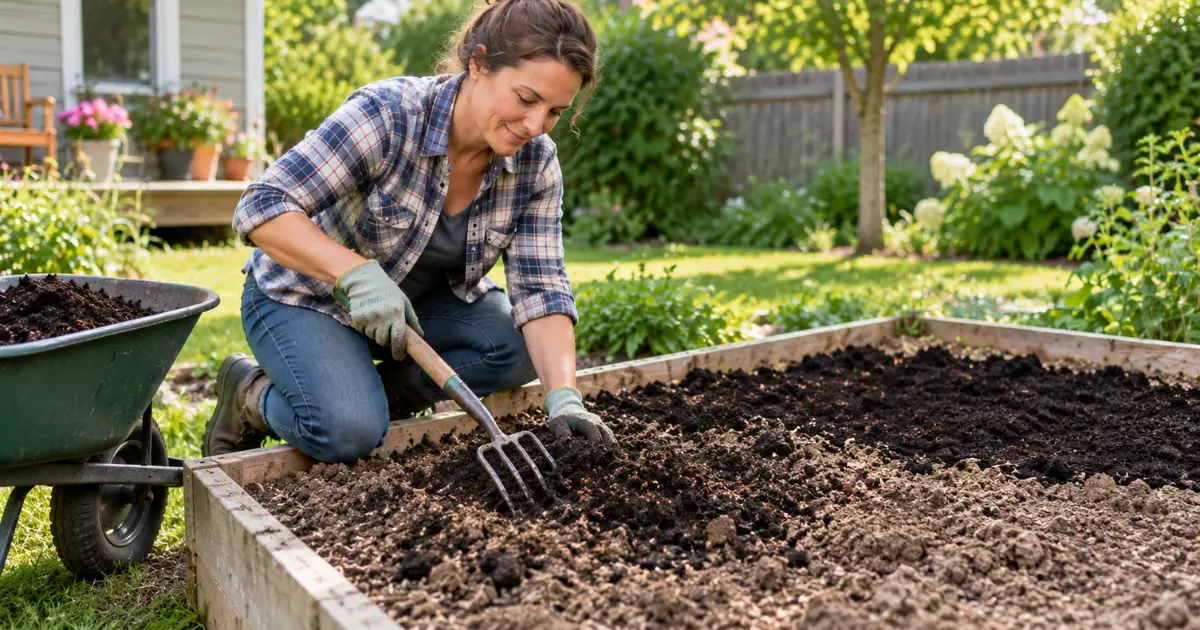
Before planting a new bed, compost can be incorporated into the upper part of the existing soil to improve organic matter and soil condition. This is one of the situations where a more substantial initial application may be appropriate.
Oregon State University Extension’s garden-compost recommendations advise 3–4 inches of compost for new vegetable beds, worked into the top 8–12 inches. For new landscape planting areas, its guidance similarly recommends incorporating compost into the existing soil rather than creating a separate pure-compost layer.
Avoid digging when soil is saturated, because working very wet soil can damage its structure. Also remember that compost cannot correct every site problem. Poor drainage, contaminated soil, severe compaction, or unsuitable plant choice may require solutions beyond adding organic matter.
If you are preparing your first garden bed as part of a larger garden-starting project, our beginner garden guide can help you plan the process from the beginning.
Adding Compost to an Existing Garden Bed
Established beds generally need less compost than new soil being amended for the first time. A light surface application can replenish organic matter without repeatedly loading the bed with large quantities.
University of Maryland Extension’s organic-matter guidance notes that about 1 inch of compost per year can help maintain productivity in flower and vegetable beds, while Oregon State gives a range of roughly ¼–1 inch annually for existing vegetable beds. These recommendations illustrate why how to use compost changes between initial soil improvement and ongoing maintenance.
If you know the bed has received generous compost applications for several years, do not assume another heavy layer is automatically beneficial. Consider soil condition, plant performance, the compost source, and soil-test results where appropriate.
Mixing Compost Into Soil vs Leaving It on the Surface
Mixing compost into soil is most useful when you are preparing a new bed or otherwise working the soil before planting. Incorporation distributes organic matter through the future root zone.
Surface application is often more practical around established plants because digging deeply can damage roots. Compost placed on the surface can gradually interact with the upper soil as organisms, rainfall, irrigation, and normal soil processes move organic matter and nutrients downward.
If you are learning how to use compost around established plantings, surface application is often the gentler starting point. Keep the material away from direct contact with stems, crowns, and trunks.
How to Use Compost in a Vegetable Garden
Vegetable gardens are one of the most common places gardeners want to use finished compost, but the application should still match the bed’s history and soil condition.
Before Planting
For a new vegetable bed, incorporate finished compost into the soil before planting rather than planting vegetables into a bed of pure compost. Oregon State’s guidance of 3–4 inches incorporated into the upper 8–12 inches is an example for new beds, not an annual requirement for every garden.
For an established vegetable plot, a lighter maintenance application is usually more appropriate. If the soil has been heavily amended for years, soil testing becomes increasingly useful because compost can contribute nutrients as well as organic matter.
For a practical example of preparing soil for a specific edible crop, see our beginner’s guide on how to grow garlic, which covers soil preparation, planting cloves, and caring for the crop through harvest.
If you’re preparing a bed for herbs, our beginner-friendly guide on how to grow cilantro explains how to assess soil conditions, sow seeds directly, and maintain suitable moisture for healthy leafy growth.
This is an important part of how to use compost responsibly: the goal is healthy soil, not the greatest possible volume of compost.
Around Established Vegetable Plants
During the growing season, finished compost can be applied in a modest layer around established vegetables as a top dressing when the soil would benefit from additional organic matter.
Spread it over the soil rather than burying plant stems or crowns. Leave a little clear space immediately around stems, especially where constant moisture against the plant base could create problems.
Do not assume the compost supplies every nutrient a demanding vegetable crop needs. Compost nutrient content varies, and some garden soils may still require fertilizer based on crop needs and soil-test information. Oregon State also notes that compost generally has lower fertilizer value than concentrated fertilizers and that some crops may still require additional nutrients.
How to Use Compost in Raised Beds
Raised beds make it easy to see why compost should be treated as one component of a growing medium rather than the entire medium.
Adding Compost to a New Raised Bed
Do not fill a new raised bed entirely with pure compost as a general recommendation. Raised beds need a growing medium with suitable physical structure, drainage, aeration, and a mineral component.
Oregon State University Extension’s raised-bed compost guidance recommends using a soil mix and gives up to about 25% compost by volume as one approach when filling a raised bed. The exact mix should depend on the materials available, bed design, crop needs, and characteristics of the compost.
When considering how to use compost in a new raised bed, think blend, not fill.
Refreshing an Existing Raised Bed
Existing raised beds often settle over time as organic components decompose and the mix consolidates. Finished compost can be used to replenish some organic matter and restore part of the lost volume.
Apply a modest amount, mix it into the upper layer if the bed is empty and you are preparing for planting, or use it as a surface amendment around established plants when disturbing roots would be undesirable.
Avoid automatically topping the bed with a thick layer every season. The right amount depends on what is already in the bed and how much compost has been added previously.
How to Use Compost Around Existing Plants
Finished compost can be useful around established landscape plants, but roots, stems, crowns, and trunks should be respected.
Trees and Shrubs
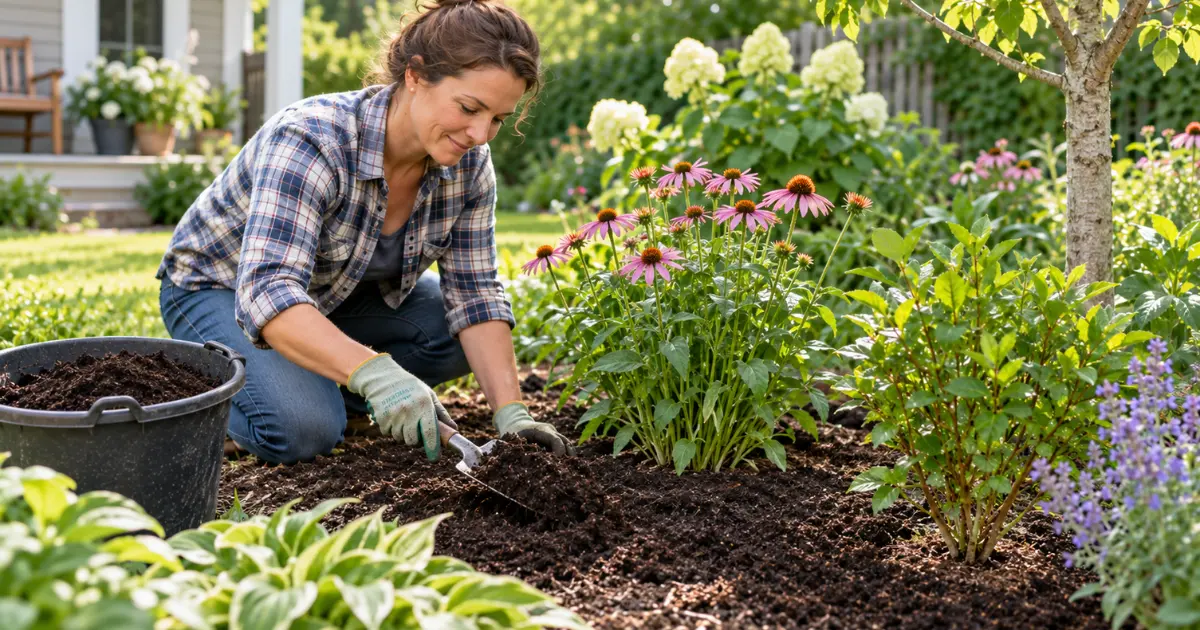
Around established trees and shrubs, spread compost over the soil surface rather than digging aggressively through established root systems. University of Maryland Extension’s organic-matter guidance recommends removing existing mulch, spreading about an inch of compost over the area, and then replacing the mulch when improving soil around established trees, shrubs, and herbaceous perennials.
Keep compost away from direct contact with the trunk or main stems. Do not mound it into a “volcano” around a tree.
This surface approach is a practical example of how to use compost without unnecessarily disturbing roots.
Flowers and Perennials
Flower and perennial beds can also receive a light top dressing of finished compost. Work around plant crowns rather than burying them. For hostas specifically, our hosta care guide explains how soil, organic matter, moisture, mulch, and feeding work together to support healthy plants.
Where the bed is empty between growing seasons and shallow incorporation can be done without damaging roots, some gardeners mix compost lightly into the upper soil. In an established perennial planting, however, surface application is usually less disruptive.
Can You Use Compost in Containers?
Yes, but finished compost should generally be treated as a component of container growing media rather than automatically used as the entire potting medium.
Container roots depend on an appropriate balance of water retention, drainage, and air space. Pure compost can vary widely in texture, salinity, nutrient concentration, and water-holding behavior, so a material that works well as a garden amendment may not provide the physical properties needed in a pot by itself.
If you want to use compost in containers, blend an appropriate amount into a quality container mix suitable for the plants you are growing. Avoid one universal compost percentage for every container because compost products and plant requirements vary.
For a practical example of container growing, our guide to starting an indoor herb garden explains how to choose suitable potting mix, provide proper drainage, and care for herbs grown in pots inside your home.
University of Maryland Extension’s compost-selection guidance notes that compost quality and nutrient content depend on source materials, and that some composts can contain relatively high soluble salts or nutrient concentrations.
For container gardening, how to use compost well is less about maximizing the amount and more about maintaining a suitable root environment.
For an edible-crop example, our guide to growing potatoes in containers explains how to choose a suitable growing medium, use compost appropriately, and manage drainage and watering in pots or grow bags.
How to Use Compost on a Lawn
Fine, finished compost can be used as a top dressing on an established lawn when the goal is to add organic matter at the soil surface.
Top-Dressing an Existing Lawn
The key is a thin, even layer that settles between grass blades rather than smothering them. Oregon State University Extension’s lawn top-dressing guidance recommends approximately ¼–½ inch of compost for an existing lawn as part of its lawn-renovation approach.
Use screened or fine-textured finished compost so large chunks do not sit on the turf. Spread it evenly with a shovel and rake or appropriate top-dressing equipment, and avoid leaving thick piles in individual spots.
Lawn needs differ by climate, grass species, soil, irrigation, and management, so this section is not a complete lawn-care prescription. It is simply the lawn-specific application of how to use compost.
When Is the Best Time to Add Compost?
There is no single season when every gardener must apply compost. Timing depends on what you are doing, local climate, soil conditions, and whether plants are already growing.
University of Maryland Extension’s soil-amendment guidance notes that compost can be added at any time of year and can also be used as a top dressing during the growing season. The practical timing question is therefore not “What month is mandatory?” but “When can I apply it appropriately for this garden task?”
Before Planting
Before planting is a convenient time to mix compost into a new bed because the soil is already being prepared and roots are not yet occupying the area.
Plant-specific needs still matter—for example, see our guide on how to plant lavender before adding compost or other amendments to a lavender planting site.
This is often the simplest time to make a deeper initial amendment where one is genuinely needed.
During the Growing Season
Finished compost can be applied as a light surface top dressing around established plants during the growing season. Keep it away from stems and crowns and avoid burying low-growing foliage.
Watering or rainfall can help settle a fine surface application, but do not add compost simply because a calendar date has arrived. Apply it because the bed or management plan calls for it.
After the Growing Season
In climates and gardens where fall or post-harvest bed preparation is practical, compost can also be added after crops are removed or plants become dormant.
Whether you incorporate it or leave it at the surface depends on the bed, soil-management approach, erosion risk, and what will be planted next. Local conditions matter more than a universal seasonal rule.
Common Mistakes When Using Compost
- Using unfinished compost
Unfinished material can continue decomposing after application and may behave very differently from mature compost. Make sure the material is ready before using it around plants. - Assuming more compost is always better
Heavy repeated applications can add more nutrients or salts than a soil needs. Match the amount to the site and compost rather than treating it as harmless bulk material. - Treating compost as a universal replacement for soil
Compost is principally a soil amendment. Raised beds, garden beds, and containers still need appropriate growing media and physical structure. - Assuming compost automatically replaces all fertilizer needs
Compost nutrient content varies. Some composts contribute meaningful nutrients, while others are relatively low in fertilizer value. Plant needs and soil-test results still matter. - Applying excessive amounts year after year
Even a sensible one-time application can become excessive if repeated without considering previous additions. Keep track of how the bed has been managed. - Piling compost against trunks, stems, or crowns
Leave breathing room around plant bases. Constantly moist organic material held against stems or trunks can create undesirable conditions. - Ignoring compost quality and source
Yard-waste compost, food-waste compost, composted manure, and other products can differ in nutrient content, soluble salts, texture, maturity, and contaminants. Choose material suited to the intended use. - Using an unsuitable container mixture
Do not assume a compost that performs well in garden soil is suitable as a stand-alone potting medium. Container roots need adequate drainage, aeration, and structure.
Avoiding these mistakes is part of learning how to use compost as a gardening input rather than as a one-size-fits-all solution.
Frequently Asked Questions About Using Compost
Can I plant directly into compost?
Not as a general recommendation. Most garden plants are better grown in suitable soil or growing media with compost used as an amendment. Pure compost can vary in nutrient concentration, salinity, water retention, and physical structure.
Should I mix compost with soil?
Sometimes. When preparing a new garden bed, mixing finished compost into the upper soil can distribute organic matter through the future root zone. Around established plants, surface application is often less disruptive because digging can damage roots.
Can I put compost on top of soil?
Yes. Surface top dressing is a common way to use finished compost in existing beds and around established plants. Apply an appropriate amount and keep it away from direct contact with stems, crowns, and tree trunks.
How much compost should I add to my garden?
The amount depends on the garden situation, compost, soil, and history of previous applications. New beds may justify a larger initial incorporation, while established beds generally need lighter maintenance applications. Avoid one universal ratio for every garden.
How often should I add compost to my garden?
There is no rigid schedule that suits every soil. Some Extension guidance describes annual light applications for established beds, but whether you need compost each year depends on your soil, previous additions, crops, and compost characteristics. If you apply nutrient-rich compost regularly, soil testing can help guide future decisions.
Can I add compost around existing plants?
Yes. A light surface application around many established plants can add organic matter without disturbing roots. Keep the compost away from direct contact with stems, crowns, and trunks.
Can compost be used as fertilizer?
Compost can contribute plant nutrients, but it should not automatically be treated as a complete fertilizer. Nutrient levels vary widely with the source materials and composting process, and some plants may still need additional nutrients based on soil conditions and their growth requirements.
The most reliable way to understand how to use compost is to separate its role as an organic soil amendment from the separate question of whether your plants need additional fertilizer.
Put Your Finished Compost to Work
Once your compost is mature, using it well is mainly a matter of matching the application to the garden situation.
Use larger, well-qualified amendments when preparing soil that genuinely needs improvement. Use lighter applications for established beds. Blend compost into raised-bed or container media rather than assuming it should replace the entire medium. Apply it carefully around existing plants and keep it away from trunks, stems, and crowns.
Most importantly, remember that how to use compost is not about adding as much as possible. It is about using a valuable soil amendment where it can help, in an amount that makes sense for your soil, plants, and compost source.


