
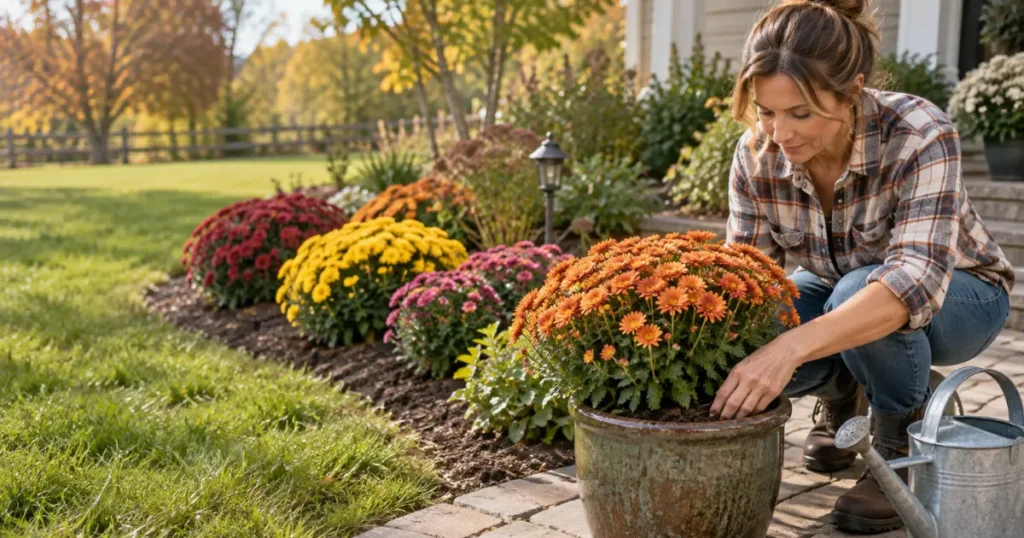
How often to water mums – gardener checking soil moisture in a potted mum beside garden-bed mums

How Often to Water Mums: Avoid These Common Watering Mistakes

There is no single watering schedule that works for every mum. If you’re wondering how often to water mums, the better approach is to check the moisture where the roots are growing and water according to what you find.

A mum in a container can lose moisture differently from one established in garden soil. Weather, drainage, container size, growing medium, and whether the plant was recently planted can also change how quickly the root zone dries.

The practical rule is straightforward: check moisture first, water thoroughly when needed, and then let excess water drain away. Avoid watering automatically just because a certain number of days has passed.

This guide focuses specifically on watering—how to judge when mums need it, how container and in-ground plants differ, and why newly planted mums deserve closer attention while their roots establish.

Quick Summary

  • There is no universal daily or weekly watering schedule for mums.
  • When deciding how often to water mums, check actual root-zone or potting-mix moisture rather than relying only on the calendar.
  • Potted mums can dry differently from mums growing directly in garden soil, so check containers regularly.
  • When a mum needs water, water thoroughly rather than repeatedly giving only a small splash.
  • Containers need effective drainage so excess water can escape after watering.
  • Established garden mums benefit from consistent moisture, but consistently moist does not mean permanently saturated.
  • Recently planted mums need closer attention because the original nursery root ball can dry differently from the surrounding garden soil.
  • Heat, rain, wind, and other conditions can change how quickly moisture is lost, so checking frequency should change with the weather.

How Often Should You Water Mums?

There is no reliable rule such as “water every day” or “water once a week” that works for mums in every US garden.

The most useful answer to how often to water mums is to base the decision on actual moisture in the root zone. Water when conditions indicate that the plant needs it, then check again as the soil or potting mix begins to dry.

Where the plant is growing makes a major difference.

A mum in a container has a limited volume of growing medium, and that medium can lose moisture relatively quickly under some conditions. A mum established in garden soil has access to a much larger root zone, and the surrounding soil may hold moisture differently.

Weather also matters. Warm, dry, or windy conditions can increase moisture loss, while rainfall or cooler conditions may allow the root zone to stay moist longer. Recently planted mums require additional attention because their roots are still concentrated largely within the original nursery root ball.

This is why a calendar alone is a poor watering tool.

Instead, think of watering frequency as something that changes with the plant’s actual growing conditions. Check moisture where the roots are, then make the watering decision from there.

The detailed recommendations for containers and garden beds differ, but the principle is the same in both situations: observe first and water in response to actual need rather than habit.

How to Tell When Mums Need Water

Before reaching for the watering can or hose, check the moisture around the roots.

For a potted mum, that means checking the potting mix rather than judging the plant only by how the surface looks from a distance. For an established mum in the ground, check the soil in the plant’s actual root zone.

The goal is to answer a simple question:

Is the root zone beginning to dry enough that watering is appropriate, or is it still adequately moist?

This matters because the appearance of the plant does not always provide a reliable diagnosis on its own.

Wilting, for example, can occur when a plant is genuinely short of water, but visible wilting does not automatically prove that the soil is dry. Heat and other stresses can affect how a plant looks even when moisture is still present around the roots.

That makes this sequence more reliable:

observe the plant → check the moisture → consider the conditions → decide whether to water

If the root zone is still adequately moist, adding more water simply because the leaves look different can create unnecessarily wet conditions.

Likewise, avoid diagnosing a watering problem from leaf color alone. Yellowing, browning, or declining foliage can have multiple possible causes, so those symptoms should not automatically trigger extra watering or withholding water.

For beginners, the most useful habit is regular observation. Learn how the potting mix or soil feels as it changes from freshly watered to progressively drier conditions.

You do not need an exact universal finger-depth measurement. The relevant depth and moisture pattern vary with the plant, root system, container, soil, and growing environment.

The important point is to check where the roots actually are rather than relying only on the calendar or one visible symptom.

How Often to Water Mums in Pots

Container-grown mums deserve regular moisture checks because a pot creates a much smaller and more changeable root environment than a garden bed.

However, it is important to distinguish between general outdoor container mums and the specific potted flowering mums often sold by florists, supermarkets, and garden retailers.
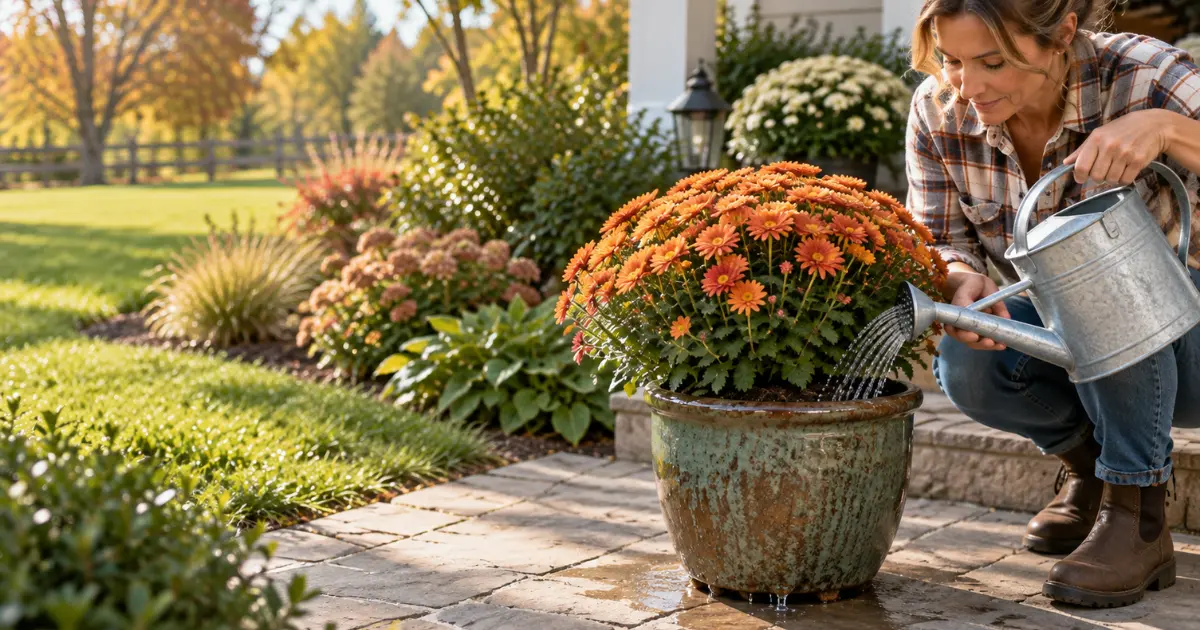
Gardener watering a potted mum thoroughly as excess water drains from the container

For potted flowering mums, Iowa State University Extension recommends checking the soil moisture frequently. When the soil surface becomes dry to the touch, its guidance is to water until water begins to flow from the bottom of the pot.

That gives beginners a useful practical sequence:

check → water when needed → water thoroughly → allow excess water to drain

It should not, however, be turned into a claim that every outdoor garden mum in every container must be watered according to exactly the same trigger.

Outdoor containers can dry at different rates depending on factors such as:

  • container size and material;
  • the amount of potting medium;
  • the size of the plant and root system;
  • sun and wind exposure;
  • temperature;
  • rainfall;
  • the properties of the growing medium.

A large container in a sheltered location may retain moisture differently from a smaller pot exposed to warm sun and wind.

When watering is needed, apply enough water to moisten the root zone thoroughly rather than giving the plant repeated small surface splashes. Make sure excess water has somewhere to escape.

If the nursery pot has been placed inside a decorative cover or outer container, do not allow drained water to leave the root ball sitting in a reservoir of water. Iowa State’s guidance specifically recommends removing the inner pot from a decorative cover for watering and returning it afterward.

The central lesson is not “potted mums need water every X days.”

It is that their limited root-zone volume makes regular checking especially important. Watering frequency follows the moisture conditions you find.

How Often to Water Mums in the Ground

Established garden mums also benefit from consistent moisture, but they should not be managed as though they were simply larger versions of container plants.

Roots growing in garden soil occupy a different environment. The soil volume is much larger, and moisture movement depends on soil texture, drainage, rainfall, surrounding vegetation, and weather.

Iowa State University Extension’s guidance on garden chrysanthemums describes mums as preferring moist, well-drained soil and a consistent supply of moisture through the growing season. Its regional guidance advises watering during prolonged dry periods when the soil is dry.

That principle transfers more safely across the United States than one fixed number of days:

check the soil and water during dry conditions when the root zone needs moisture.

Do not interpret “consistent moisture” as continuously saturated ground. Iowa State specifically recommends well-drained soil and advises avoiding wet, poorly drained sites.

Rainfall should be judged by whether it actually moistens the relevant root zone. After rain, check the soil before deciding whether additional watering is needed, while substantial rainfall may keep soil moist long enough that additional irrigation is unnecessary.

Likewise, established plants can behave differently from newly planted mums because their roots have had more time to extend into the surrounding soil.

The practical approach is therefore to monitor the root zone during dry weather, water when the soil conditions justify it, and allow drainage rather than maintaining permanently wet ground.

Newly Planted Mums Need Closer Moisture Checks

A newly planted mum deserves closer monitoring because its roots have not yet spread widely into the surrounding garden soil.
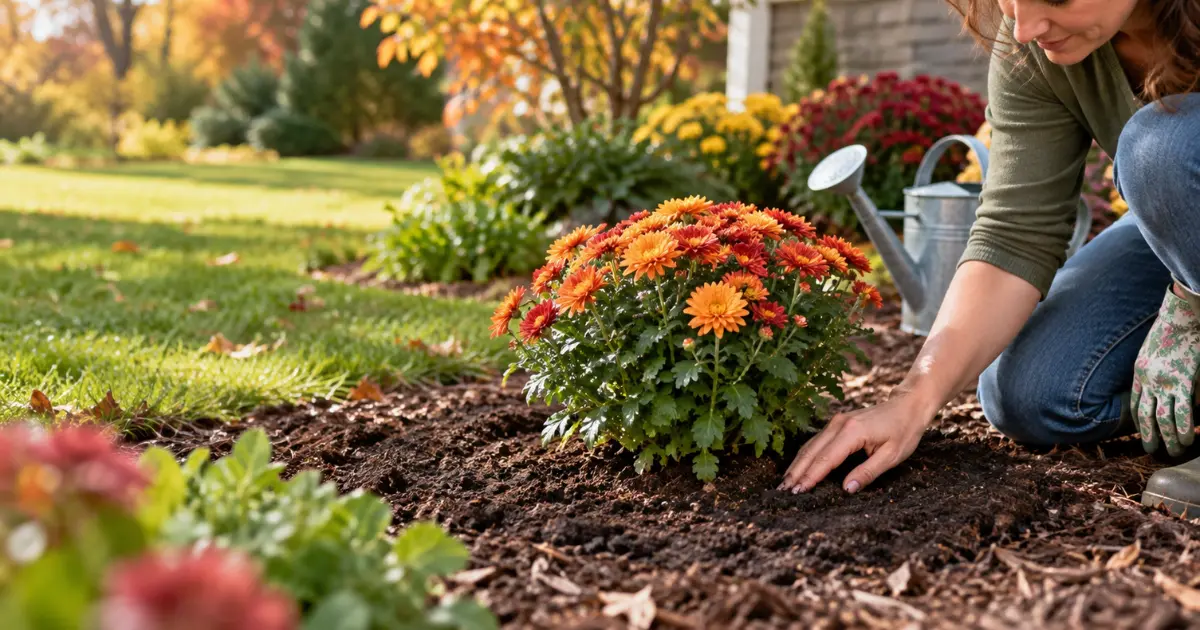
Gardener checking soil moisture around the root zone of a newly planted mum

One particularly important detail is easy to miss: the original nursery root ball may not hold moisture exactly like the soil around it.

Illinois Extension’s guidance on chrysanthemums notes that the growing medium around a recently planted container-grown mum’s original roots can dry faster than the surrounding garden soil.

That means checking soil several inches away from the plant can give a misleading impression.

The surrounding garden soil may still feel moist while the original root ball—the area containing most of the plant’s roots immediately after planting—is becoming dry.

After planting a container-grown mum, check moisture in the original root-ball area, rather than judging only by soil farther away.

As roots begin to grow into the surrounding ground, the plant gradually becomes less dependent on that concentrated nursery root zone. Until then, closer observation helps prevent the root ball from drying excessively while also avoiding unnecessary watering when it is already moist.

This is an establishment issue, not a reason to keep the planting area constantly wet. The same basic principle still applies: check the moisture where the roots actually are, then water according to what you find.

How Weather Changes How Often Mums Need Water

Weather changes how quickly moisture leaves the root zone, which means the time between waterings can change even when the plant itself has not.

During hot, dry conditions, moisture can be lost more quickly from both containers and garden soil. Wind can increase drying as well, particularly for exposed pots. In these conditions, the useful response is to check moisture more frequently.

That does not automatically mean watering more frequently.

If the root zone is still adequately moist, adding more water is unnecessary even during warm weather. The moisture check still comes first.

Rainfall works the same way in reverse. A meaningful rain may reduce the need for irrigation, while a brief shower may wet only the surface and leave the deeper root zone relatively dry. Judge rain by the moisture it actually provides rather than assuming any rainfall means watering can be skipped.

Cooler conditions can also slow moisture loss, allowing soil or potting mix to remain moist longer between waterings.

Containers deserve particular attention because a limited volume of potting medium can respond quickly to changes in heat, wind, and exposure. An exposed pot may dry noticeably faster than the same-sized container in more sheltered conditions.

The practical adjustment is therefore simple:

  • hotter, drier, or windier conditions → check sooner;
  • substantial rainfall or cooler conditions → the root zone may stay moist longer;
  • water only after checking confirms that moisture is actually needed.

This keeps watering responsive to the plant’s conditions rather than turning the weather forecast into another rigid schedule.

How Much Water Do Mums Need?

There is no useful universal answer in cups, ounces, gallons, or a fixed number of minutes with a hose.

The amount needed during a watering depends on factors such as:

  • the size of the plant and its root system;
  • container size;
  • potting medium or garden soil;
  • drainage;
  • recent rainfall;
  • weather;
  • whether the mum is newly planted or established.

For potted mums, it is generally more useful to think in terms of thorough watering than a predetermined volume.

When watering is needed, apply enough water to moisten the root ball properly and allow excess water to leave through the drainage holes. A large container may naturally require more water to accomplish that than a small one, which is why a fixed number of cups is not especially helpful.

For mums growing in the ground, the aim is similar: provide enough water to moisten the relevant root zone rather than merely wetting the soil surface.

At the same time, adequate watering does not mean keeping the ground continuously saturated.

The better question is not:

“Exactly how much water should I pour on this mum?”

It is:

“Have I moistened the active root zone adequately without leaving it persistently waterlogged?”

That approach adapts naturally to different plant sizes, soils, containers, and weather conditions without pretending that one quantity fits every garden.

How to Water Mums Effectively

A simple watering routine works better than repeatedly guessing at frequency or volume.

1. Check the moisture where the roots are.
For a container, check the potting mix. For a mum in the ground, assess the actual root zone. Newly planted mums deserve special attention around the original nursery root ball.

2. Water only when the moisture check indicates it is needed.
Do not water solely because a particular number of days has passed.

3. Water thoroughly.
Apply enough water to moisten more than just the immediate soil surface. Repeated light splashes can leave much of the root zone inadequately moistened.

4. Let excess water drain.
For containers, drainage holes should allow excess water to escape. Do not leave the root ball sitting in accumulated drainage water.

5. Recheck according to conditions.
Warm, dry, or windy weather may justify checking sooner. Cooler or wetter conditions may allow moisture to remain longer.

When practical, direct water toward the soil or growing medium rather than deliberately soaking the foliage. This puts the water where roots can use it. University of Illinois Extension also notes that watering the soil rather than the foliage can reduce unnecessary leaf wetness, which is useful where foliar disease is a concern. Illinois Extension guidance on how and when to water a garden

That does not mean a few wet leaves are automatically harmful or that overhead watering is forbidden. The important priorities are adequate root-zone moisture, good drainage, and avoiding conditions that remain unnecessarily wet for long periods.

Signs You May Be Overwatering or Underwatering Mums

Visible symptoms can alert you that something is wrong, but they should not be treated as a diagnosis by themselves.

A mum may wilt because its root zone is excessively dry, but wilting can also occur during heat stress even when moisture is still present in the soil.

Leaf yellowing, browning, or general decline can also have multiple possible causes. None of those symptoms proves that the plant is receiving too much or too little water.

If your mum’s leaves are turning yellow, our guide to yellow leaves on plants explains how to examine yellowing patterns and investigate watering, drainage, nutrient issues, and other possible causes before deciding what action to take.

Use this troubleshooting sequence instead:

observe the plant → check actual moisture → consider drainage and recent conditions → adjust watering only if the evidence supports it

If the Root Zone Seems Too Dry

Check the soil or potting mix where most of the roots are located.

If it is excessively dry and the plant is showing stress, watering may be appropriate. Water thoroughly enough to moisten the root zone, then allow normal drainage.

Afterward, continue monitoring rather than immediately adopting a fixed shorter watering interval. The dry condition may have resulted from unusually hot weather, wind, a small container, or another temporary factor.

If the Root Zone Stays Too Wet

Persistently wet or poorly drained conditions point to a different problem.

If the potting mix or garden soil remains saturated for long periods, roots receive less air and plant performance can suffer. In a container, make sure excess water can leave freely rather than collecting around the root ball.

Do not confuse one thorough watering with overwatering.

Water flowing from the drainage holes of a properly drained container after watering is expected. The concern is repeated watering while the root zone is still wet or conditions that prevent excess moisture from draining away.

If the plant looks unhealthy but the soil is already wet, adding more water because the leaves appear wilted may make the situation worse.

Likewise, if the soil is dry, withholding water simply because one leaf has yellowed may miss the actual problem.

The moisture conditions around the roots provide more useful information than one symptom viewed in isolation.

Frequently Asked Questions About Watering Mums

Do Mums Need to Be Watered Every Day?

Not necessarily.

Some mums may need closer moisture checks during hot, dry weather or when growing in exposed containers, but that does not mean they automatically require water every day.

Check the actual root-zone or potting-mix moisture and consider whether the plant is in a pot or the ground, recent weather, rainfall, and drainage.

If the root zone is still appropriately moist, wait and check again later.

Morning is generally a good time to water, particularly when the watering method may wet the foliage. Water applied earlier in the day gives wet leaves more opportunity to dry as the day progresses.

However, this is a preference rather than an absolute rule.

If a mum is genuinely short of water and the root zone is dry later in the day, do not leave it severely water-stressed simply to wait for the next morning.

Check moisture first, then respond to the plant’s actual need.

Yes.

Problems can develop when the root zone remains persistently wet or poorly drained.

That is different from watering thoroughly once and allowing the excess to drain away. A properly watered container may produce drainage from the bottom without being “overwatered.”

The concern is keeping the root environment continuously saturated—for example, by watering again while the potting mix is still wet or allowing a container to sit in accumulated water.

Good drainage and moisture checking help prevent both extremes.

Conclusion

The most reliable way to decide how often to water mums is to stop treating watering as a fixed calendar task.

Check moisture where the roots actually are. When watering is needed, moisten the root zone thoroughly and let excess water drain. Then adjust how often you check according to weather, whether the mum is in a container or garden soil, and whether it is newly planted or established.

That approach is more useful than memorizing one daily or weekly schedule because the conditions controlling moisture are always changing.

If you also need guidance on sunlight, feeding, flowering, seasonal maintenance, and other aspects of growing healthy mums, see our complete guide to caring for mums.

Leave a Comment

Your email address will not be published. Required fields are marked *

Scroll to Top