
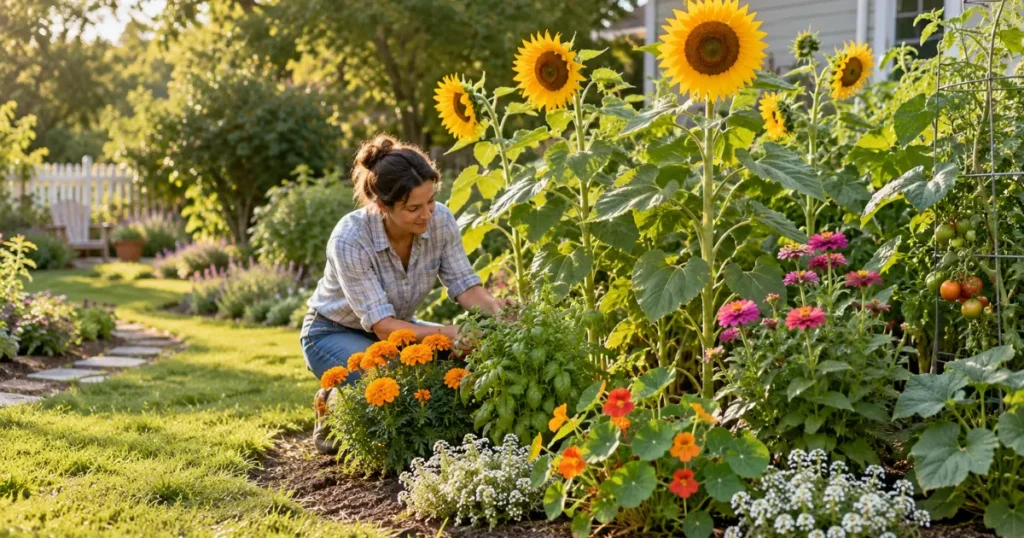
Sunflower companion plants growing together in a healthy mixed home garden

Sunflower Companion Plants: What to Grow With Sunflowers

Choosing sunflower companion plants is less about finding a supposedly perfect pairing and more about understanding how plants will actually share the garden. Sunflowers can become tall, cast substantial shade, develop extensive roots, and compete for moisture, while some sunflower tissues also have documented allelopathic potential.

That does not mean sunflowers need to grow alone. Flowers, herbs, and vegetables can share space with them successfully when their needs are compatible and you plan for mature height, sunlight, spacing, airflow, and water. This guide explains which plants can make practical companions, which pairings deserve more caution, and how to arrange them without relying on rigid companion-planting folklore.

Quick Summary

  • Good sunflower companion plants include several annual flowers, herbs, and vegetables that can share similar sunny growing conditions when given enough room.
  • Marigolds, nasturtiums, sweet alyssum, zinnias, cosmos, and some herbs can add flowering diversity without needing to be presented as scientifically proven sunflower “helpers.”
  • Tomatoes can grow near sunflowers, but positioning matters because tall sunflowers may shade tomatoes and both plants need adequate root space, water, and airflow.
  • Cucumbers, squash, and pumpkins can share the area if sprawling vines are managed and are not expected to climb unsupported sunflower stems.
  • Sunflower cultivars vary enormously in height, so plan companion placement according to the mature cultivar rather than the size of young seedlings.
  • Sunflowers have documented allelopathic potential, but this does not mean every neighboring plant will be harmed.
  • Avoid overcrowding, excessive shading, incompatible moisture needs, and concentrated accumulations of sunflower hulls or residues around sensitive plants.
  • Garden conditions and plant requirements are usually more useful guides than long internet lists of plants labeled simply “good” or “bad.”

Why Grow Companion Plants With Sunflowers?

Mixed planting can make a garden more productive, visually interesting, and useful to wildlife, but companion planting works best when the goals are realistic.

There is limited garden-scale research behind many popular companion-planting claims. University of Minnesota Extension notes that online companion charts frequently include relationships that have not been adequately tested, even though some forms of interplanting have research support.

For sunflowers, the strongest reasons to mix plants are often much simpler: use garden space efficiently, maintain flowers over a longer season, provide varied resources for visiting insects, and arrange plants of different heights without allowing one to overwhelm another.

Making Better Use of Garden Space

Sunflowers grow primarily upward, which can make the space around them available to shorter plants if spacing and sunlight are managed well.

A row or loose group of sunflowers toward the back or north side of a sunny bed, for example, may leave much of the rest of the bed available for lower-growing flowers and vegetables. In the Northern Hemisphere, positioning tall plants toward the north side can often reduce the amount of midday shade they cast over shorter sun-loving crops, although the exact pattern changes with season and site orientation.

This is a more useful form of companion planting than squeezing as many plants as possible into one bed. Efficient use of space still requires enough room for leaves, roots, airflow, and access for watering and harvesting.

Supporting Pollinators and Garden Diversity

A sunflower head is made up of many small individual flowers, and open-pollinated forms can provide pollen and nectar for visiting insects. Illinois Extension notes that sunflowers are visited by bees and other pollinators and also cautions that some cultivars bred for cut-flower production are pollenless.

Adding other flowering plants can broaden the range of flower shapes and bloom periods available in the same part of the garden. That does not mean each companion automatically improves the sunflower itself. The value may simply be a more diverse planting with flowers available before, during, or after peak sunflower bloom.

If supporting pollinators is one of your goals, check sunflower cultivar descriptions rather than assuming every modern sunflower produces abundant pollen.

If you want to take that goal further, our guide to creating a pollinator garden explains how to combine season-long blooms, suitable plants, habitat, water, and practical maintenance to support pollinators more broadly.

Sunflowers also contribute directly to garden insect diversity. The University of Illinois Extension notes that sunflowers are visited by bees, beetles, butterflies, and other pollinators, making them a useful flowering component in a diverse garden.

Using Sunflower Height and Structure Wisely

Sunflowers vary more in mature size than many gardeners realize.

University of Illinois Extension describes cultivars ranging from around 6 inches tall to more than 12 feet, with both branching and single-stem forms available. More recent Illinois Extension guidance likewise notes garden cultivars ranging from about 18 inches to 14 feet.

That difference completely changes companion planting.

A 2-foot dwarf sunflower can fit into a mixed flower border without dominating it. A 10- to 14-foot giant can cast substantial shade, use far more vertical space, and potentially need protection from strong wind.

Choose and position companions according to the sunflower you are actually growing.

Best Sunflower Companion Plants

Here, “best” means plants that can make practical sense near sunflowers under suitable conditions. It does not mean every pairing has been scientifically proven to give either plant a special biological benefit.

The following plants can be useful because of their size, flowering habit, garden role, or ability to share similar sunny beds. Whether any pairing succeeds still depends on cultivar size, spacing, soil, moisture, and climate.

Marigolds

Marigolds can work well around sunflowers because many varieties stay much shorter, prefer sunny conditions, and add color at a lower level of the planting.

Plant them toward the front or sunnier edge of a sunflower bed rather than directly behind towering cultivars. Compact marigolds are especially easy to fit between widely spaced plants without creating a dense wall of foliage.

You will often see claims that marigolds repel almost every garden pest. Those claims should not be generalized. Research has found useful effects from particular marigold combinations in certain crop and pest systems, but that does not prove that planting marigolds beside sunflowers creates universal pest protection. University of Minnesota Extension specifically warns that many traditional marigold pest claims lack consistent research support.

For this pairing, their reliable value is simpler: marigolds are manageable flowering plants that can occupy lower space in a sunny mixed bed.

If you want to raise your own plants for the bed, our guide on how to grow marigolds from seed covers sowing, germination, seedling care, hardening off, and transplanting step by step.

Nasturtiums

Nasturtiums provide a very different growth form from upright sunflowers. Depending on the type, they can trail across the soil or form relatively low mounds, making them useful around bed edges.

Their flowers also add another source of nectar and pollen in the garden.

Give them enough light, however. A nasturtium planted directly beneath the dense foliage of a tall sunflower group may stretch or flower less well if the position becomes heavily shaded.

Avoid assuming that nasturtiums automatically repel pests from sunflowers. Although research supports nasturtium use in some specific crop-pest combinations, those findings do not establish the same effect for every nearby plant.

Sweet Alyssum

Sweet alyssum is useful where you want a very low flowering layer.

Its small stature means it is unlikely to compete with sunflower stems for vertical space, and its masses of small flowers can provide resources for small beneficial insects.

It works best along an open edge where it still receives enough light. If giant sunflowers create deep shade over the planting, alyssum performance may decline.

Because alyssum spreads outward as it develops, leave enough open soil around young sunflower stems rather than packing plants tightly around every stalk.

Zinnias

Zinnias and sunflowers are a natural practical combination for a sunny flower garden.

Both are warm-season annuals, and zinnias come in a wide range of mature heights. Short cultivars can occupy the foreground, while medium-height types can create a gradual transition between low edging plants and taller sunflowers.

Their bloom periods may overlap for much of summer, providing a varied flowering display and additional floral resources.

The main challenge is spacing. Dense zinnias placed directly against branching sunflowers can reduce airflow, so leave enough room for both plants to reach their expected width.

Cosmos

Cosmos can complement sunflowers visually and horticulturally because their fine foliage contrasts with the sunflower’s coarser leaves.

Many cosmos cultivars become fairly tall themselves, so this pairing needs more room than a sunflower-and-alyssum combination. Instead of inserting cosmos between every sunflower, use loose groups where both plants can develop without becoming an intertwined mass.

In rich soil, some cosmos can produce substantial leafy growth. Consider their mature size and avoid placing them where they will crowd sunflower stems or block access through the bed.

Basil and Other Suitable Herbs

Basil can fit around moderate-sized sunflowers when both receive adequate sun and water. Its shorter growth can make it practical near the front of a mixed vegetable-and-flower bed.

Do not rely on basil as a proven sunflower pest repellent simply because basil appears on many companion charts. Research has demonstrated useful basil relationships in some crops, including particular tomato systems, but those results should not be automatically transferred to sunflowers.

Dill is another option when you have enough room. If allowed to flower, it adds a different flower form to the garden, but mature dill can become tall and airy. Give it enough space that its stems do not become tangled among dense sunflower growth.

The practical question is not “Is this herb on a companion list?” It is whether the herb can receive enough sun, water, and physical space in the position you have chosen.

Vegetables to Grow With Sunflowers

Vegetables can also share space with sunflowers, but the arrangement usually matters more than the name of the crop.

Common sunflower (Helianthus annuus) performs best in full sun, and many vegetables listed here also need strong light. North Carolina Extension describes common sunflower as a full-sun annual that prefers good drainage and can become drought tolerant after establishment.

When combining sunflowers with vegetables, avoid turning the sunflower row into a wall between the vegetable and the sun.

Tomatoes

Yes, you can plant tomatoes with sunflowers, but neither plant should be positioned without considering its mature size.

Both prefer strong light. If a row of tall sunflowers stands immediately south of tomatoes in a Northern Hemisphere garden, it may shade the tomato plants for a substantial portion of the day. That can be more important than any supposed companion effect.

Give tomatoes enough open sky, airflow, and root space. Also remember that both a large tomato plant and a tall branching sunflower can develop a substantial canopy, so a bed that looked spacious in May may become crowded by midsummer.

Moisture management matters as well. Newly establishing sunflowers and actively growing tomatoes both need access to water. If plants are packed together in a small bed, competition becomes more likely during hot or dry weather.

There is no need to classify tomatoes as either universally good or universally bad sunflower companions. With sensible placement, the two can occupy the same garden area; with poor placement, shade and crowding can become the real problem.

Cucumbers

Cucumbers can grow near sunflowers when there is adequate sunlight and room for their vines.

The easiest arrangement is usually to give cucumbers their own trellis or allow them to trail into an open area rather than depending on sunflower stalks for support.

A lightweight cucumber vine might occasionally climb another plant, but a mature vine plus fruit can become surprisingly heavy. A sunflower grown primarily for flowers or seed should not automatically be treated as structural garden hardware.

Place cucumber roots far enough from sunflower stems that watering and harvesting remain practical. If the sunflower cultivar is very tall, consider where its afternoon shadow will fall across the cucumber leaves.

Squash and Pumpkins

Squash and pumpkins require even more planning because their vines can occupy a large amount of horizontal space.

They can share a broad garden area with sunflowers, particularly when the sunflower stems occupy vertical space and the vines are intentionally directed across open ground.

The risk is crowding. Large squash leaves can cover the soil around sunflower stems, while branching sunflowers can shade the vines from above. Access for watering, inspection, and harvesting may also become difficult.

Avoid wrapping heavy pumpkin or large squash vines around sunflower stems. The fruit weight and vigorous growth make a dedicated open area or appropriate support much more reliable.

Mixed flowering can be useful for the garden’s insect community because squash and pumpkins depend on insect pollination, and a season-long sequence of flowers can provide food resources for pollinators. University of Minnesota Extension specifically recommends maintaining consistent flowering habitat around cucurbit plantings to support bumblebees and other pollinators.

Corn

Corn and sunflowers can grow in the same garden, but this is a pairing of two tall, sun-demanding plants.

Rather than expecting one to benefit the other automatically, think about the physical consequences. Both can create significant shade and need adequate root space. Dense planting can also make it difficult to move between plants.

A loose arrangement in a large garden can work. A small raised bed packed with full-sized corn and giant sunflowers is more likely to become crowded.

Position both according to mature height, and keep shorter sun-loving vegetables out of the heaviest shadow.

Beans and Peas

Beans and peas deserve more cautious advice than many companion charts provide.

You will find sources describing legumes as ideal partners because they fix nitrogen, while other gardening lists say they should never be planted near sunflowers because of allelopathy. Neither statement is a good universal rule.

Nitrogen fixation primarily supports the legume and the soil system; it should not be interpreted as beans immediately pumping fertilizer into a neighboring sunflower. Oregon State Extension notes that nitrogen from legume root nodules becomes available over time as plant material decomposes.

At the same time, sunflower allelopathy has been documented, and controlled studies show that effects differ among species, sunflower tissues, cultivars, concentrations, and experimental conditions. That does not justify assuming that every garden bean or pea planted nearby will fail.

If you want to grow them together, give the legume good light and adequate root space. Use a proper trellis for climbing beans or peas rather than relying on a sunflower stem that may bend, break, or become difficult to harvest around.

What Flowers Grow Well With Sunflowers?

Instead of building a flower bed from a fixed list, choose flowering companions according to what the sunflower will look like at maturity.

Start with height.

If you are growing a giant sunflower, shorter flowers such as alyssum, compact marigolds, or dwarf zinnias can create a lower layer, while medium-height flowers can transition between the foreground and sunflower stems.

With dwarf sunflowers, the arrangement changes completely. A tall cosmos cultivar might tower over them, so the sunflower no longer automatically belongs at the back of the bed.

Next, consider bloom timing. A mixed planting is more useful to visiting insects when something is flowering across a longer part of the growing season rather than everything opening and finishing simultaneously.

Flower form matters too. Combining the broad composite heads of sunflowers with smaller clustered flowers or different floral structures creates a more varied set of resources for visiting insects.

Finally, preserve sunlight and airflow. A beautiful combination on paper may perform poorly if every plant is crowded into the same narrow strip.

For gardeners wondering what flowers to grow with sunflowers, the practical answer is therefore broader than a list: choose flowers that fit the available light, mature height, width, bloom period, moisture conditions, and space around your particular sunflower cultivar.

If you are looking for more approachable options for your garden, our guide to easy flowers to grow for beginners covers 18 choices along with their basic light, moisture, drainage, and care needs.


What Should You Avoid Planting Near Sunflowers?

“Avoid” should not be interpreted as “this plant will certainly die if it grows next to a sunflower.”

There are two separate issues to consider.

One is evidence of chemical interference, or allelopathy. The other is ordinary garden competition caused by shade, crowding, water use, mature size, or poor airflow.

Separating those issues leads to better decisions than a long blacklist.
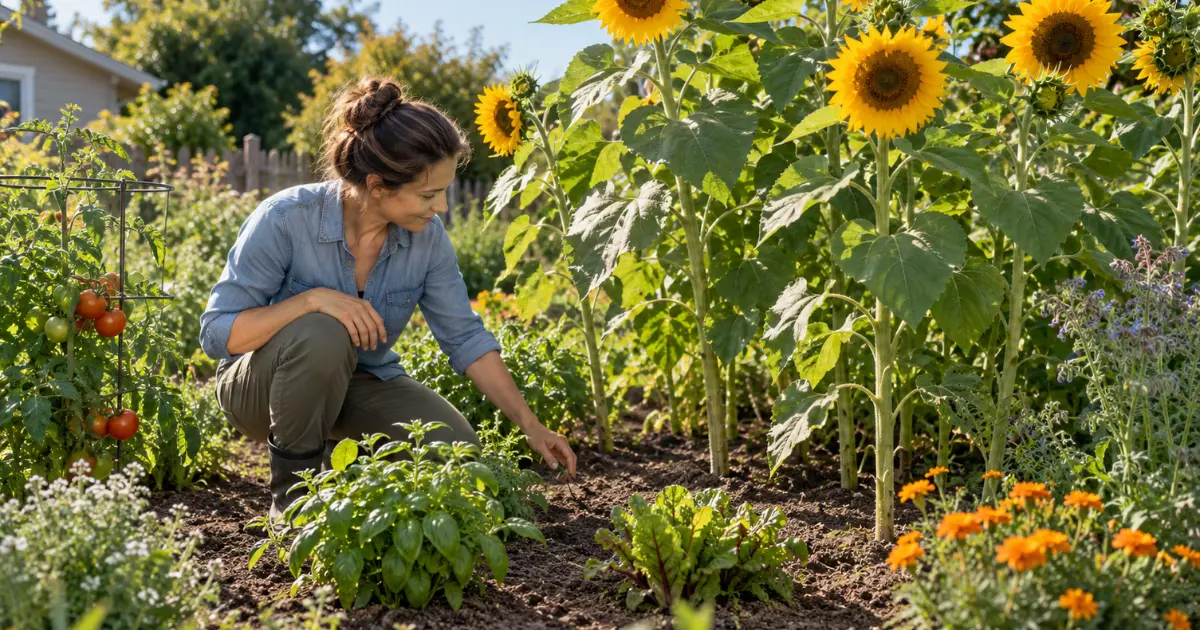
Gardener checking spacing and competition between sunflower companion plants in a mixed garden

Plants Sensitive to Sunflower Allelopathy

Sunflowers have demonstrated allelopathic activity against some plants in research settings.

Studies have found inhibited germination or growth in plants including mustard and soybean under particular experimental conditions involving sunflower extracts, residues, exudates, or close competition. Results have varied with receiving species, sunflower cultivar, concentration, and plant material.

That evidence deserves attention, but it does not establish a simple home-garden rule that mustard, soybeans, or related plants can never grow near a sunflower.

A sensible precaution is to avoid sowing sensitive small seeds into soil containing a heavy concentration of fresh sunflower residues, especially if you have previously noticed poor germination in that spot.

Accumulated sunflower hulls deserve particular attention. Illinois Extension advises clearing dropped hulls because their phytotoxic effects can suppress turfgrass and other plants beneath bird feeders or mature sunflowers.

Do not use a thick layer of sunflower hulls as casual garden mulch around plants you are trying to establish.

This concern is not simply gardening folklore. Penn State Extension identifies sunflowers (Helianthus spp.) among garden plants capable of producing allelopathic compounds, which is one reason potential plant sensitivity should be considered rather than relying on a universal companion-plant list.

Plants That May Struggle With Shade or Competition

For many home gardens, simple competition will matter more than allelopathy.

A short, full-sun vegetable placed directly behind a 10-foot sunflower row may struggle simply because it no longer receives enough light.

Likewise, combining multiple large plants in a small volume of soil can increase competition for water. This becomes particularly important during hot, dry weather or in raised beds and containers where the available root zone is limited.

Plants that require open airflow can also suffer when crowded into dense sunflower foliage.

Before deciding that two species are chemically “bad companions,” first ask whether one plant is simply shading, crowding, or outcompeting the other.

Why Long “Never Plant These” Lists Can Be Misleading

Companion planting is an area where repetition online can easily turn an uncertain observation into a supposed rule.

University of Illinois Extension notes that many companion recommendations are anecdotal and that garden-scale interactions among plants, insects, disease, soil, and growing conditions are complex.

This is especially important with sunflowers because cultivar size varies so dramatically.

A compact 18-inch sunflower in a large vegetable bed creates an entirely different environment from a dense row of 12-foot giants. Labeling another crop “incompatible with sunflowers” without acknowledging that difference can be misleading.

Are Sunflowers Allelopathic?

Yes. Sunflowers have documented allelopathic potential.

Allelopathy is the ability of one plant to release chemical compounds that influence the germination, growth, or development of other plants.

Penn State Extension includes Helianthus among plants known to produce allelopathic compounds. Peer-reviewed studies have also detected inhibitory activity from sunflower tissues, extracts, leachates, root exudates, and sunflower-grown soils.

The important word is potential.

One classic study found that sunflower leaf extracts strongly inhibited wild mustard germination at one concentration, while diluted extracts actually stimulated germination. Responses also differed among weed species and sunflower cultivars.

Other research has found growth reductions in soybean and sorghum when certain quantities of ground sunflower material were incorporated into soil or plants were exposed to sunflower exudates.

These findings show why the phenomenon should be taken seriously—but also why it should not be simplified into “sunflowers poison everything nearby.”

A laboratory extract can expose seeds to concentrations and conditions that are not identical to ordinary garden soil. Effects can vary with the sunflower cultivar, receiving plant species, plant tissue, concentration, soil, environmental conditions, and how the compounds reach neighboring plants.

For home gardeners, the most reasonable approach is caution rather than alarm. Avoid concentrating fresh sunflower residues or hulls around newly germinating plants, watch how sensitive crops perform in your own conditions, and do not assume that ordinary proximity automatically means failure.

A practical example comes from University of Illinois Extension, which explains that sunflower hulls contain growth-inhibiting compounds and recommends clearing accumulated hulls where desirable plants are growing.

How to Plant Sunflowers With Companion Plants

Planning the layout before plants reach full size prevents many of the problems blamed later on “bad companions.”

Sunflower companion plants arranged with proper spacing and sunlight in a home garden

The first thing to know is how large your sunflower cultivar is expected to become. Illinois Extension documents sunflowers ranging from very compact dwarf forms to plants exceeding 12 feet tall, so a single universal companion-planting layout would make little sense.

Consider the Direction of Sunflower Shade

Imagine the sunflower at full height, not as a 4-inch seedling.

In most Northern Hemisphere gardens, tall plants placed toward the north side of a bed are less likely to block midday sun from shorter crops positioned to the south. East and west placement can still affect morning and afternoon light.

Watch your own garden, though. Buildings, fences, trees, slope, and latitude can change the pattern substantially.

Some cooler-season crops can tolerate or even benefit from limited shade during hot periods, but most flowering and fruiting vegetables still need adequate sunlight. Do not accidentally create deep shade over a crop that requires full sun.

Leave Enough Space Between Plants

There is no useful universal spacing measurement for “a sunflower and its companions.”

A dwarf sunflower occupies a very different amount of space from a branching 8-foot cultivar or giant seed sunflower.

Use the expected mature width of each cultivar and allow the canopies to develop without becoming tightly interlocked. Crowding also makes it harder to inspect plants, harvest vegetables, and direct water toward the soil.

Think of spacing as a three-dimensional problem: width at ground level, canopy width, and height all matter.

Consider Water and Root Competition

Sunflowers may tolerate some dryness once established, but young plants and actively growing large specimens still need access to moisture.

Companion plants have their own requirements.

A moisture-loving vegetable placed beside a large sunflower in rapidly draining soil may need closer attention during hot weather. Conversely, repeatedly saturating poorly drained soil to satisfy one plant can create unsuitable root conditions for another.

Check the soil rather than watering every plant on a rigid calendar. Mulch can help moderate evaporation where appropriate, but keep the stems and crowns of garden plants from being buried under excessive material.

Keep Good Airflow Around Dense Plantings

Mixed gardens can become much denser in midsummer than they appear at planting time.

Branching sunflowers, tomatoes, squash, cosmos, and other vigorous plants can collectively create a large amount of foliage.

Avoid filling every opening between young plants. Reasonable airflow makes plants easier to maintain and can reduce the prolonged leaf wetness and dense humidity that favor some disease problems.

The goal is a diverse planting, not an impenetrable thicket.

Can You Grow Sunflower Companion Plants in Pots?

Yes, but container volume places a much stricter limit on companion planting.

Dwarf sunflower cultivars are usually more practical than giant types. University of Illinois Extension lists several sunflowers that remain around 1–3 feet tall and notes that some compact cultivars can be grown in containers.

Once multiple plants share a pot, they also share the same limited reservoir of root space and water.

Choose a container large and stable enough for the mature sunflower, not merely the seedling. Tall plants can become top-heavy, especially in wind.

Add companions sparingly. A compact alyssum or another modest plant may fit beside an appropriately sized sunflower in a generous container, while combining a giant sunflower, tomato, and vigorous trailing vine in the same pot is likely to create severe competition.

Container mixes also dry more quickly than garden soil, so monitor moisture closely without allowing the pot to remain waterlogged.

Common Sunflower Companion Planting Mistakes

One of the most common mistakes is planning around young plant size instead of mature size. A sunflower seedling barely taller than a tomato transplant can eventually stand many feet above it and cast a very different shadow.

Another is putting short, sun-loving plants directly where mature sunflower foliage will block much of their light. Consider direction and seasonal sun angle before planting, especially with tall cultivars.

Overcrowding is equally common. Companion planting does not mean every square inch of soil must contain another plant. Leaves, roots, and gardeners all need space.

It is also easy to overlook water competition. Several vigorous plants packed into one small bed may perform well during a wet spring and then begin competing noticeably during summer heat.

Do not assume sunflower stems are universal living trellises. Light vines may occasionally use them, but heavy cucumbers, squash, pumpkins, or vigorous beans can pull on stems and complicate harvesting. Provide proper support when a vine genuinely needs it.

Another mistake is treating every online companion list as research-backed. Some specific intercropping combinations have evidence behind them, but many traditional claims have not been tested adequately in home-garden conditions. Extension educators specifically caution gardeners against assuming long companion lists are scientifically established.

Finally, avoid both extremes with allelopathy. It is neither imaginary nor proof that nothing can grow near a sunflower. The evidence shows real chemical effects under certain conditions, while also showing that responses vary considerably.

Frequently Asked Questions About Sunflower Companion Plants

What Are the Best Companion Plants for Sunflowers?

Practical choices include marigolds, nasturtiums, sweet alyssum, zinnias, cosmos, some herbs, and several vegetables when their space, sunlight, and water requirements can be accommodated.

The best choice for your garden depends heavily on sunflower height and planting position. A companion that works beside a dwarf cultivar may receive too much shade beneath a group of giant sunflowers.

There is no scientifically defensible universal blacklist.

Be cautious with plants that will be heavily shaded or crowded, plants with very different moisture requirements, and sensitive seedlings growing in soil containing concentrated sunflower residues. Research confirms sunflower allelopathic potential, but the magnitude of the effect varies by plant species and conditions.

Yes, provided both receive adequate light, spacing, water, and airflow.

Keep tall sunflowers from casting prolonged shade over tomatoes, particularly during the part of the day when the tomato bed would otherwise receive strong sun.

You can grow cucumbers in the same garden area if sunlight and space are adequate.

Give cucumber vines their own support or room to trail rather than depending on sunflower stalks to carry the mature vine and fruit.

They can grow in the same garden, but both can become tall and compete for sunlight, water, and physical space.

Use a relatively open layout and consider how their combined height will affect shorter plants around them.

Yes, in a sufficiently large space.

Direct pumpkin vines away from sunflower stems and other crowded areas. Do not expect a sunflower to support a heavy pumpkin vine or fruit.

Yes. Research has demonstrated that sunflower tissues and compounds can inhibit germination or growth in some plant species under certain conditions.

That does not mean all plants growing near sunflowers will be harmed. Species, cultivar, concentration, residues, soil, and environmental conditions all affect the outcome.

Yes, particularly with compact sunflower cultivars and generously sized containers.

Keep the number of plants modest because all plants in the container compete for the same limited water and root volume. Giant sunflower cultivars are generally much less practical for mixed containers.

Conclusion

Successful companion planting with sunflowers depends much more on thoughtful garden design than on memorizing lists of supposed friends and enemies.

Choose sunflower companion plants that can share the available sunlight, soil, and moisture. Consider how tall and wide the sunflower will eventually become, place shorter sun-loving crops outside its heaviest shade, leave enough space for airflow and roots, and avoid forcing vigorous plants into a crowded bed.

Flowers such as marigolds, nasturtiums, alyssum, zinnias, and cosmos can fit well in many sunflower plantings, while vegetables including tomatoes, cucumbers, squash, pumpkins, corn, beans, and peas can be considered when their individual requirements are respected.

Sunflower allelopathy is real, but it should be understood rather than exaggerated. Avoid concentrated hulls and residues around sensitive young plants, observe how combinations perform in your own conditions, and let practical growing requirements guide the layout.

That approach gives you something much more useful than a rigid companion chart: a mixed garden designed around how the plants actually grow.

Leave a Comment

Your email address will not be published. Required fields are marked *

Scroll to Top