
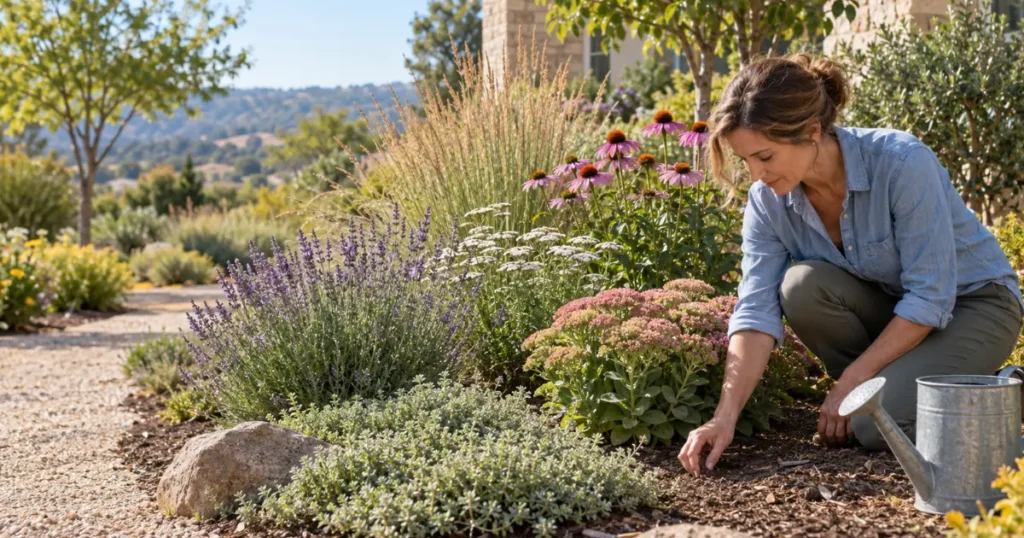
Choosing plants that cope well with dry periods can make a home landscape easier to manage where rainfall is inconsistent or supplemental watering is limited. But drought tolerant plants are not plants that can simply be planted and forgotten.
A newly planted specimen still needs appropriate moisture while its roots establish, and even mature plants differ in how much dryness they can tolerate. Climate, sunlight, soil texture, drainage, heat, exposure, and the particular species or cultivar all influence performance.
That is why plant selection matters as much as drought tolerance itself. A plant that thrives in dry, sunny soil may struggle in shade or persistently wet ground, while another may tolerate a wider range of conditions.
The 20 choices below represent different garden roles, from flowering perennials and semi-woody plants to grasses, groundcovers, and other water-wise forms. Use them as a starting point, then match each plant to the conditions in your own garden.
Quick Summary
- Drought tolerant plants still need appropriate water while becoming established and may need supplemental water during extended dry conditions.
- Drought tolerance varies by species, cultivar, climate, soil, drainage, heat, and exposure.
- Many dry-site choices perform best in sunny, well-drained locations, but not every plant on this list has identical light or soil needs.
- Good drainage is especially important for plants such as lavender, Russian sage, and other species that perform poorly in persistently wet soil.
- Check local hardiness and climate suitability before assuming a plant will perform well everywhere in the United States.
- Consider mature size and spreading habit as well as water needs when choosing a plant for a permanent garden location.
- This guide includes 20 curated choices representing different landscape roles rather than claiming that one plant is universally best.
- Matching the plant to the existing site usually produces better results than choosing by appearance or drought reputation alone.
Table of Contents
ToggleWhat Makes a Plant Drought Tolerant?
In practical home gardening, drought tolerance means a plant can withstand periods of reduced moisture better than plants that require more consistently moist conditions. It does not mean the plant needs no water.
Root establishment is a major part of the difference.
A nursery plant has a relatively small root system when it first goes into the landscape. Until those roots spread into the surrounding soil, the plant cannot draw moisture from the same volume of ground as an established specimen. Colorado State University Extension’s drought-watering guidance likewise emphasizes that newly planted material needs appropriate watering while roots become established.
This is why a plant described as drought tolerant at maturity may still require careful moisture management during its first establishment period.
Performance also depends on the environment around the roots. Soil texture, drainage, rainfall, heat, wind, reflected heat from paving or walls, and competition from nearby plants can all influence how quickly moisture becomes unavailable.
Species and cultivars differ as well. Some dry-site plants tolerate lean, rocky ground but decline in wet soil. Others cope with a broader range of moisture conditions.
The term drought resistant plants is also commonly used in gardening, but it should not be treated as a rigidly separate category unless a particular source defines it that way.
For gardeners, the useful question is not whether a plant carries a drought label. It is whether that plant’s individual needs match the site where you intend to grow it.
20 Drought Tolerant Plants for Home Gardens
The plants below represent several different landscape roles and growing conditions. They are not ranked from best to worst, and no single choice is appropriate for every US garden.
If you are looking for a broader selection beyond dry-site choices, our guide to easy flowers to grow for beginners covers approachable annuals and perennials for a wider range of garden conditions.
Compare each plant’s light, drainage, climate needs, mature habit, and important limitations with your own site before planting.
Flowering Perennials
1. Yarrow — Achillea millefolium
Plant type: Herbaceous perennial
Light: Full sun is generally best
Best fit: Sunny beds with well-drained soil
Yarrow handles dry conditions well once established and can perform in relatively lean soils where fussier flowering plants may struggle. Its flat flower clusters and finely divided foliage also add a different texture to mixed borders.
The main caution is spread. Yarrow can expand by both rhizomes and seed and may become aggressive in a garden bed if conditions suit it. That does not automatically make it an invasive species, but it does mean gardeners should give it room and monitor unwanted spread.
2. English Lavender — Lavandula angustifolia
Plant type: Woody-based perennial/subshrub
Light: Full sun
Best fit: Sunny sites with excellent drainage
English lavender is drought tolerant once established, but drainage is just as important as reduced irrigation. Persistently wet soil can cause serious problems, particularly where winters or summers are humid.
New plants still need appropriate moisture while roots establish. Hardiness also varies with cultivar and local conditions, so avoid relying on one nationwide zone range.
For practical planting guidance, see how to plant lavender and even Colorado State University Extension’s lavender guidance also emphasizes establishment and the importance of well-drained conditions.
3. Catmint — Nepeta × faassenii
Plant type: Herbaceous perennial
Light: Full sun to partial shade
Best fit: Sunny, well-drained beds and borders
This specific hybrid catmint is a dependable dry-site perennial once established. It tolerates heat and periods of limited moisture better than many plants that prefer consistently damp soil.
Good drainage remains important, and growth is usually strongest with plenty of sunlight. Depending on cultivar and conditions, plants can spread outward or develop a loose habit over time.
Use the botanical identity carefully: Nepeta × faassenii is a particular hybrid, and its behavior should not automatically be generalized to every species sold under the broad name “catmint.”
4. Blanket Flower — Gaillardia aristata
Plant type: Herbaceous perennial
Light: Full sun
Best fit: Hot, sunny locations with freely draining soil
Blanket flower is well suited to bright, relatively dry garden sites and is a useful choice where heat and leaner soils make other perennials more demanding.
That drought suitability should not be exaggerated. During prolonged drought, especially while plants are still establishing, supplemental moisture may still be necessary.
Gaillardia aristata can reseed where conditions suit it, which may be welcome in an informal border but less desirable in a tightly controlled planting. Its native distribution is regional rather than nationwide, so it should not be described simply as a US-native plant without geographic context.
5. Purple Coneflower — Echinacea purpurea
Plant type: Herbaceous perennial
Light: Full sun to partial shade
Best fit: Sunny perennial beds with reasonably well-drained soil
Purple coneflower becomes drought tolerant once established and can handle periods of dry weather without needing constantly moist soil.
It is not an extreme desert or xeric plant, however. Newly planted coneflowers still need appropriate moisture while their root systems develop, and good drainage helps prevent the root zone from remaining saturated.
Cultivars also differ in vigor and performance, so avoid assuming that every ornamental coneflower selection behaves identically to the straight species.
For beginners, it is a useful example of a perennial that becomes more resilient after successful establishment.
6. White Beardtongue — Penstemon digitalis
Plant type: Herbaceous perennial
Light: Full sun to partial shade
Best fit: Well-drained beds that may experience dry periods
White beardtongue tolerates dry soil and periods of drought once established, while still fitting into a wider range of garden conditions than some highly xeric plants.
Despite the botanical epithet digitalis, this plant is a Penstemon, not a true foxglove in the genus Digitalis. That distinction is useful because the similar naming can create unnecessary confusion for gardeners.
Give it a site with suitable drainage and enough light for good growth and flowering. Its adaptability makes it useful in mixed perennial borders where occasional dry conditions are expected.
7. Aromatic Aster — Symphyotrichum oblongifolium
Plant type: Herbaceous perennial
Light: Full sun
Best fit: Sunny, well-drained beds with relatively dry conditions
Aromatic aster is a strong choice for dry, sunny sites and can tolerate poorer soils better than plants that demand consistently rich, moist conditions.
Its suitability still depends on climate and site. It is particularly associated with central and eastern North American conditions and should not be treated as automatically appropriate in every US region.
Good drainage is important, and avoiding overly wet, crowded conditions can help reduce problems associated with poor airflow and prolonged moisture.
Its late-season flowers can add useful color without requiring the consistently moist root zone preferred by many other flowering perennials.
8. Blue False Indigo — Baptisia australis
Plant type: Herbaceous perennial
Light: Full sun to partial shade
Best fit: Permanent beds where the plant can remain undisturbed
Blue false indigo develops a deep root system that contributes to strong drought tolerance once the plant is established.
That same root structure creates its main practical limitation: mature plants can be difficult to move successfully. Choose the planting location carefully rather than assuming the plant can be relocated easily later.
It performs best where drainage is suitable and has enough room to develop its natural clumping form.
If native status is discussed, it should be geographically qualified because its natural distribution covers particular parts of eastern and central North America rather than every region of the United States.
Shrubs and Semi-Woody Plants
9. Russian Sage — Salvia yangii
Plant type: Woody-based perennial/subshrub
Light: Full sun
Best fit: Hot, sunny, well-drained sites
Russian sage is well suited to dry garden conditions once established and generally performs best where it receives abundant sun and excess water drains readily.
Wet soil, particularly combined with humid conditions, is a poorer fit than a bright, open planting site. Give the plant enough space for air movement and its mature form.
The current botanical name is Salvia yangii. Gardeners may still encounter the older name Perovskia atriplicifolia on nursery labels or in older references, but it should not be used as the primary name here.
10. Autumn Sage — Salvia greggii
Plant type: Small woody or semi-woody perennial shrub
Light: Full sun, with some local variation
Best fit: Warm, well-drained gardens where dry conditions are common
Autumn sage is a useful dry-site choice where climate and drainage suit it. Once established, it can handle periods of limited moisture and performs particularly well in sunny, freely draining conditions.
Regional suitability matters, however. The species is associated especially with the southern United States and Mexico, and different cultivars can vary in cold tolerance and overall garden performance.
For that reason, do not rely on one universal hardiness range. Check the specific cultivar and local conditions before treating autumn sage as a dependable perennial in colder climates.
11. Leadplant — Amorpha canescens
Plant type: Deciduous semi-shrub/perennial
Light: Full sun
Best fit: Sunny, well-drained prairie-style or naturalistic plantings
Leadplant develops a deep root system that helps established plants cope with dry conditions. It performs best in open, sunny sites where excess moisture can drain away rather than collecting around the roots.
This is primarily a prairie plant of central North America, so local climate and site suitability still matter. Its drought resilience should not be interpreted as nationwide adaptability. Give it a permanent location where its upright, semi-woody habit can fit naturally into the planting.
12. Creeping Juniper — Juniperus horizontalis
Plant type: Low-growing evergreen shrub
Light: Full sun
Best fit: Sunny slopes, banks, rock gardens, and other well-drained sites
Creeping juniper forms a spreading evergreen mat and becomes drought tolerant once established. Its low habit makes it useful where year-round structure is wanted without a tall shrub.
Good drainage is important; permanently wet soil is a poor fit. Mature spread also deserves attention because some selections can cover considerably more ground than gardeners expect. Allow enough room for the plant to develop without crowding paths or neighboring plants, and check the particular cultivar rather than assuming every creeping juniper grows identically.
Ornamental Grasses
13. Little Bluestem — Schizachyrium scoparium
Plant type: Warm-season ornamental grass
Light: Full sun
Best fit: Sunny, well-drained beds, meadows, and naturalistic plantings
Little bluestem is strongly drought tolerant once established and performs well in relatively lean, dry soils. Its upright summer growth and warm fall color provide structure without requiring consistently moist ground.
Rich, heavily fertilized conditions can encourage softer growth that is more likely to flop, so more fertility is not necessarily better. Although this grass is native across large areas of North America, local ecotypes and cultivars can differ, making site-appropriate selection preferable to treating every form as interchangeable.
14. Blue Grama — Bouteloua gracilis
Plant type: Warm-season grass
Light: Full sun
Best fit: Dry, sunny sites with well-drained soil
Blue grama is particularly well adapted to limited moisture and can be useful in lower-water landscapes where summer dryness is common. Its distinctive horizontal seed heads add ornamental interest without requiring lush, highly irrigated conditions.
Regional adaptation still matters. This grass is especially associated with the central and western parts of North America and should not automatically be assumed to perform equally well in humid, high-rainfall regions. It may also self-seed where conditions favor it, which is useful in some naturalistic plantings but less desirable in tightly controlled beds.
15. Switchgrass — Panicum virgatum
Plant type: Warm-season ornamental grass
Light: Full sun to light shade, depending on cultivar and site
Best fit: Landscapes needing an adaptable upright grass
Switchgrass earns a place here because established plants can withstand dry periods, but it is not an extreme xeric specialist. It tolerates a broader range of soil moisture than little bluestem or blue grama and can also grow in sites that are periodically moist.
That adaptability can be an advantage in gardens where conditions fluctuate. Cultivars differ significantly in height, color, form, and performance, so match the selection to the site rather than treating switchgrass as one uniform plant.
Groundcovers and Other Low-Water Forms
16. Autumn Joy Stonecrop — Hylotelephium (Herbstfreude Group) ‘Herbstfreude’
Plant type: Succulent perennial
Light: Full sun
Best fit: Sunny beds with excellent drainage
Autumn Joy stonecrop stores water in its fleshy foliage and becomes drought tolerant after establishment. It performs best where soil drains readily and is generally a poor match for persistently wet ground.
Gardeners may still encounter this plant sold under the older Sedum naming or simply as ‘Autumn Joy.’ The practical growing requirement is more important than the taxonomy: give it plenty of light, avoid waterlogged soil, and do not assume succulent foliage means a newly planted specimen can establish without appropriate moisture.
17. Bearberry (Kinnikinnick) — Arctostaphylos uva-ursi
Plant type: Low evergreen groundcover/shrub
Light: Full sun to partial shade
Best fit: Cool-climate sites with dry, sandy, rocky, or otherwise well-drained soil
Bearberry forms a slow-spreading evergreen mat and tolerates dry conditions well where its climate requirements are met. However, this is one of the most regionally restricted choices in the collection.
That limitation is significant. It can be an excellent groundcover in suitable cooler, well-drained locations, but it should not be treated as a universally dependable choice simply because it tolerates drought.
18. Prairie Winecups — Callirhoe involucrata
Plant type: Low-growing spreading perennial
Light: Full sun
Best fit: Sunny, dry beds, slopes, and informal borders
Prairie winecups develops a substantial taproot that helps established plants tolerate dry conditions. Its trailing stems and bright flowers work well along bed edges or where they can spread naturally without covering smaller neighbors.
Drainage matters, especially because overly wet conditions can be harder on the crown than seasonal dryness. The deep root system also makes established specimens less convenient to relocate. Prairie winecups is particularly associated with central North America, so climate and regional suitability should still be checked before planting.
19. Creeping Thyme — Thymus serpyllum
Plant type: Low-growing perennial groundcover
Light: Full sun
Best fit: Sunny, well-drained beds, rock gardens, and spaces between suitable hardscape
Thymus serpyllum tolerates dry conditions well once established and favors sites where water drains readily. Its low, spreading habit can soften edges and cover small areas without creating substantial height.
“Creeping thyme” is also used loosely in the nursery trade for other thyme species and cultivars, so check the botanical name when specific performance matters. Normal garden spreading should not automatically be described as invasiveness, and suitability can still vary with regional climate and winter conditions.
20. Eastern Prickly Pear — Opuntia humifusa
Plant type: Perennial evergreen cactus/succulent
Light: Full sun
Best fit: Very well-drained sandy, rocky, or sloping sites
Eastern prickly pear is highly tolerant of drought, heat, and dry soil and provides a distinctly different form from the herbaceous and grassy choices above. It does poorly in wet, poorly drained ground.
A handling warning is important. NC State Extension notes that Opuntia humifusa has clusters of barbed bristles called glochids, even though obvious long spines may be absent. Wear appropriate gloves and avoid casual skin contact when working around the pads.
How to Choose the Right Plants for a Dry Garden
The drought label should be only one part of the decision. The most successful drought tolerant plants are the ones whose other requirements also match the place where they will grow.
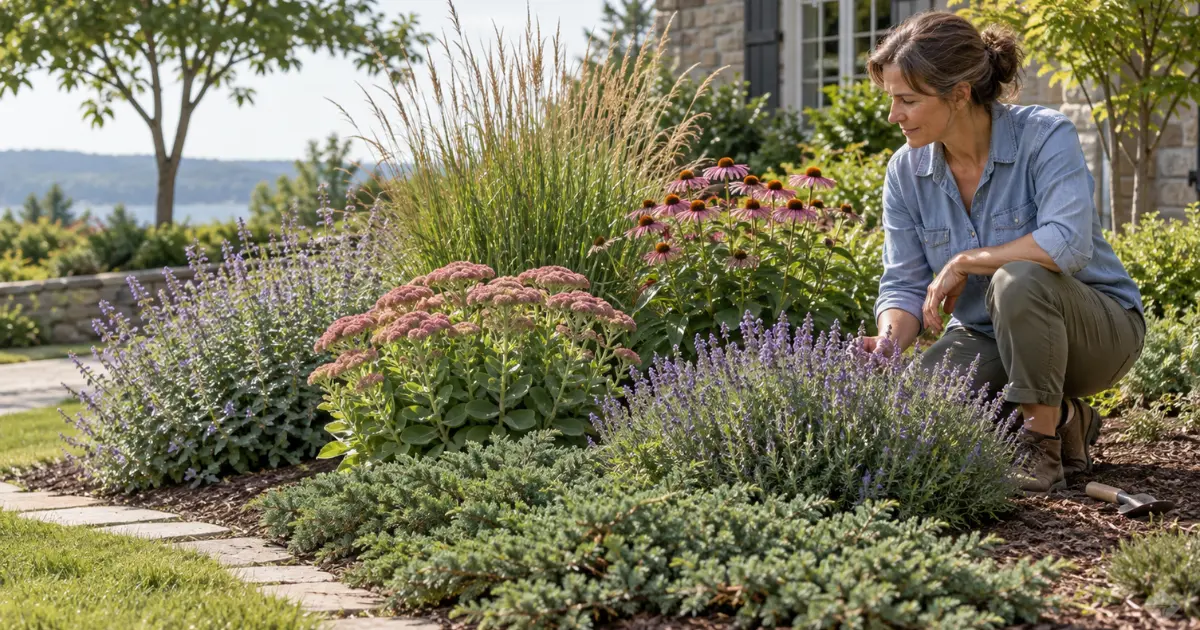
A useful selection sequence is:
Site → climate → light → soil and drainage → mature size → plant role
Start with climate. Winter cold, summer heat, humidity, rainfall patterns, and the length of the growing season can all affect whether a species performs well. A plant that excels in a dry western garden may struggle through humid eastern summers even if both locations occasionally experience drought.
Next, assess sunlight and exposure. Many plants for dry conditions prefer full sun, but drought tolerance and sun tolerance are not the same trait. Use the light requirement of the individual plant rather than assuming every lower-water choice belongs in an exposed sunny bed.
Then look closely at soil and drainage. Lavender, Russian sage, stonecrop, thyme, and prickly pear are especially poor candidates for chronically wet soil. Other plants, such as switchgrass, tolerate a wider moisture range. “Dry garden” should never become shorthand for one universal soil prescription.
Consider mature size and growth habit before planting as well. Creeping juniper can spread widely, yarrow may travel through a bed, and blue false indigo is difficult to move once established. Giving each plant appropriate space reduces future crowding and unnecessary transplanting.
Finally, decide what job the plant needs to perform. A groundcover, upright flowering perennial, structural grass, and semi-woody accent solve different design problems.
Cultivars can also differ from their parent species in size, hardiness, form, or performance. When climate suitability is uncertain, check the specific cultivar and locally relevant Extension guidance rather than relying only on a generic plant label.
Helping Dry-Site Plants Get Established
A mature plant’s ability to withstand dry periods does not mean a newly installed specimen should immediately be left without supplemental water.
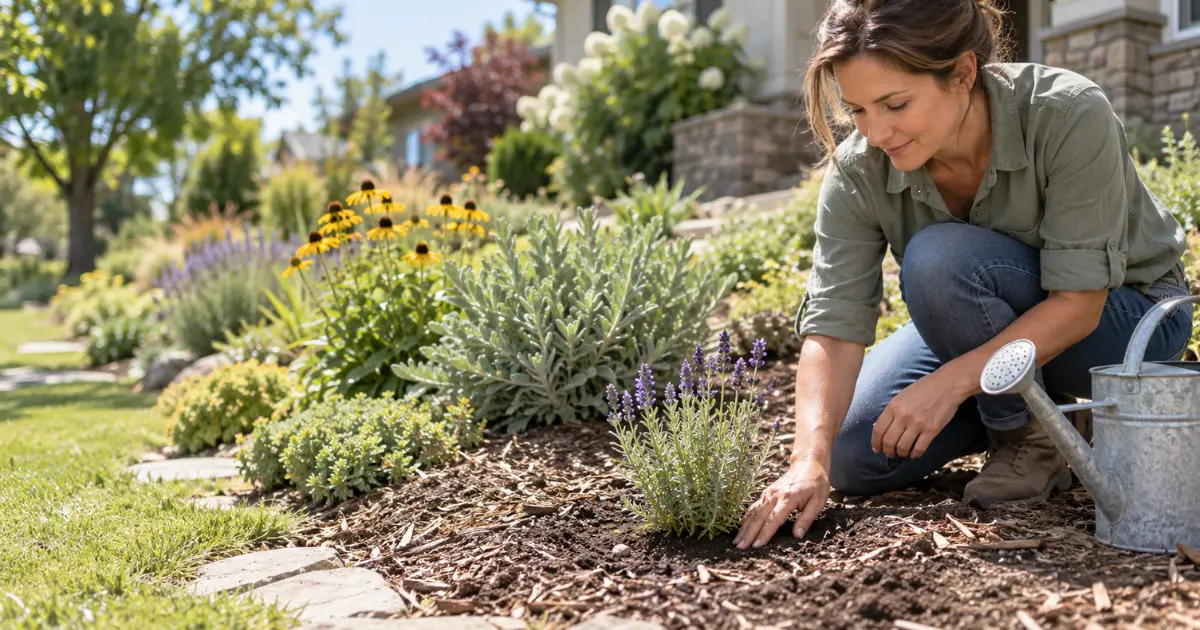
At planting time, roots are concentrated in a relatively small volume of soil or nursery growing medium. They need appropriate moisture while expanding into the surrounding ground. The length of this establishment period varies with the species, plant size, soil, season, weather, and local growing conditions.
Check the actual root-zone moisture rather than following an automatic schedule. Hot, windy conditions may dry newly planted material faster, while rainfall or moisture-retentive soil may extend the interval between irrigation.
When watering is needed, the goal is to support root establishment without keeping the soil permanently saturated. Good drainage remains important even for young plants.
A suitable layer of mulch can help moderate soil moisture and temperature in many garden settings, but keep it away from direct contact with plant crowns and woody stems rather than piling it deeply against them.
As roots spread and the plant becomes established, its mature tolerance of dry conditions can become more relevant. Until then, regular observation is more useful than assuming a “low-water” label eliminates establishment care.
Common Mistakes to Avoid
Assuming drought tolerance means no watering.
Even resilient plants may need supplemental moisture during establishment or sufficiently severe dry periods. Check actual soil conditions instead of applying an absolute no-water rule.
Ignoring the establishment stage.
A newly planted lavender, grass, shrub, or perennial does not yet have the root system of a mature specimen. Give roots time and appropriate moisture to expand.
Choosing a plant before checking the light.
Many dry-site species need substantial sun, while others tolerate some shade. Match the plant’s actual light requirement to the location.
Overlooking drainage.
A dry-site reputation does not mean a plant will tolerate waterlogged soil. For lavender, thyme, stonecrop, Russian sage, and prickly pear, poor drainage can undermine otherwise suitable conditions.
Forgetting mature size and spread.
A small nursery pot gives little indication of eventual footprint. Check mature habit so spreading groundcovers, grasses, and perennials have enough room.
Treating every water-wise plant alike.
Bearberry and switchgrass demonstrate why this fails: one has a significant hot-humid climate limitation, while the other handles a comparatively broad moisture range.
Assuming national popularity means local suitability.
Check local climate, winter hardiness, summer conditions, and Extension guidance before investing heavily in a plant that is common in national gardening media.
Frequently Asked Questions About Dry-Garden Plants
Do Dry-Site Plants Still Need Water?
Yes. Newly planted specimens generally require appropriate moisture while roots establish, and established plants may still benefit from supplemental water during unusually prolonged or severe drought.
The amount and timing depend on the species, soil, weather, and root development. Rather than following a universal calendar, check the root-zone moisture and respond to actual conditions.
Lower-water gardening reduces unnecessary irrigation; it does not mean every plant can live indefinitely without water.
Do Low-Water Plants Always Need Full Sun?
No.
Many species adapted to dry sites perform best in full sun, including lavender, little bluestem, blue grama, and eastern prickly pear. But drought tolerance does not automatically determine a plant’s light requirement.
Some choices can grow in partial shade or tolerate a range of exposures. Follow the individual species or cultivar recommendation instead of assuming that “dry-site” and “full sun” mean the same thing.
Are Drought Resistant Plants the Same as Drought-Tolerant Plants?
In everyday gardening language, the terms are often used broadly and sometimes interchangeably.
There is no need for home gardeners to assume a universal scientific boundary between them unless a particular authoritative source defines the terms for a specific purpose.
What matters more is the actual plant: how long it tolerates dry conditions, whether that tolerance develops only after establishment, and which climate, soil, drainage, and light conditions allow it to perform well.
Can Dry-Site Plants Grow in Containers?
Some can, but container conditions change how plants experience moisture.
Pots contain a limited volume of growing medium and can dry more quickly than garden soil, especially during hot or windy weather. That means a plant known for handling dry conditions in the ground may still need closer moisture monitoring in a container.
Choose a species appropriate for container culture and provide suitable drainage, but treat detailed container plant selection and irrigation as a separate gardening decision rather than assuming ground-grown performance transfers directly to pots.
Choose Plants for Your Conditions, Not Just Their Drought Label
The strongest dry-garden choices are not simply the plants with the toughest reputation. They are the plants that fit the conditions you actually have.
When comparing drought tolerant plants, look first at your climate, sunlight, soil, drainage, available space, and the role the plant needs to fill. Then consider how much care it will need during establishment and whether its mature growth habit fits the garden long term.
A well-matched plant can become substantially more resilient once its roots are established, but low-water gardening still requires observation. Extended drought, unusual heat, newly planted roots, or an unsuitable site can change what a plant needs.
Choose for the whole site rather than one label. That approach gives you a garden that uses water more thoughtfully while still respecting the individual needs of each plant.