
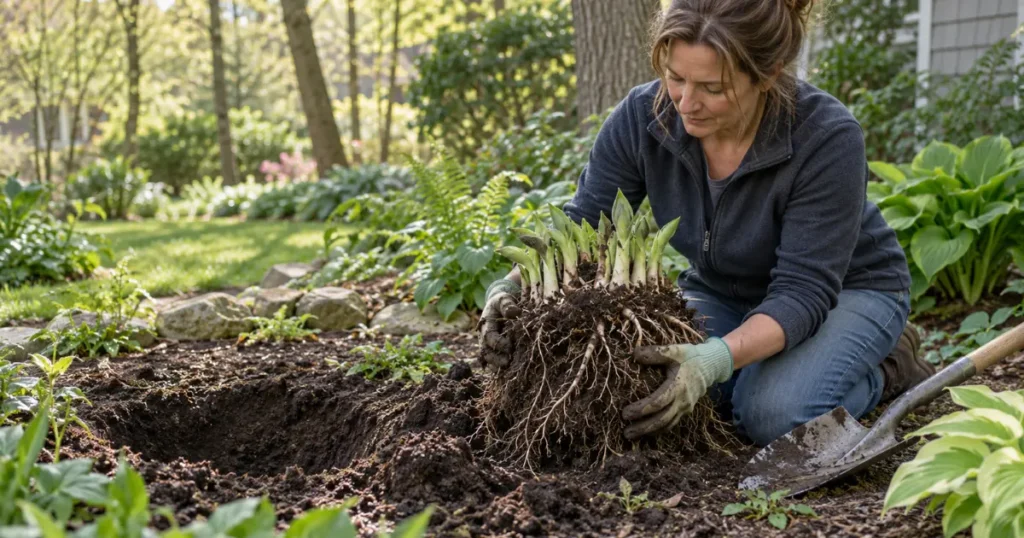
Dividing a hosta means lifting or separating an established clump into smaller, viable sections that can be replanted. If you are learning how to divide hostas, the good news is that healthy plants do not need to be split simply because a certain number of years has passed.
Timing matters more than following a routine schedule. Early spring, as new shoots begin emerging and before the leaves fully expand, is often the easiest time to work with the plant. Division can also be possible later in the growing season when conditions are suitable.
This guide explains when division makes sense, how to prepare for the job, how to separate the clump safely, how to replant the resulting sections, and how to help them establish afterward.
Quick Summary
- Healthy hostas can remain undisturbed for years, so there is no need to divide them automatically on a fixed schedule.
- Divide when you have a practical reason, such as making more plants, sharing divisions, managing an oversized clump, or addressing a declining center.
- Early spring, as new shoots begin to emerge, is often the easiest time to divide a hosta.
- Late-summer or fall division can also be possible when weather and local conditions give the divisions a reasonable opportunity to establish.
- When learning how to divide hostas, prepare the new planting location before lifting the original clump whenever practical.
- A useful division needs growing point(s), part of the crown, and a healthy share of roots.
- Replant divisions promptly at approximately their previous growing level rather than burying them unusually deeply.
- Water thoroughly after replanting and maintain appropriate moisture while the divisions establish.
Table of Contents
ToggleDo Hostas Need to Be Divided?
No. A healthy hosta does not need to be divided simply because a fixed number of years has passed.
Iowa State University Extension specifically notes that hostas can be left undisturbed for years. Unlike perennials that require frequent division to maintain performance, hostas are better divided when there is a useful reason to do the job rather than according to an arbitrary calendar.
Practical reasons include:
- making additional plants for another part of the garden;
- sharing divisions with another gardener;
- reducing a clump that has grown beyond its available space;
- separating plants that are crowding neighboring growth;
- improving the appearance of an older clump that has begun declining in the center.
A large hosta is not automatically unhealthy. Many cultivars naturally form substantial clumps as they mature, so size alone is not a reason to reach for a spade.
Likewise, do not assume every older hosta will eventually have exactly the same problem. Growth rate, cultivar, site, and local conditions influence how a clump develops.
If a hosta is healthy, fits its space, and still looks good, leaving it alone is a perfectly reasonable option. Division is a useful propagation and size-management technique—not mandatory routine maintenance.
When Is the Best Time to Divide Hostas?
The best timing depends more on the hosta’s stage of growth and the conditions in your garden than on one nationwide calendar date.
For most gardeners, early spring is the easiest and most practical window. Late-summer or fall division can also work, and division during summer is possible when necessary, but hotter weather and a large canopy of leaves can make the process more stressful and awkward.
Local climate matters. A gardener in a region with a long mild fall has a different establishment window from someone whose garden moves quickly into severe winter conditions.
Dividing Hostas in Spring
Early spring is generally the strongest choice.
Iowa State University Extension recommends dividing hostas as their new leaves begin emerging. At this stage, the shoots are still compact, making the crown easier to see and the clump easier to handle than it will be after the foliage fully expands.
Spring also gives newly replanted divisions the growing season ahead in which to develop.
Watch the plant rather than the calendar. In one region, shoots may emerge much earlier than they do in another, so there is little value in declaring one month correct for the entire United States.
You also do not need to wait until the hosta has produced a full mound of leaves. Working while the emerging shoots are still relatively small usually makes it easier to see what you are doing and reduces the amount of foliage in your way.
Dividing Hostas in Fall
Fall can also be a suitable time in some gardens.
The important issue is establishment. A newly separated hosta needs reasonable growing conditions after replanting rather than being divided immediately before severe winter weather arrives.
University of Arkansas Extension guidance notes that hostas can be divided in either spring or fall, while Iowa State includes late summer as another workable period. Together, these recommendations reinforce that timing varies with regional conditions rather than fitting one national deadline.
If your climate moves rapidly from warm weather into hard freezes, be more cautious about delaying the job late into the season.
Avoid inventing a precise frost countdown. Local weather, plant condition, soil moisture, and the severity of winter all affect how well a late division establishes.
Can You Divide Hostas in Summer?
Yes, it can be done, but summer is not necessarily the easiest time.
Iowa State University Extension notes that hostas can be divided from spring through late summer.
The challenge is that a fully leafed-out plant is larger and more cumbersome to handle, while hot, dry weather can increase stress on freshly disturbed roots and foliage.
If division cannot reasonably wait, try to avoid the harshest weather where possible. Prepare the destination before lifting the clump, replant the divisions promptly, and pay attention to moisture while their roots re-establish.
Do not interpret this as meaning summer division is impossible. It simply requires more care than working with compact emerging growth in spring.
What You Need Before Dividing a Hosta
Hosta division does not require specialized equipment.
For most plants, a simple set of ordinary garden tools is enough:
- a sturdy garden spade or shovel for digging around and lifting the clump;
- a sharp garden knife, spade, or other suitable dividing tool if the clump is too dense to separate readily;
- gardening gloves;
- a hose or watering can for replanting;
- a prepared location for the new divisions.
Iowa State University Extension recommends a sharp knife or spade for dividing hosta clumps, while University of Georgia Extension describes both lifting the root mass and removing sections with a sharp shovel as workable methods.
Not every hosta requires every tool. Smaller or looser clumps may separate relatively easily, while a large, mature clump can be dense enough to require a strong, sharp tool.
Whenever practical, prepare the new planting location before you lift the parent plant. Iowa State advises replanting divisions immediately, so having the destination ready minimizes unnecessary delay once roots are out of the soil.
You do not need expensive dividing equipment or a collection of specialized products. A suitable site, a dependable digging tool, and a way to make a clean division are the important basics.
How to Divide Hostas Step by Step
The aim is not simply to chop a hosta into arbitrary pieces.
Each useful division ultimately needs enough living plant structure to continue growing—one or more viable growing points, a portion of crown tissue, and a healthy share of roots. Iowa State’s hosta guidance similarly emphasizes retaining growing points along with crown and root system when sections are separated.
Before reaching that stage, first get the destination ready and lift the original clump carefully.
Step 1: Prepare the New Planting Area
Choose and prepare the destination before disturbing the parent hosta whenever possible.
The new location should provide growing conditions appropriate to the hosta you are dividing. Hostas vary in their tolerance of sunlight, but they generally perform best in conditions that provide appropriate shade or filtered light for the particular cultivar, along with soil that drains well while retaining suitable moisture.
University of Georgia Extension notes that hosta light requirements can range from partial sun to dense shade and recommends checking the needs of the specific plant rather than treating every hosta identically.
Clear enough space for the intended division and have the planting area ready to receive it promptly.
There is no need to create an elaborate new bed or add fertilizer automatically. This step is simply about making sure the divided section will have a suitable place to go once it has been separated.
Step 2: Dig Around the Hosta Clump
Begin by working around the outside of the clump rather than driving a shovel blindly through the visible crown.
Use a garden spade or shovel to loosen the soil progressively around the plant. Your aim is to free enough of the root mass that the clump can eventually be lifted while keeping a useful portion of the roots attached.
There is no universal digging radius. A compact hosta and a very large mature clump can have substantially different root masses, so use the size of the plant and what you encounter in the soil as your guide.
Work gradually and angle the tool beneath the root mass as the surrounding soil loosens.
If the soil is extremely dry and hard, making the ground reasonably workable beforehand can make digging easier. If it is already appropriately moist, there is no need to add water simply as a ritual before division.
Expect some roots to be cut during digging. The goal is to retain a useful root system, not to extract every root perfectly intact.
Step 3: Lift the Clump Carefully
Once you have loosened the soil around the hosta, begin working the spade beneath the root mass.
Lift gradually rather than pulling upward on the leaves or forcing the plant out by its shoots. Use the tool to support and loosen the root ball until the clump can be raised from the ground.
Large mature hostas can be dense, awkward, and surprisingly heavy because the crown, roots, and attached soil may come up together. If the clump is too large to handle safely as one piece, work deliberately rather than trying to wrestle it free.
University Extension guidance recognizes both lifting the full root mass and removing manageable portions of a large clump with a sharp spade as practical approaches.
It is normal for some roots to be damaged during lifting. Preserve as much useful root system as practical, but do not expect every fine root to remain untouched.
Once the clump is out—or has been reduced to a manageable section—set it down where you can clearly inspect the shoots, crown, and roots before deciding where the actual divisions should be made.
Step 4: Identify the Crown and Growing Points
With the clump lifted or reduced to a manageable section, look closely at the structure before making any cuts. You should now be able to distinguish the shoots, crown, and roots that will make up each viable division.
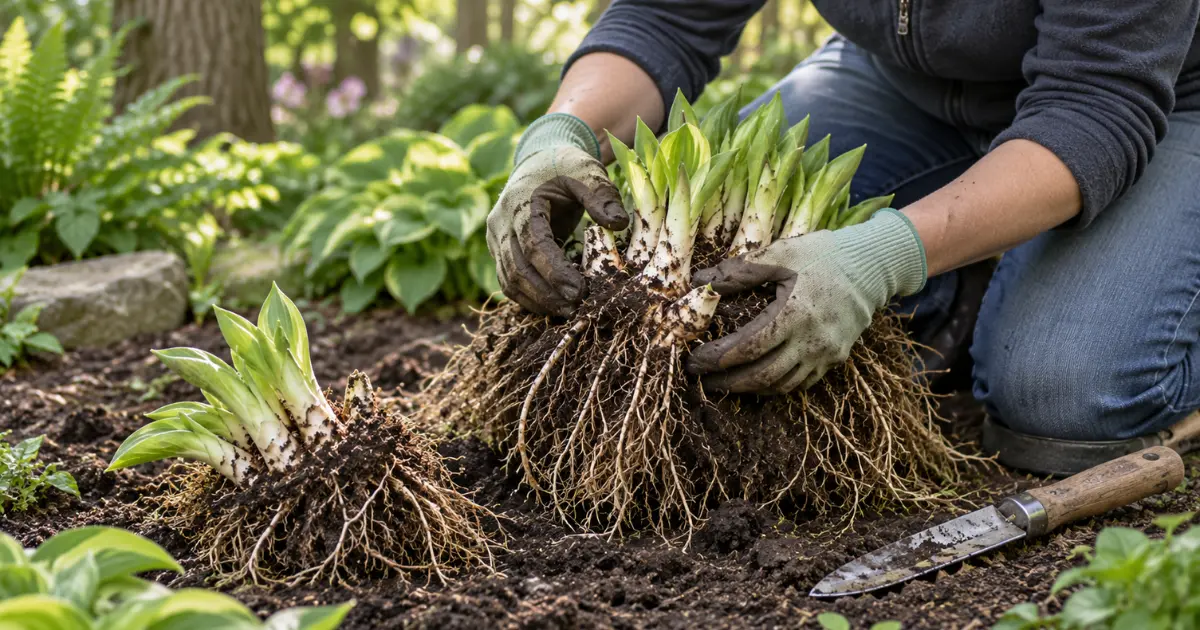
The growing points—sometimes called points, noses, or eyes—are the shoots from which leaves emerge. Beneath them is the crown, the thicker plant tissue connecting those shoots to the root system. The roots extend below and outward from the crown.
Each division needs these parts to remain connected. Iowa State University Extension recommends sections with two or three growing points plus a good portion of crown and roots as a practical standard for hostas. Treat that as useful guidance rather than a rule that every division must contain exactly the same number of shoots.
A large clump may naturally show several groups of shoots that suggest where divisions can be made.
If loose soil is hiding the structure, gently shake or tease away enough soil to see the crown. There is no need to strip every root completely clean simply to divide the plant.
Take a moment to identify promising sections before reaching for a knife or spade. That makes the next step much more controlled.
Step 5: Separate or Cut the Hosta Into Divisions
How you separate the clump depends on its size and density.
Some hostas form sections that can be eased apart by hand once the roots are exposed. Denser clumps may require a sharp garden knife, spade, or another suitable dividing tool. Iowa State’s hosta division guidance supports both hand separation and cutting with a sharp tool, depending on the structure of the clump.
Work deliberately.
For each section you intend to keep, make sure the growing point or points remain attached to crown tissue and a useful portion of roots. Do not simply chop the root mass into equal-sized pieces without first looking at where the living plant structures are located.
Some root damage is normal during division. The goal is not to preserve every fine root, but to avoid unnecessarily destroying the crown or leaving a division with very little functioning root system.
If an older clump has developed a clearly dead central portion, that nonproductive material can be discarded rather than replanted. Not every mature hosta develops a dead center, so remove it only when it is actually present.
Larger divisions usually have more stored plant material and roots and may regain a substantial appearance more quickly than very small pieces. Smaller viable divisions can still be useful when you want more plants, but do not keep reducing sections merely to maximize their number.
Finish with healthy, manageable divisions ready to go back into the ground promptly.
Step 6: Replant the Divisions
Move each division to its prepared location as soon as practical.
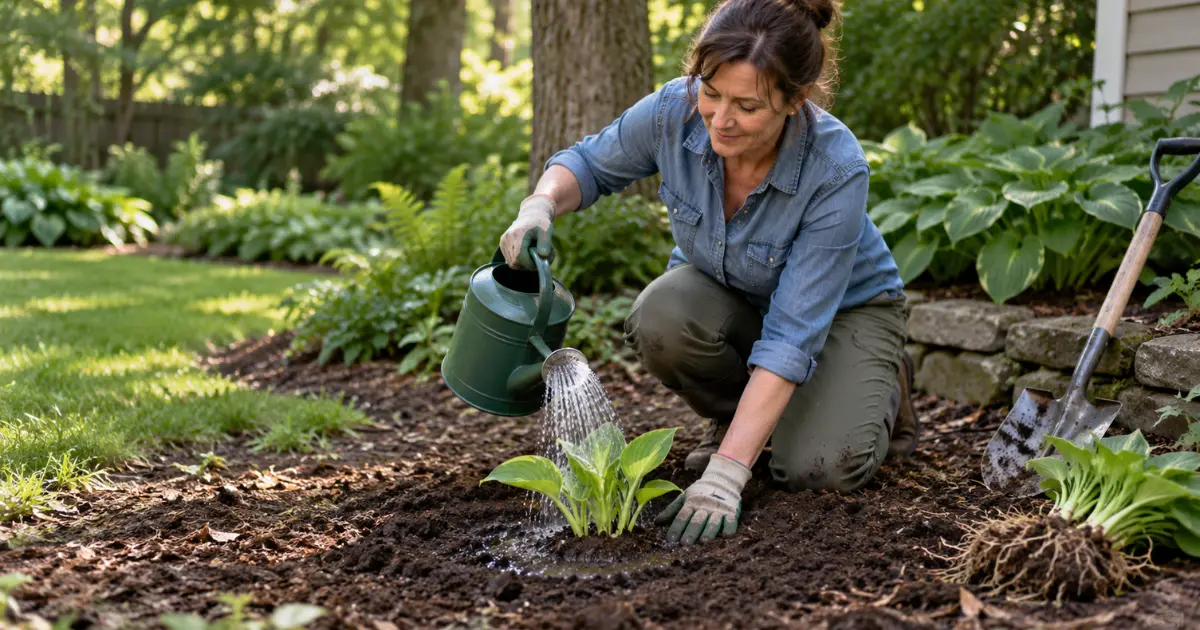
Place it so the crown returns to approximately the same growing level it had before division. Do not bury the crown deeply beneath new soil, and do not leave the root system unnecessarily exposed above the soil surface.
Iowa State University Extension guidance for divided perennials recommends replanting divisions at the same level at which they were previously growing.
Where possible, arrange the roots naturally in the planting area rather than folding them tightly into a compact bundle. Backfill around them with soil, working gently enough to reduce major air gaps without aggressively packing the root zone.
Firm the soil sufficiently to hold the division upright.
There is no need to add fertilizer automatically at this stage. Likewise, do not use one universal planting-hole dimension or spacing rule: hosta cultivars vary greatly in mature size, and the site itself matters.
This step concerns only the newly created divisions. Relocating an intact mature hosta is a broader transplanting task and can involve different considerations.
Step 7: Water Thoroughly
Water each replanted division thoroughly after planting.
This first watering helps settle soil around the roots and provides moisture to plant tissue that has just been disturbed. Extension guidance consistently recommends prompt watering after perennial division and replanting.
After that initial watering, respond to actual conditions rather than following a fixed schedule.
Check:
- rainfall;
- soil moisture;
- drainage;
- heat and wind;
- the condition of the foliage;
- how recently the division was replanted.
Freshly divided hostas should not be allowed to become unnecessarily dry during establishment, but the answer is not to keep poorly drained soil continuously saturated.
The next stage is observation rather than repeatedly watering by habit.
Can You Divide a Hosta Without Digging Up the Whole Plant?
Sometimes.
With a large, established clump, it may be possible to cut away an accessible outer section with a sharp spade without lifting the entire plant. University of Georgia Extension specifically describes cutting a section from a hosta clump with a sharp shovel as one division method.
The same viability rules still apply: the section you remove needs growing point(s), crown tissue, and enough roots to establish independently.
This approach can be useful when you want only one additional division or need to reduce one side of a very large clump.
However, it is not necessarily the easiest method for a beginner. When the whole crown is hidden in the soil, judging exactly where to cut can be harder.
Lifting a manageable clump or section gives you a clearer view of its structure before separating it. Partial in-ground division also disturbs the parent plant, so it should not be treated as a no-impact shortcut.
How to Care for Hostas After Dividing
Fresh divisions need a period of attentive establishment before they regain the size and appearance of mature hostas.
Moisture is the main thing to monitor.
Keep the root zone from becoming excessively dry while new roots establish, especially during warm, dry, or windy weather. At the same time, good drainage still matters. Hostas generally prefer moist, well-drained conditions rather than soil that remains continually saturated.
Check the planting area after the first few waterings or substantial rain. Loose backfill can settle.
If settling exposes roots, add enough soil to cover them appropriately. If the crown has become buried more deeply than intended, correct the planting level rather than leaving it covered.
A modest mulch layer can help conserve moisture and suppress weeds where appropriate, but keep mulch from being packed heavily over the crown. Iowa State includes mulch as a useful establishment aid for divided perennials, while late-season hosta divisions may need climate-appropriate protection against freeze-thaw heaving in colder regions.
Avoid repeatedly disturbing the division once it is planted.
The leaves may not immediately look as full as the original clump, particularly when substantial root disturbance occurred or division took place later in the growing season. That does not automatically mean the plant has failed.
Give it time to rebuild its root system and produce new growth. Recovery speed depends on the division itself and the conditions in which it is establishing.
For ongoing care after the divisions become established, see our complete hosta care guide for guidance on light, soil, watering, feeding, mulching, and seasonal maintenance.
Common Mistakes When Dividing Hostas
- Dividing without a practical reason.
Healthy hostas can remain undisturbed for years. Splitting a plant merely because a fixed interval has passed creates unnecessary disturbance. Divide when you want additional plants, need to manage size, or have another clear reason. - Choosing unnecessarily stressful timing.
Division is generally easiest in early spring as shoots emerge. Hot, dry weather or division very late in the growing season can make establishment more difficult. If you have flexibility, choose conditions that reduce stress rather than forcing the job into the least favorable weather. - Damaging too much crown and root tissue.
Some damage is unavoidable, but indiscriminate chopping can destroy the structures a division needs. Identify the crown and growing points before cutting, then use a sharp, controlled tool where separation by hand is not practical. - Making weak divisions without enough viable plant tissue.
A piece of root by itself is not the goal. Keep growing point(s), crown tissue, and a useful root system together. Very small divisions can also take longer to regain size than more substantial sections. - Replanting at the wrong growing level.
Do not bury the crown unusually deeply or leave roots exposed. Replant divisions at approximately the level at which they were growing previously, then settle soil gently around the roots. - Letting divisions dry excessively.
Roots lose moisture while they are out of the ground. Prepare the new location in advance, keep divisions protected if there is a short delay, and replant promptly. After planting, monitor moisture carefully during establishment rather than leaving the new divisions to dry out.
Frequently Asked Questions About Dividing Hostas
How Often Should Hostas Be Divided?
There is no universal schedule.
Healthy hostas can remain undisturbed for years, and division should be based on the plant and your gardening goals rather than a rule such as “every three years.”
If a hosta still fits its space and looks healthy, there is no requirement to disturb it simply because it has been growing in the same location for a long time.
How Small Can You Divide a Hosta?
Think about viability rather than a specific physical size.
When learning how to divide hostas, aim to keep growing point(s), a portion of the crown, and sufficient healthy roots together in each section.
Iowa State recommends two or three points with a good portion of crown and roots as practical hosta-division guidance, but that should not be interpreted as an absolute rule for every clump. Larger divisions often regain a substantial appearance faster, while smaller viable ones may take longer to establish.
Can You Divide Hostas While They Are Blooming?
Yes, it can be physically possible, but that does not make flowering the preferred stage.
Division is usually easier in early spring, when shoots are emerging and there is less developed foliage to handle. A fully grown or flowering plant has more top growth and may experience greater visible stress after its roots are disturbed.
If division can wait, choose a more favorable growth stage. If it cannot, replant promptly and pay close attention to establishment conditions.
Can You Divide Hostas in Pots?
Yes. A container-grown hosta can be divided when there is a practical reason to do so.
Remove or work the plant from its container carefully enough to expose the crown and root structure, then separate viable sections using the same basic principle: each new plant needs growing point(s), crown tissue, and roots.
Replant the resulting divisions into suitable space promptly.
Container selection, potting mix, and long-term container watering are broader growing topics and do not change the basic viability requirement for division.
How Long Does It Take a Divided Hosta to Recover?
There is no reliable universal recovery period.
A substantial spring division with plenty of roots may establish differently from a small section divided during hot weather.
Recovery is influenced by:
- season;
- division size;
- retained root system;
- weather;
- soil moisture;
- cultivar;
- site conditions.
A division may resume growth before it once again forms the large, full clump you remember from the parent plant. Iowa State notes more broadly that smaller perennial divisions can take longer to recover and that newly divided plants may not flower strongly right away.
Divide Hostas at the Right Time and for the Right Reason
The central lesson in how to divide hostas is that division should be purposeful rather than routine.
A healthy hosta can remain undisturbed for years. When you do have a reason to split one, choose favorable conditions, identify the plant’s growing points and crown before cutting, and make divisions that retain a useful root system.
Replant those sections promptly at approximately their previous growing level, water them thoroughly, and then monitor moisture while the roots re-establish.
You do not need perfectly equal divisions, an exact cutting formula, or a fixed calendar schedule.
Careful timing, viable plant structure, and sensible establishment care matter much more than turning division into a rigid procedure.

