
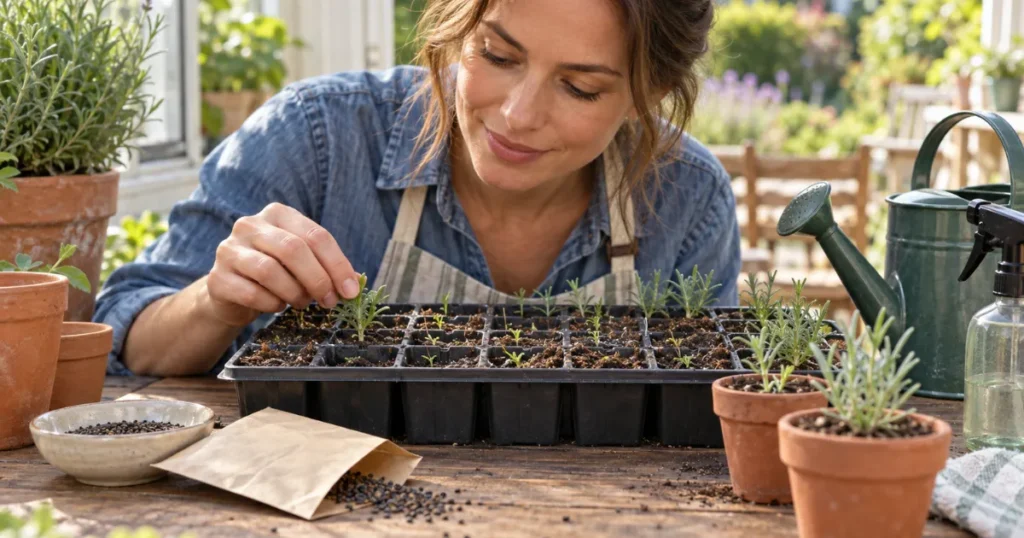
Lavender can be grown from seed, but it asks for more patience than many common garden plants. If you are learning how to grow lavender from seed, the most reliable beginner approach is usually to start seeds in trays or small pots where you can control moisture, light, and the germination environment before gradually moving young plants outdoors.
Germination can be slow and uneven, and different lavender species, cultivars, and seed strains may come with different instructions. Some benefit from pre-chilling, while others may be supplied with different recommendations. Seed-grown plants can also vary from their parents, particularly when seed comes from named cultivars.
The practical goal is not to force every lavender seed through one formula. It is to follow the instructions for the seed you have, keep the growing medium appropriately moist without saturating it, give emerged seedlings strong light, and move them outdoors only after they are ready.
Quick Summary
- How to grow lavender from seed successfully starts with accepting that germination can be slow and uneven.
- Starting seeds in trays or small pots indoors is usually the most manageable beginner method.
- Do not assume every lavender seed needs cold stratification; follow the instructions for your species, cultivar, or seed strain.
- Use a fine, free-draining seed-starting medium and sow the small seeds shallowly according to packet guidance.
- Keep the medium evenly moist during germination, but never saturated or waterlogged.
- After seedlings emerge, give them strong light and enough space to develop without crowding.
- Harden indoor-grown seedlings gradually before transplanting them into a sunny, well-drained outdoor location.
Table of Contents
ToggleBefore You Start Growing Lavender From Seed
Growing lavender from seed is entirely possible, but it is not the fastest or most predictable way to produce a lavender plant.
Iowa State University Extension notes that lavender seed may germinate slowly and unevenly and that plants raised from seed can vary in habit, size, and flower characteristics. Cuttings are commonly used when growers want plants that reliably reproduce known traits. Iowa State University Extension’s lavender propagation guidance
That does not make seed starting a poor choice for a home gardener. It simply means expectations matter.
Is Lavender Easy to Grow From Seed?
Lavender is best described as possible but comparatively slow and sometimes unpredictable from seed.
Unlike fast-sprouting vegetables or annual flowers that may fill a tray quickly, lavender seedlings can appear over an extended period. Some seeds may germinate before others even when they were sown at the same time.
If you would prefer to begin with a faster, more beginner-friendly annual, our guide on how to grow marigolds from seed walks through sowing, germination, seedling care, and transplanting step by step.
That makes patience part of the process.
If your goal is to grow a few lavender plants inexpensively and you enjoy seed starting, growing from seed can be rewarding. If your priority is reproducing an exact named plant with highly predictable characteristics, vegetative propagation is generally more reliable.
What Kind of Lavender Seeds Should You Start With?
Buy seed from a reputable supplier and read the packet carefully before doing anything else.
Lavender belongs to the genus Lavandula, and different species, cultivars, and seed strains do not necessarily respond identically during propagation.
One particularly important point is seed-grown variability.
The Royal Horticultural Society notes that lavender grown from seed collected from cultivars may produce offspring that differ from the parent. RHS guidance on growing lavender from seed
If a packet represents a seed strain developed specifically for seed propagation, follow its instructions closely. Avoid assuming that advice for one English lavender strain automatically applies to every lavender seed sold in the United States.
When to Plant Lavender Seeds
There is no single nationwide date for when to plant lavender seeds.
Your timing should work backward from your local outdoor planting conditions, the expected pace of the seed you are growing, and the instructions provided by the supplier.
Starting Lavender Seeds Indoors
For beginners, starting lavender seeds indoors gives you the most control over the early stages.
You can regulate:
- the seed-starting medium;
- moisture;
- warmth;
- light after emergence;
- protection from heavy rain, drying wind, and outdoor temperature swings.
Because lavender can take time to germinate and develop into a sturdy seedling, do not wait until outdoor planting weather has already arrived before beginning an indoor batch unless your packet specifically directs you to do so.
At the same time, starting extremely early can create another problem: seedlings may outgrow their containers long before conditions outside are suitable.
Relating Seed-Starting Time to Your Local Growing Season
Work backward from when young lavender plants can safely transition outside in your area.
Consider:
- your typical last spring frost period;
- how long the particular seed may need for germination;
- the time required for seedlings to develop enough to handle transplanting;
- a hardening-off period before permanent outdoor planting;
- any seed-specific pre-sowing treatment.
A gardener in a long, mild growing season may use a different timeline from someone gardening where winter lasts much longer.
Seed-packet instructions should take priority when they provide timing for the specific lavender you purchased.
Do Lavender Seeds Need Cold Stratification?
Not all lavender seeds should automatically be treated as though cold stratification is mandatory.
Cold stratification is a seed treatment that exposes seeds to cool, moist conditions before sowing, roughly mimicking part of a natural winter cycle. It is used to help overcome dormancy in plants that respond to this environmental cue.
Some lavender guidance recommends cold treatment for particular types or seed strains. Iowa State Extension, for example, reports improved germination with cold stratification in its guidance on lavender propagation.
But this should not be turned into a universal rule.
Cultivar-specific guidance illustrates why. The RHS, for example, gives a pre-chilling instruction for the seed-propagated English lavender strain ‘Blue Spear’. That is guidance for that particular plant, not proof that every lavender seed packet requires exactly the same treatment.
Before stratifying your seed:
- Read the seed packet.
- Check whether a species, cultivar, or seed strain is identified.
- Follow the supplier’s recommended pre-treatment where one is provided.
- Do not invent a longer chilling period because “more must be better.”
If your packet does not call for stratification, do not automatically assume it was omitted by mistake.
What You Need to Start Lavender Seeds
You do not need an elaborate seed-starting setup.
A practical beginner kit includes:
- lavender seeds;
- a clean seed-starting tray, cell pack, or small pots;
- fine, free-draining seed-starting medium;
- clean water;
- a bright location or suitable grow light for seedlings after emergence;
- plant labels if you are starting more than one lavender type;
- a tray beneath containers if needed to protect the growing surface.
Avoid filling seed trays with dense soil dug straight from the garden.
Indoor seed starting works better with a fine-textured medium that provides a more predictable balance of moisture and air around small developing roots.
University of Maryland Extension advises sowing fine herb seed shallowly and following packet directions because the appropriate planting depth depends partly on seed size and the particular plant. Its seed-starting guidance also notes that lavender can be difficult to germinate from seed. University of Maryland Extension guidance on starting herbs from seed
How to Plant Lavender Seeds Step by Step
A controlled indoor setup is the simplest way for most beginners to learn how to grow lavender from seed.
The exact covering, pre-treatment, and germination conditions may vary with the seed you purchased, so use the following process as a framework and keep the packet instructions beside you.
Prepare the Seed-Starting Mix and Containers
- Fill clean cells, trays, or small pots with a fine, free-draining seed-starting medium.
- Gently level the surface without compressing it into a hard layer.
- Moisten the medium so it is evenly damp before sowing.
- Allow excess water to drain.
The aim is a medium that holds enough moisture for germination but still contains air.
Do not begin with saturated, muddy material.
Sow the Lavender Seeds
Lavender seeds are small, so careful handling is more useful than digging deep holes.
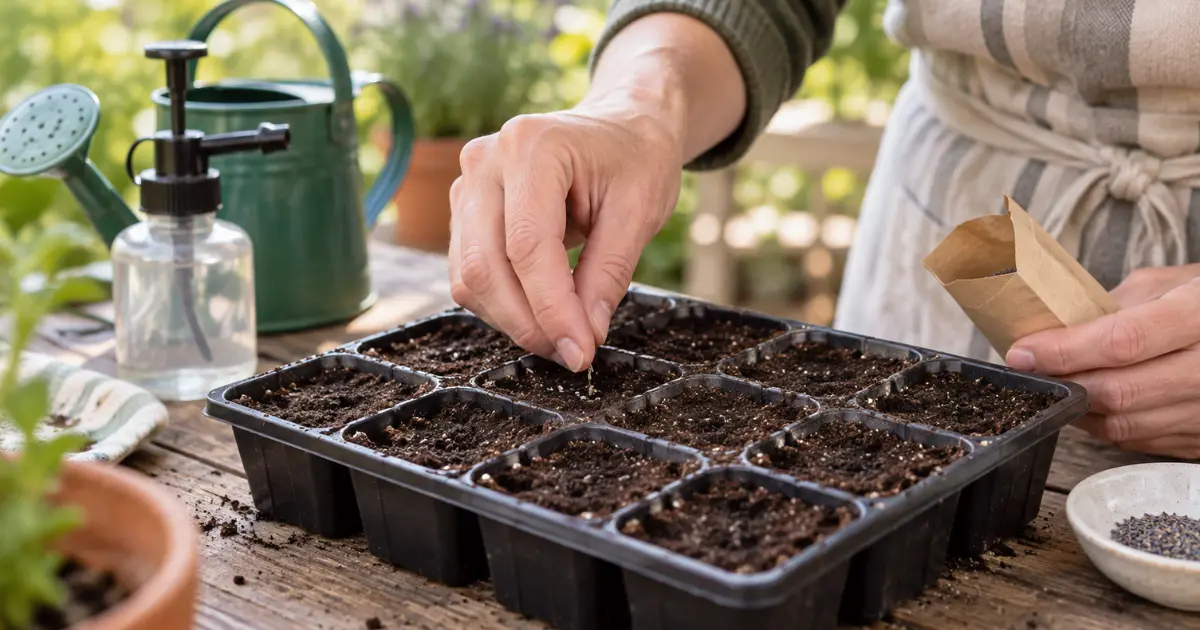
Place the seeds according to the spacing and sowing instructions on the packet.
Lavender is generally shallow-sown, but do not use one fixed depth for every lavender seed. Some seed instructions may call for very light covering, while others may specify a different surface treatment.
Follow the directions for the seed you actually have.
Avoid burying tiny seeds deeply simply because larger garden seeds are planted deeper.
Moisten the Growing Medium Carefully
After sowing, make sure the seeds have appropriate contact with the moist growing medium without washing them into one corner of the container.
Gentle watering is best.
Depending on your setup, that may mean carefully misting or watering in a way that does not disturb the small seeds.
During germination, monitor the medium instead of watering on a fixed daily schedule.
The goal is consistent appropriate moisture, not saturation.
Repeatedly soaking the tray can reduce air around the seed and developing roots. Letting newly sown seed repeatedly become excessively dry can interrupt germination.
Provide Suitable Temperature and Germination Conditions
Use the temperature and environmental guidance supplied for your lavender seed when available.
Do not assume every Lavandula species has one ideal universal germination temperature.
For perspective, Iowa State reports that lavender germination may take roughly two to four weeks or longer under the conditions described in its guidance. Utah State University Extension provides a somewhat different example for English lavender. These examples demonstrate why gardeners should not turn one source’s conditions into a guarantee for every seed packet.
Keep the germination setup in a reasonably stable environment and continue observing moisture.
Avoid repeatedly moving the container between dramatically different conditions in an attempt to make the seeds sprout faster.
Do Lavender Seeds Need Light to Germinate?
There is no good reason to state that every lavender seed universally requires light for germination.
Seed-covering recommendations can differ among lavender species, cultivars, seed strains, and suppliers.
This is another situation where the seed packet should guide you.
Do not confuse two separate questions:
Does this particular seed need to be exposed to light during germination?
and
Do emerged lavender seedlings need good light?
The second answer is much clearer: once seedlings appear, adequate light becomes very important for healthy development.
If young seedlings receive inadequate light, they may stretch, lean, and produce weak growth as they try to reach a brighter source.
So even when the germination instructions call for some seed covering, prepare to provide strong light as soon as seedlings emerge.
How Long Do Lavender Seeds Take to Germinate?
Lavender seeds can take several weeks, and emergence may be uneven.
Do not treat a single germination number as a deadline after which every unsprouted seed has failed.
For example, Iowa State Extension notes germination may take two to four weeks or longer in the conditions it describes. Other species, seed strains, or starting methods may behave differently.
You may see:
- one seedling emerge first;
- several more appear later;
- some seeds fail to germinate;
- different results from different seed lots.
Before giving up on a tray, check the packet’s expected germination information and review your growing conditions.
If the medium has remained suitable and the expected window has not clearly passed, patience may be more appropriate than repeatedly changing the setup.
What Do Lavender Seedlings Look Like?
New lavender seedlings do not immediately resemble small mature lavender bushes.
The first growth is delicate and simple.
Early Lavender Seedling Stages
After germination, the seedling first produces its initial seed leaves, called cotyledons.
These temporary leaves help support the young plant before its more characteristic true foliage develops.
As growth continues:
- the seedling establishes a small root system;
- true leaves begin developing;
- the young plant gradually takes on a more recognizable lavender appearance;
- stems and foliage become more substantial as the seedling matures.
Do not discard a healthy seedling simply because its earliest leaves do not yet look like the narrow foliage of an established lavender plant.
If you have several plants germinating in the same tray, labels are useful because many young seedlings can look surprisingly similar at the earliest stage.
How to Care for Lavender Seedlings
Once the first seedlings emerge, the job changes.
You are no longer simply trying to germinate seed. You are now trying to develop compact, healthy young plants strong enough to survive transplanting.
This stage is a major part of how to grow lavender from seed successfully.
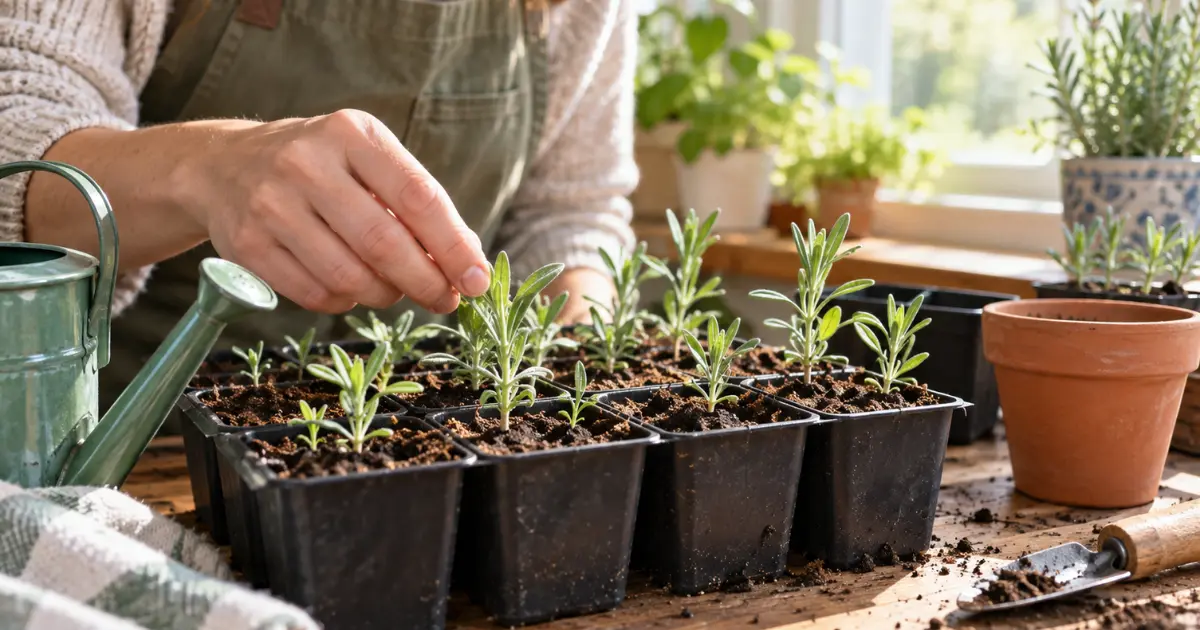
Give Seedlings Enough Light
Move the focus from germination conditions to seedling growth.
Young lavender needs strong light.
If you are using artificial lighting, position it according to the manufacturer’s guidance and adjust it as seedlings grow. If you rely on natural light, monitor seedlings for stretching or leaning.
Weak, elongated growth is a sign that the seedlings may not be receiving enough usable light.
Also provide reasonable air circulation without blasting delicate seedlings with strong wind.
Keep Moisture Balanced
After emergence, continue checking the growing medium instead of watering according to the clock.
Very small seedlings have small root systems and should not repeatedly dry out severely.
At the same time, continuously saturated medium creates poor root-zone conditions.
Water carefully enough to keep the seedlings growing steadily while preserving drainage and air in the medium.
As roots develop and plants grow larger, their moisture use can change. Continue responding to the container rather than assuming the same routine will work indefinitely.
Thin or Pot On Seedlings When Needed
Crowded seedlings eventually compete for light, space, and root room.
If several seedlings occupy a space intended for one plant, thinning may be appropriate.
Seedlings started together in a tray may also need to be moved into individual containers as they become large enough to handle and begin competing for space.
When potting on:
- handle young plants gently;
- avoid crushing delicate stems;
- give roots enough room in the new container;
- use a suitable free-draining growing medium;
- water carefully after the move;
- return seedlings to good light once they recover.
Do not rush tiny newly emerged seedlings into unnecessarily large pots.
The goal is a gradual transition toward sturdy transplant-size plants.
Hardening Off Lavender Seedlings
Indoor-grown seedlings should not move directly from protected indoor conditions to permanent exposure outdoors.
Hardening off means gradually acclimating young plants to outdoor sun, wind, and temperature variation before transplanting.
University of Maryland Extension describes hardening off as the gradual exposure of transplants to outdoor conditions so they can adjust before being planted permanently in the garden. University of Maryland Extension’s hardening-off guidance
The same general acclimation principle is useful for lavender seedlings.
Begin with protected outdoor conditions rather than placing tender indoor-grown seedlings immediately in intense sun and wind.
Over time, increase their exposure as conditions permit.
Watch the plants throughout the process. Hardening off is supposed to prepare seedlings, not deliberately stress them until they wilt or suffer damage.
There is no need to force one rigid number of days onto every climate or weather pattern.
How to Transplant Lavender Seedlings Outdoors
Transplant once the seedlings are sufficiently developed, have been hardened off, and local conditions are suitable.
Your job at this stage is to establish the young plant successfully—not to begin an exhaustive mature-lavender care program. For the complete outdoor planting process, see our guide on how to plant lavender.
Choose a Sunny, Well-Drained Location
Lavender’s long-term site should provide ample sunlight and excellent drainage.
Illinois Extension emphasizes well-drained conditions for lavender and warns against allowing roots to remain in wet soil. Illinois Extension’s lavender growing guidance
Choose a suitable garden site before transplant day rather than moving seedlings outdoors and then searching for somewhere to put them.
If the lavender will share a bed or border with other plants, choose lavender companion plants with compatible sunlight, drainage, and moisture needs.
Avoid low areas that routinely remain saturated.
Transplant After Local Frost Risk Has Passed
Do not use one nationwide transplant date.
Your local frost pattern, current weather, lavender type, seedling development, and hardening-off progress all matter.
A typical last-frost date can be useful for planning, but actual weather still needs to be considered.
Wait until conditions are appropriate for the young plants you have raised.
Help Young Lavender Establish
Plant the seedling so its root system can make good contact with the surrounding soil without burying the plant unnecessarily deeply.
Water after transplanting as needed to settle the soil around the roots and support establishment.
During this early period, monitor the young plant carefully because newly transplanted lavender does not yet have the established root system of a mature plant.
Continue to prioritize:
- adequate sunlight;
- good drainage;
- appropriate moisture during establishment;
- protection from avoidable transplant stress.
Once the plant is established and moving into mature growth, its ongoing pruning, flowering, harvesting, and long-term maintenance belong to broader lavender-care guidance.
Can You Grow Lavender From Seed Outdoors?
Yes, growing lavender from seed outdoors is possible, but direct sowing is generally less controlled than starting seeds in trays or pots.
For a beginner, indoor or protected-container starting remains the more practical default because you can manage the germination environment more closely.
When Direct Sowing May Be Practical
Direct sowing may make sense when:
- your seed supplier recommends it;
- the seed type is suited to the method;
- your climate provides appropriate seasonal conditions;
- you have a well-prepared site;
- you can monitor moisture without keeping the seedbed saturated.
Outdoor sowing exposes seeds to natural temperature changes and weather from the beginning.
For some gardeners and seed types, that may work well.
Why Direct Sowing Can Be Less Predictable
Outdoors, small seeds can face more variables:
- heavy rain;
- drying winds;
- rapid soil-moisture changes;
- fluctuating temperatures;
- crusted soil surfaces;
- disturbance by animals;
- competition from weeds.
Slow or uneven germination can make newly emerging lavender particularly easy to overlook outdoors.
That does not mean direct sowing is wrong. It simply means a controlled seed tray usually makes it easier for a beginner to see what is happening and correct problems early.
If you direct sow, follow seed-specific instructions rather than treating the method as interchangeable with indoor starting.
How Long Does Lavender Take to Grow From Seed?
There is no single honest number that covers the entire journey from seed to mature flowering plant.
Several different stages are involved:
Germination: the seed sprouts and emerges.
Seedling development: the young plant forms true leaves and develops a stronger root system.
Transplant readiness: the seedling becomes large and sturdy enough to harden off and move outdoors.
Establishment: the transplanted young plant begins rooting into its permanent location.
Maturity and flowering: the plant develops the size and maturity needed for substantial flowering.
These stages vary with lavender type, growing conditions, seed quality, climate, and how the plant is managed.
NC State Extension notes that seed propagation is slow and that seed-grown plants may vary, reinforcing why gardeners should avoid expecting every lavender seed to follow one fixed production timeline.
If your primary goal is rapid flowering, seed propagation may test your patience.
If your goal is to raise lavender from the beginning and you are comfortable with gradual progress, the longer timeline is simply part of the project.
Why Are My Lavender Seeds Not Germinating?
When lavender seeds are not sprouting, do not immediately assume that you forgot to cold-stratify them.
Several factors can produce the same outcome.
Check the Seed-Specific Instructions
Start with the packet.
Ask whether your seed was supposed to receive:
- a pre-sowing treatment;
- a particular type of covering;
- a particular germination environment.
Requirements can differ, so troubleshooting should begin with the seed you actually planted.
Check How the Seeds Were Sown
Small seeds planted too deeply may struggle.
If your packet called for surface sowing or very light covering but the seeds were buried deeply, sowing technique may be contributing to the problem.
Avoid digging up seeds repeatedly to inspect them, which can disturb the germination environment further.
Check Moisture
Ask two questions:
Has the seed-starting medium repeatedly dried excessively?
and
Has it stayed saturated?
Either extreme can create problems.
Aim for appropriate, reasonably consistent moisture while preserving drainage and air around the seed.
Check the Germination Environment
If the seed packet specifies a suitable temperature range or other conditions, compare those instructions with the environment you provided.
A tray in a cold draft, very hot location, or rapidly fluctuating environment may behave differently from one kept under steadier conditions.
Do not automatically respond by adding more heat. First determine what the specific seed requires.
Consider Seed Quality and Age
Old, poorly stored, or low-viability seed may produce weaker germination.
Buying fresh seed from a reputable source cannot guarantee that every seed will germinate, but it removes some avoidable uncertainty.
Make Sure You Have Waited Long Enough
Lavender is not always quick.
If the packet’s expected germination period has not passed and the tray remains in appropriate condition, the best response may simply be to wait.
Slow germination is not the same thing as failed germination.
Common Mistakes When Growing Lavender From Seed
- Assuming every lavender seed needs identical treatment.
Species, cultivars, seed strains, and suppliers may give different propagation instructions. - Automatically cold-stratifying every seed.
Stratification may benefit or be recommended for some lavender seed, but it should not be presented as a universal requirement. - Ignoring the seed packet.
Generic gardening advice should not override reliable instructions written for the seed you actually purchased. - Burying small seeds too deeply.
Lavender is generally shallow-sown, although the precise covering should follow seed-specific guidance. - Keeping the growing medium saturated.
Germinating seeds need moisture, but waterlogged conditions reduce air in the root zone. - Allowing newly sown seed to repeatedly dry excessively.
Erratic moisture can interfere with the germination process. - Expecting every seed to sprout together.
Lavender germination can be uneven. - Giving emerged seedlings too little light.
Adequate light after emergence is important for compact, healthy development. - Leaving seedlings crowded for too long.
Growing plants eventually need adequate light, root room, and air movement. - Moving indoor-grown seedlings directly outdoors.
Gradual hardening off helps young plants adjust to the much harsher outdoor environment. - Transplanting into poorly drained soil.
Establishing young lavender in a persistently wet site creates problems that careful seed starting cannot solve. - Expecting a mature flowering lavender plant immediately.
How to grow lavender from seed is a multi-stage process, and patience is part of it.
Frequently Asked Questions About Growing Lavender From Seed
Is lavender hard to grow from seed?
Lavender can be more challenging than many easy annuals because germination may be slow and uneven. Starting in containers where moisture and the environment can be controlled makes the process more manageable for beginners.
Do lavender seeds need cold stratification?
Not universally. Some lavender seed strains or cultivars may benefit from or specifically require pre-chilling, while instructions vary. Follow the guidance supplied for the particular seed you purchased.
How long do lavender seeds take to germinate?
It varies. Some Extension guidance for English lavender reports germination beginning within a few weeks under suitable conditions, but other seed types and growing conditions can take longer. Do not use one number as a deadline for every lavender seed.
Can I start lavender seeds indoors?
Yes. Starting indoors in trays, cells, or small pots is a practical beginner method because it gives you more control over growing medium, moisture, temperature, and seedling light.
Can I plant lavender seeds directly in the ground?
Yes, direct sowing may be possible when the seed type and local conditions are suitable. However, outdoor germination is exposed to more weather and moisture variation, so starting in containers is generally easier to monitor.
Do lavender seeds need light to germinate?
Do not assume that every lavender seed has the same light requirement during germination. Follow packet instructions for sowing and covering. Once seedlings emerge, however, they need adequate light for healthy growth.
How long does lavender take to bloom from seed?
There is no universal flowering timeline. Lavender type, growing conditions, climate, germination speed, seedling development, and establishment all affect when a seed-grown plant becomes mature enough to flower.
Start Small and Give Lavender Time to Grow
Learning how to grow lavender from seed is mostly an exercise in careful observation and patience.
Start with good seed and read its instructions before assuming it needs a particular treatment. Use a fine, free-draining seed-starting medium, sow shallowly according to the packet, keep moisture balanced, and expect germination to be less uniform than it is with many easy garden seeds.
After emergence, shift your attention to strong light, healthy root development, and enough space for each seedling to grow. Harden the plants gradually before moving them permanently outdoors, then establish them in the sunny, well-drained conditions lavender needs.
You do not need every seed to germinate on the same day or every young plant to progress at exactly the same rate. A small number of healthy, well-established seedlings is a much better outcome than rushing the process in search of an artificial deadline.

