
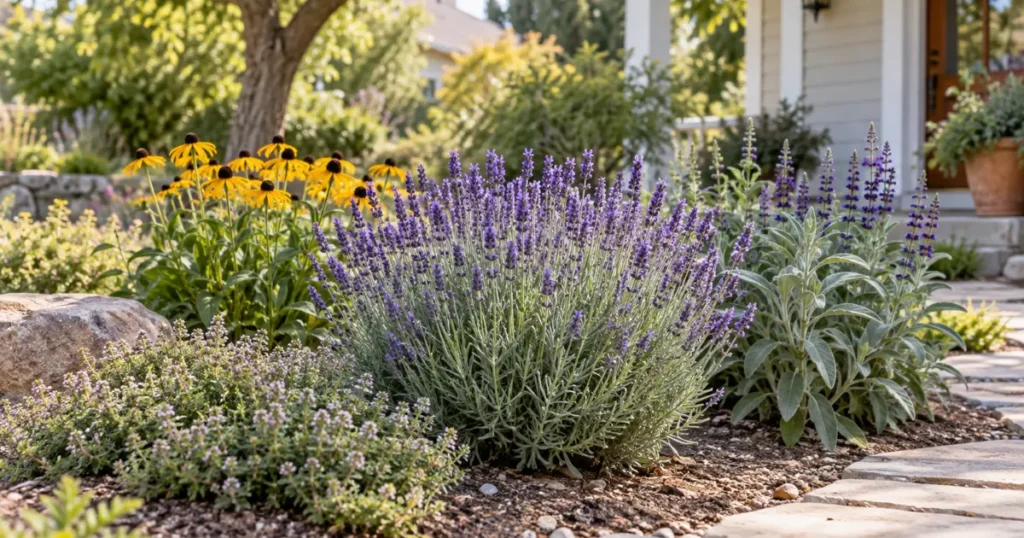
Lavender is easiest to pair with other plants when you start with growing conditions rather than a decorative theme. The best lavender companion plants are not automatically the plants most often repeated on companion-planting lists. They are plants that can live comfortably beside lavender without forcing you to manage one side of the planting completely differently from the other.
For most home gardeners, that means looking first at sunlight, drainage, moisture needs, mature size, climate suitability, and available space. Rosemary, sage, thyme, coreopsis, coneflower, black-eyed Susan, and yarrow can all be practical candidates in the right setting, but none is a universal choice for every garden.
This guide explains what to plant with lavender in beds, borders, and containers, which pairings deserve extra caution, and how to choose companions without relying on unsupported claims about pest control or plant-to-plant “benefits.”
Quick Summary
- Choose lavender companion plants primarily by compatible light, drainage, moisture, climate, and space needs.
- Rosemary, sage, thyme, coreopsis, coneflower, black-eyed Susan, and yarrow can be useful candidates when their specific requirements suit the site.
- A plant can be compatible with lavender without providing any special pest-control, growth, flowering, or disease-prevention benefit.
- Border companions should be chosen with mature height and spread in mind so lavender is not crowded or shaded.
- Container companions need especially close matching because they share the same root space, potting medium, drainage, and watering regime.
- Plants that need persistently moist soil, much less light, or much more root space are usually poor practical companions.
- Climate and cultivar matter, so confirm the needs of the exact plant you are buying before combining it with lavender.
Table of Contents
ToggleHow to Choose Good Companion Plants for Lavender
Companion planting is most useful when it begins with the conditions plants actually need. Colorado State University Extension’s peer-reviewed lavender guidance describes lavender as a plant that performs best with abundant sun and good drainage and warns that insufficient drainage can contribute to root rot. Because that resource is written for Colorado, its more region-specific recommendations should not automatically be applied to every U.S. garden.
That baseline is more useful than asking whether two plants simply “look good together.” Good lavender companion plants should be able to share the same general site without one plant needing the root zone kept much wetter, shadier, or more crowded than the other can tolerate. The most reliable lavender companion plants are therefore selected by site compatibility first.
Match Sun, Drainage, and Moisture Needs
Start with the root zone. If lavender is planted where the soil drains freely and is managed on the drier side once established, a companion that needs consistently wet soil can create a basic management conflict.
The same principle applies to light. A plant chosen for deep shade is not a logical partner for lavender in an open sunny bed, even if its flowers would make an attractive color combination.
Penn State Extension’s guide to growing herbs groups lavender, rosemary, sage, and thyme among Mediterranean herbs that generally thrive in full sun and well-drained, comparatively dry soils. That shared preference is one reason those herbs can be considered together, while still leaving room for species, cultivar, and climate differences.
If you are looking beyond lavender for more plants suited to lower-water conditions, our guide to drought tolerant plants covers 20 choices for different home garden and landscape roles.
Consider Mature Size and Growth Habit
A small plant in a nursery pot may become much wider or taller after a few seasons. Before planting, check the expected mature size and growth habit of both lavender and its companion.
A low thyme can occupy a very different layer of the planting from an upright rosemary or tall coneflower. A spreading plant may eventually move into lavender’s crown area, while a taller companion may cast shade if positioned too close.
Spacing should therefore be based on the plants’ mature dimensions rather than the empty spaces you see on planting day. This matters especially in borders where several perennials are intended to remain for years.
Check Climate, Hardiness, and Garden Purpose
Two plants can prefer similar soil and light yet still be a poor long-term pairing if one cannot tolerate the local winter or summer climate.
Rosemary is a good example. It shares several cultural preferences with lavender, but Penn State Extension’s rosemary profile describes rosemary as a tender perennial suited to warmer hardiness zones and recommends container or indoor overwintering where it is not hardy.
Also decide what you want the planting to do. A culinary herb grouping, a flowering border, and a mixed patio container place different demands on mature size, maintenance, and seasonal appearance.
Best Lavender Companion Plants
Rosemary
Why it may pair well: Rosemary and lavender both favor sunny, freely drained conditions and are often grown in dry herb gardens.
Compatibility consideration: Rosemary is less cold-hardy in many U.S. regions, so a permanent outdoor pairing depends on climate.
Works best: Warm-climate beds, gravelly herb gardens, or movable containers where both plants have enough space.
Sage / Salvia
Why it may pair well: Culinary sage and some ornamental salvias prefer sunny, well-drained sites that can overlap with lavender's needs.
Compatibility consideration: Salvia is a large genus, and species and cultivars differ in size, moisture tolerance, and climate suitability.
Works best: Sunny beds where the exact sage or salvia has been checked for similar drainage and moisture requirements.
Thyme
Why it may pair well: Many thymes suit sunny, well-drained, relatively dry sites and can stay much lower than lavender.
Compatibility consideration: Growth habit varies, so choose a thyme that will not spread into or cover the lavender crown.
Works best: Edges of dry beds, rock-garden-style plantings, and open spaces where low growth is useful.
Coreopsis
Why it may pair well: Some coreopsis species thrive in sunny, well-drained to dry sites that can fit a lavender bed.
Compatibility consideration: Coreopsis species vary in height, spread, and moisture preference, so select the plant rather than relying on the genus name alone.
Works best: Sunny perennial borders with enough room for each plant's mature habit.
Coneflower / Echinacea
Why it may pair well: Purple coneflower performs well in sun and well-drained soil and can tolerate dry periods once established.
Compatibility consideration: Coneflowers can tolerate a broader range of garden moisture than lavender, so their requirements should not be treated as identical.
Works best: Mixed sunny borders where irrigation can suit the drier plant rather than keeping lavender constantly moist.
Black-Eyed Susan
Why it may pair well: Some black-eyed Susans perform well in full sun and well-drained soil, making them possible flowering partners.
Compatibility consideration: Rudbeckia species and cultivars differ, so confirm moisture needs and mature size before planting beside lavender.
Works best: Sunny mixed borders where the selected Rudbeckia fits the site's water regime and available space.
Yarrow
Why it may pair well: Yarrow is commonly suited to sunny, well-drained, relatively dry conditions.
Compatibility consideration: Some yarrows spread or become floppy in rich conditions, and cultivars vary in habit.
Works best: Open sunny borders where both plants have room and the soil is not kept excessively wet or rich.
The evidence behind these choices varies by plant. Illinois Extension’s tickseed guidance, purple coneflower guidance, and common yarrow guidance describe those plants as sun-loving choices that perform in well-drained conditions. University of Minnesota Extension likewise identifies black-eyed Susan as preferring full sun and well-drained soil. These similarities support considering the plants together; they do not prove a special biological interaction with lavender.
Colorado State University Extension’s rock-garden plant guidance lists multiple thymes for sunny, dry, well-drained conditions. University of Minnesota Extension’s salvia guidance describes the salvias it covers as favoring sun, good drainage, and comparatively dry soil—while also reinforcing why the exact species or cultivar matters.
Flowering Companion Plants for Lavender
If your priority is flowers, choose among the verified candidates by structure and space rather than simply adding every flowering plant to the same bed.
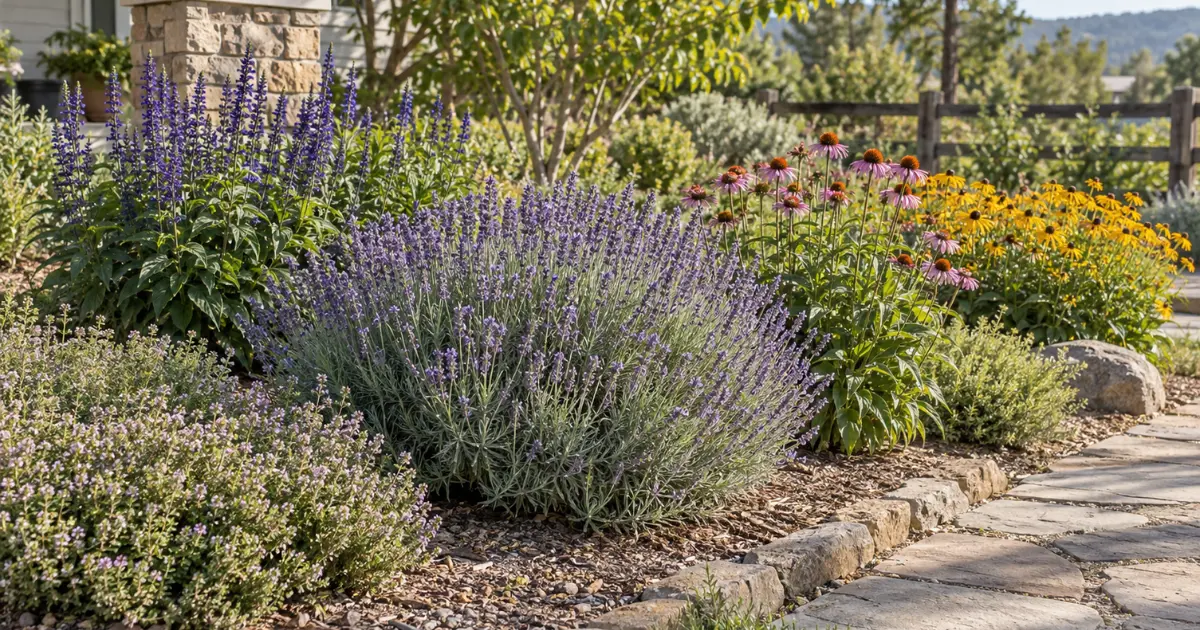
Coreopsis can provide a finer, lighter visual texture, while coneflower and black-eyed Susan can create a taller layer in many mixed borders. Yarrow can add broad flower clusters and finely divided foliage. Their exact sizes and habits depend on species and cultivar, so confirm mature dimensions before deciding where they belong.
This is where lavender companion plants work best as part of a planned border rather than a list. A taller plant can sit behind or offset from lavender instead of directly shading it. Lower or less bulky plants can occupy front edges or gaps as long as they do not crowd the lavender crown.
Seasonal appearance also matters. Different plants may peak at different times, and cultivars within the same genus can vary considerably. If a long display matters to you, compare actual bloom periods for the varieties available in your region instead of assuming every coreopsis, echinacea, Rudbeckia, or yarrow follows the same calendar.
Herbs That Grow Well With Lavender
Some of the strongest lavender companion plants for herb gardens are rosemary, culinary sage, and thyme because their traditional growing environments overlap in important ways.
Penn State Extension’s herb-growing guidance describes lavender, rosemary, sage, and thyme as Mediterranean herbs that thrive in full sun and dry, gravelly, well-drained soil. That does not mean they are interchangeable, but it gives them a stronger practical basis for consideration than an herb that needs consistently moist soil.
Rosemary requires the most climate caution. In places where winter cold makes it unreliable outdoors, you may prefer to grow it in a separate pot that can be moved rather than designing a permanent bed around it.
Thyme can be useful where a lower plant is desirable, but spreading forms should still be kept from smothering the base of lavender. Sage can work in the same sunny bed when the selected type has compatible drainage, moisture, mature size, and local hardiness.
For herb pairings, the value is straightforward: these plants can share similar cultural conditions. Do not assume that planting them together proves that one will repel pests or improve the other’s growth or flavor.
Can You Plant Vegetables With Lavender?
You can grow vegetables near lavender, but “near” does not always mean they should share the same immediate root zone.
Lavender companion plants in food gardens need especially careful water management because many vegetables perform best with more consistent moisture and greater fertility than lavender typically needs. University of Minnesota Extension notes that vegetable crops differ in water requirements and that several fruiting and cool-season vegetables need consistent moisture at important stages.
That creates a practical design question. If a vegetable bed is irrigated frequently and enriched heavily while lavender sits inside the same wet root zone, the conditions may suit the vegetable better than the lavender.
A better approach is often to place lavender at a dry, well-drained edge or nearby border where its irrigation can be managed separately. That allows you to grow vegetables in the same general garden without pretending they all need identical soil moisture.
There is no need to force a list of “best” vegetables into this article. If you are deciding what to plant with lavender near a food garden, compare the specific crop’s water, fertility, light, and space needs first.
What Not to Plant With Lavender
“What not to plant with lavender” is best understood as a compatibility question, not a blacklist. A good list of lavender companion plants is defined as much by shared site needs as by appearance.
Most poor pairings are not plants that biologically harm lavender. They are plants whose requirements make the shared site difficult to manage.
Plants That Prefer Consistently Moist Soil
A plant that needs reliably moist soil is usually awkward beside lavender if both occupy the same root zone. Keeping that companion happy may mean watering frequently enough to leave lavender wetter than is ideal.
This matters even more in heavy or poorly drained soil, where Colorado State University Extension warns that insufficient drainage can contribute to lavender root rot.
Instead of labeling every moisture-loving plant “bad,” place it in a different irrigation zone or a part of the garden designed for its needs.
Plants That Prefer Different Light Conditions
Shade plants can create the opposite problem. A plant selected for low-light conditions may struggle in the bright position chosen for lavender, while moving lavender into deeper shade to accommodate it undermines the purpose of the pairing.
The practical solution is not to force the combination. Use companions whose preferred light overlaps enough that both can perform in the intended location.
Plants That Create Crowding or Competition
Large, aggressive, or rapidly spreading plants can be poor neighbors if they move into the lavender crown, block airflow, overwhelm available root space, or shade the plant.
That does not make them harmful species in general. It means their growth habit may be incompatible with the size and layout of a particular lavender bed.
This is why mature spread belongs in the decision alongside sun and water. A pairing that looks spacious in its first season can become crowded later.
What to Plant With Lavender in a Border
A border gives you more flexibility than a shared pot because different roots can occupy a larger soil volume and you can create some separation between plants.
For border-focused lavender companion plants, start by placing the mature lavender in the design, not the small transplant you have today.
Choosing Plants by Height and Spread
Then position taller companions where they are less likely to shade lavender and lower companions where they will not run into its crown.
Yarrow, coneflower, black-eyed Susan, and some coreopsis selections can contribute a taller or mid-height flowering layer, depending on the exact cultivar. Thyme can fill a lower role. Rosemary and sage can add woody or shrubby structure where climate and space suit them.
Use labels and regional references for mature dimensions rather than assuming all plants within a genus stay the same size.
Creating a Long-Season Border
A long-season border does not require every plant to flower at the same time. In fact, a more useful design may combine plants that become visually prominent at different points in the season.
When comparing lavender companion plants for a border, check bloom timing for the exact cultivars you plan to buy, along with foliage texture and mature habit. The aim is a planting that remains balanced as plants grow—not a one-day color combination.
Avoid using rich soil, excessive compost, heavy irrigation, or dense planting simply to push faster growth.
What to Plant With Lavender in Containers
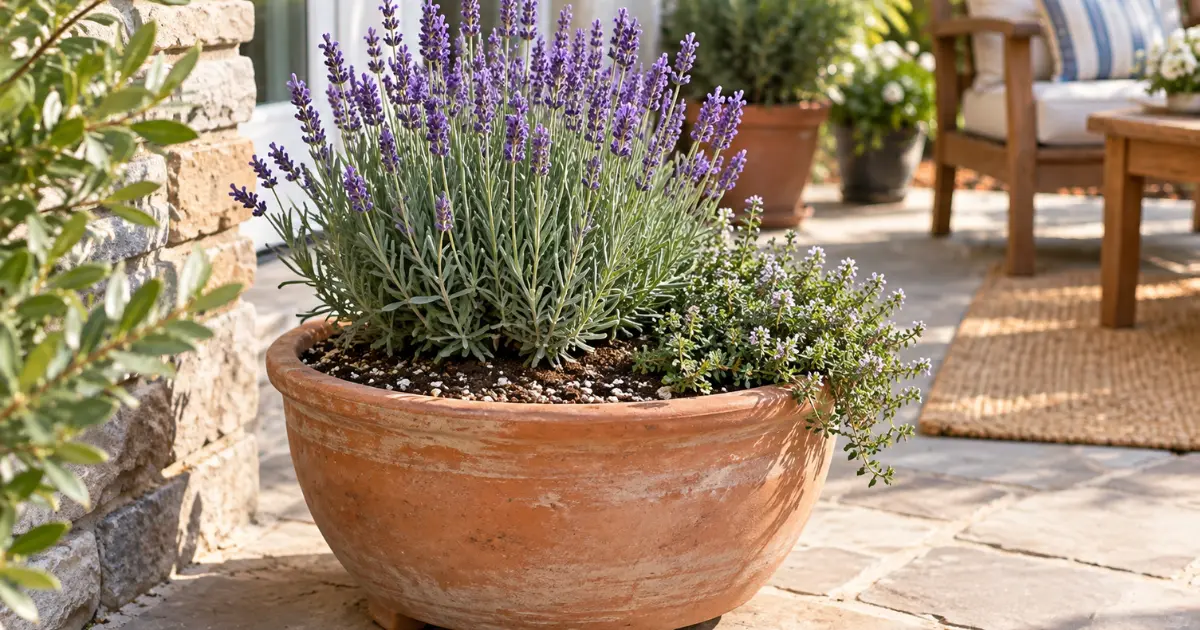
Sharing a container is more restrictive than growing two plants several feet apart in a border. The plants use the same potting medium, drainage, water supply, and limited root space.
Container lavender companion plants need a closer match in root-zone conditions than companions that merely share a garden bed.
Choose Plants With Compatible Water Needs
For a shared pot, choose a companion that will not require you to keep the entire container consistently wetter than the lavender should be.
Thyme can be easier to consider than a moisture-loving plant because many thymes tolerate the kind of free-draining conditions used for lavender. A suitably chosen sage may also work. Rosemary can share similar drainage preferences, but its eventual size can make a long-term shared container impractical.
The fact that two plants are good lavender companion plants in a garden bed does not automatically make them good roommates in one pot.
Allow Enough Room for Each Plant
Containers magnify crowding. Lavender needs room for its crown and root system, while the companion needs enough space to grow without smothering or shading it.
Choose the container based on the mature planting, not the nursery-pot sizes. If two plants will quickly fill the available root space, separate pots placed beside each other can give the same visual effect with easier watering and maintenance.
Common Lavender Companion-Planting Mistakes
- Choosing companions only by appearance. Color and flower shape matter for design, but they do not tell you whether two plants can share the same root-zone conditions.
- Ignoring moisture compatibility. A companion that needs constantly moist soil can force you into a watering regime that is poorly matched to lavender.
- Overlooking drainage. Even otherwise compatible plants can struggle if the site holds water around lavender roots.
- Planting too closely. Empty space at planting time is temporary. Allow for mature width and airflow.
- Ignoring mature plant size. A taller or spreading companion may eventually shade, crowd, or overtake lavender even if the first-year combination looks balanced.
- Forgetting local climate and hardiness. Rosemary is a classic example of a plant that can share lavender’s sunny, well-drained preferences but may not survive winter outdoors in colder regions.
- Assuming “companion” means proven biological benefit. Cultural compatibility does not demonstrate pest repellence, disease prevention, increased flowering, or improved growth.
- Assuming every bed companion will work in the same container. Pots have tighter root-space and watering constraints, so shared-container pairings need stricter compatibility.
Frequently Asked Questions About Lavender Companion
What is the best companion plant for lavender?
There is no single universally best companion. The best choice is a plant that suits your local climate and can share lavender’s light, drainage, moisture, and space conditions. Among lavender companion plants, rosemary, sage, thyme, yarrow, and several sun-loving flowering perennials can all be candidates in the right site.
What should you not plant next to lavender?
Low-growing thyme or a suitably chosen sage can be practical possibilities when the container is large enough and the plants have compatible drainage and moisture needs. Separate pots may be better when mature sizes or watering needs differ.
What can you plant with lavender in a container?
Low-growing thyme or a suitably chosen sage can be practical possibilities when the container is large enough and the plants have compatible drainage and moisture needs. Separate pots may be better when mature sizes or watering needs differ.
What vegetables can grow with lavender?
Lavender can grow near a vegetable garden, but many vegetables require more consistent soil moisture and fertility. Rather than relying on a universal vegetable list, keep lavender in a well-drained area where irrigation can be managed appropriately and compare the needs of the specific crop before placing it close by.
Can rosemary and lavender grow together?
They can be a practical pairing where the climate and site suit both plants because they share preferences for bright, freely drained conditions. The main limitation is climate: rosemary is not reliably winter-hardy outdoors in every part of the United States.
Can you plant different lavender companion plants together?
Yes, provided the entire combination still works as a planting. Check the light, drainage, moisture needs, mature size, growth habit, and hardiness of every plant rather than assuming that two plants compatible with lavender are automatically compatible with each other.
Build a Lavender Planting That Works as a Whole
Choosing lavender companion plants is less about finding a magical list and more about building a planting whose parts can live under the same practical conditions.
Start with lavender’s need for a bright, freely drained site. Then compare each potential companion for moisture needs, mature size, growth habit, local hardiness, and the amount of space available. Rosemary, sage, thyme, coreopsis, coneflower, black-eyed Susan, and yarrow can all deserve consideration when the exact plant and site align.
Use the same logic when deciding what to plant with lavender in a border or container. Give each plant enough room, avoid creating a constantly wet root zone, and do not mistake visual appeal or companion-planting folklore for evidence of a special biological effect.
A well-planned combination does not need one plant to “help” another. It simply needs the plants to fit the place—and each other.