
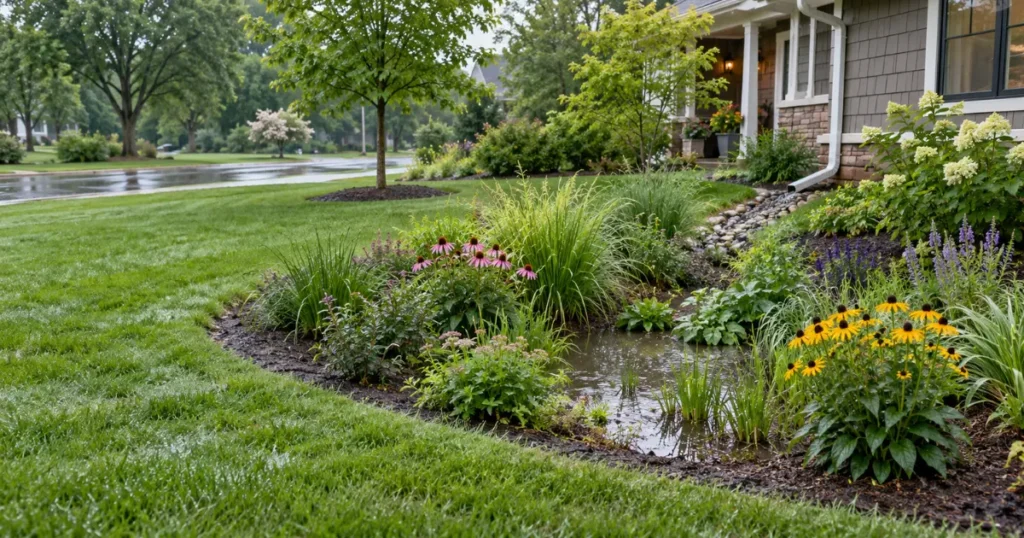
Rain garden collecting runoff in a residential yard after rainfall

Rain Garden: What It Is, How It Works & Is It Right for Your Yard?

After a heavy downpour, water running off your roof, driveway, patio, or other hard surfaces has to go somewhere. On many properties, that runoff moves quickly across the yard or toward a storm drain instead of soaking gradually into the soil.

A rain garden is one way homeowners may be able to manage part of that runoff within the landscape. Rather than functioning like a pond, it temporarily receives stormwater in a shallow planted area and, where soil and site conditions allow, gives that water time to slow down and soak into the ground.

That does not make it a guaranteed fix for flooding, standing water, or every drainage problem. The location, soil, slope, runoff source, nearby structures, utilities, and other property conditions all matter.

This guide explains what this type of stormwater feature is, how it works, what benefits it may provide, and the first questions to ask before deciding whether your yard is a suitable place for one.

Quick Summary

  • A rain garden is generally a shallow planted depression designed to receive stormwater runoff from part of a property.
  • Runoff may come from roofs, downspouts, driveways, patios, or other areas that shed water.
  • The planted basin temporarily holds and slows stormwater rather than functioning as a permanent pond.
  • Where site and soil conditions are suitable, some captured water can infiltrate into the ground.
  • These systems can help reduce the speed and amount of runoff moving directly toward storm drains or waterways.
  • Soil, infiltration, slope, groundwater, and existing drainage conditions all affect whether a site is appropriate.
  • Foundations, utilities, wells, septic systems, tree roots, and local requirements should be considered before excavation.
  • Plant selection comes later and should match the moisture, light, and other conditions within the finished feature.

What Is a Rain Garden?

At its simplest, this type of feature is a shallow planted depression that receives stormwater runoff from a defined area of the property.

The contributing area might be part of a roof connected to a downspout, a driveway, a walkway, a patio, or another surface that sheds water rather than allowing much of it to soak into the ground where it falls.

During a storm, runoff enters the depression and is temporarily stored there. Soil, vegetation, mulch or other surface materials, and the shape of the basin help slow the water. Where the underlying site can accept it, some of that water then infiltrates into the soil.

That temporary storage is an important distinction.

These features are not intended to function as permanent ponds, wetlands, or chronically waterlogged flower beds. They are designed around changing moisture conditions: wetter during and shortly after rainfall, then progressively drier afterward.

They are also more than ordinary garden beds because their location and shape have a stormwater-management purpose.

Terminology can vary. The US Environmental Protection Agency distinguishes smaller, relatively simple residential rain gardens from more engineered bioretention areas, which may use specially designed soil media, gravel layers, or underdrains. Some municipalities use the terms more loosely or interchangeably. The EPA’s overview of bioretention and other green infrastructure types explains that distinction and notes that engineered systems may either infiltrate water or convey it through an underdrain.

For a homeowner, the practical takeaway is that the basic concept is straightforward, but the details should still respond to the actual property rather than following one identical template everywhere.

How Does It Work?

A rain garden works by interrupting the fast movement of stormwater and giving that water a place to collect temporarily within a planted landscape feature.

Roof runoff flowing toward a shallow planted rain garden after rainfall

The basic sequence looks like this:

rainfall → runoff → entry → temporary storage → slowing and filtering → infiltration where conditions allow → safe overflow when needed

Rain first lands on the house, driveway, walkways, lawn, and other surfaces.

Some of it soaks into permeable ground, but water landing on roofs, pavement, compacted areas, and similar surfaces can become runoff. That runoff moves downhill unless it is intercepted or redirected.

When the system is properly located, a portion of that flow enters the shallow planted basin.

Once inside, the depression temporarily holds the runoff instead of allowing all of it to continue moving rapidly across the property. Vegetation, soil, surface materials, and the shape of the feature slow the water and may help trap sediment or reduce some pollutants carried in the runoff.

The EPA describes bioretention practices as landscaped depressions that collect stormwater from impervious surfaces and filter it through vegetation and soil or engineered media.

Where the native soil and subsurface conditions are suitable, part of the stored water can infiltrate into the ground. In more engineered situations, an underdrain or another drainage component may also be involved.

Larger storms introduce another consideration: overflow.

A residential stormwater feature cannot reasonably be expected to hold every possible rainfall event. Water that exceeds its temporary storage capacity needs a safe route that does not create erosion, send runoff toward a foundation, or cause another drainage problem elsewhere.

This is why simply digging a low area in the yard is not enough. Runoff source, soil behavior, entry and overflow routes, and surrounding site conditions all work together.

Benefits for Your Yard and Local Waterways

One of the most useful benefits of these planted systems is that they can slow stormwater runoff close to where it is produced.

Instead of runoff moving immediately from a roof or paved area toward the street, storm drain, or nearby waterway, some of it can be temporarily captured within the landscape.

Where soil and subsurface conditions permit infiltration, that additional time may allow more water to soak into the ground. EPA green-infrastructure guidance describes infiltration, filtration, temporary detention, and evapotranspiration as functions that bioretention systems can provide, depending on their design.

Slowing runoff may also reduce the amount of sediment and some pollutants moving directly downstream. Soil, vegetation, and biological processes can contribute to treatment, although the result depends on the pollutants involved and the way the system is built and maintained.

That is different from saying runoff becomes completely purified.

Rain gardens can also turn a stormwater-management function into part of an ordinary home landscape. Appropriate grasses, flowering perennials, shrubs, or other vegetation can provide visual interest while helping stabilize the planted area.

Depending on the plants selected and the surrounding habitat, the planting may also provide food, shelter, or foraging opportunities for pollinators, birds, and other wildlife. EPA information on stormwater runoff notes that these planted systems can provide habitat as well as runoff-management benefits.

If supporting pollinators is one of your broader garden goals, our guide to creating a pollinator garden explains how plant diversity, season-long blooms, habitat, water, and maintenance can work together.

The practical benefit is therefore not one single outcome. A well-sited system may combine stormwater management, landscaping, infiltration, filtration, and habitat value.

How much benefit it provides depends on the property, contributing drainage area, soil, rainfall, design, plant community, and maintenance.

Is It Right for Your Yard?

Before deciding whether a rain garden belongs on your property, start with the site rather than with a plant list or a preferred garden shape.
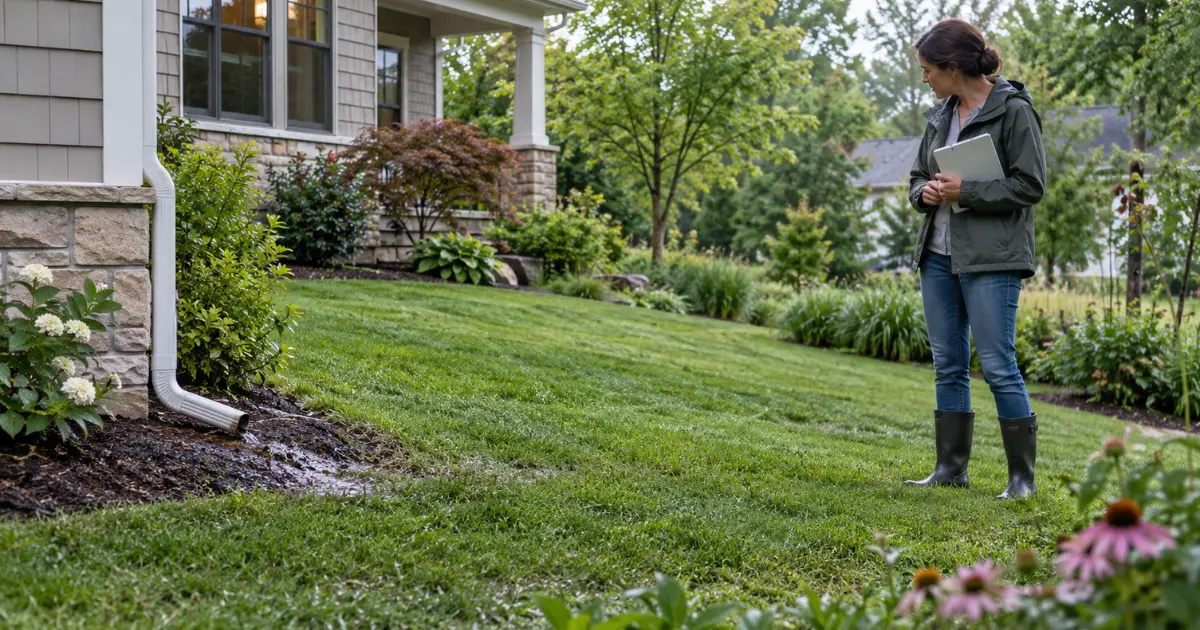
Homeowner evaluating a suitable location for a rain garden in the yard

A suitable location needs to receive runoff safely while also allowing that water to be managed without creating problems for buildings, neighboring property, utilities, septic systems, wells, trees, or other important site features.

The questions below are useful for deciding whether the idea deserves further investigation.

Identify Where the Runoff Comes From

First, identify the water you are trying to manage.

Common sources include a roof and downspout, driveway, patio, walkway, or runoff moving across another part of the landscape.

Watching the property during a normal rainfall can be very informative.

Look for three things:

Where does the water come from? → Where does it travel now? → Where could it safely be directed?

For example, roof runoff may currently leave a downspout and move across a lawn toward a driveway. In another yard, runoff may flow from a paved surface directly toward a storm drain.

The planted basin needs a contributing source of water, but that does not mean every downspout or paved area should automatically be redirected.

The route between the runoff source and the proposed location matters. Water should not be directed in a way that causes erosion, crosses an unsuitable area, or simply transfers the problem somewhere else.

Detailed piping, grading, and inlet construction belong to the design stage. At this point, the homeowner’s job is simply to understand the existing water path.

Check Whether the Site Can Handle the Water

A depression can hold water temporarily, but that does not automatically mean the underlying site can manage it successfully.

Soil characteristics influence how quickly water moves into and through the ground. Subsurface compaction, shallow restrictive layers, groundwater conditions, fill soil, and other site characteristics can also affect infiltration.

Penn State Extension emphasizes that successful installations begin with careful site selection and that knowing how the soil drains is important before construction. Penn State Extension’s introduction to site selection for rain gardens

The important beginner-level question is:

Can this location receive runoff and then release or infiltrate that water appropriately?

That cannot be answered simply by looking at the surface.

Some properties may require a formal infiltration assessment, different stormwater practice, engineered drainage, or professional guidance. Soil amendment or an underdrain can be part of some engineered systems, but those are design decisions rather than assumptions to make before the site has been evaluated.

Avoid relying on one universal infiltration threshold or one standard soil recipe. Local stormwater requirements and site conditions should guide the detailed assessment.

Consider Slope and Landscape Position

Water follows gravity, so landscape position has a major influence on feasibility.

A relatively gentle area where runoff can enter without excessive velocity is generally easier to work with than a steep slope. On a steeper site, excavation, erosion control, overflow, and maintaining a level storage area become more complicated.

That does not mean every sloping property is unsuitable.

It means slope should be evaluated as part of the design rather than treated as an afterthought.

The proposed basin also needs to fit into the larger drainage pattern. Capturing runoff in one place should not send overflow toward a neighbor, across a walkway, against a structure, or down a slope where erosion could develop.

Local guidance is especially valuable here because slope recommendations and design requirements vary among jurisdictions and stormwater programs.

At this stage, identify where the land rises and falls, where water naturally moves, and whether the proposed location could manage that flow without creating a new problem elsewhere.

Check Structures, Utilities and Other Site Constraints

Stormwater should not be deliberately concentrated next to something that could be damaged by additional subsurface moisture or excavation.

Before going further, identify nearby:

  • house and garage foundations;
  • underground electric, gas, water, sewer, communications, or other utilities;
  • septic tanks and drain fields;
  • private wells;
  • significant tree-root zones;
  • retaining walls or other structures;
  • possible high groundwater or other subsurface concerns;
  • known or suspected contaminated soil.

Setback recommendations vary by location and site condition, so avoid assuming that one nationwide distance from a foundation, well, or septic system applies everywhere.

Instead, check local stormwater, building, environmental-health, or municipal guidance before finalizing a location.

Before excavation, US homeowners should also have underground utilities located through the appropriate local 811 call-before-you-dig service.

Penn State Extension likewise recommends considering foundations, septic systems, wells, tree roots, waterlogged areas, and underground utilities during site selection.

If the property has unusual groundwater, drainage, septic, contamination, structural, or slope concerns, professional advice may be more appropriate than trying to solve the issue through a simple landscaping project.

Don’t Automatically Choose the Wettest Spot

A common assumption is that the part of the yard that already collects water must be the obvious place for a planted stormwater basin.

Sometimes it may be worth evaluating, but persistent wetness is a reason to investigate the site first, not proof that the location is suitable.

An area that remains soggy long after rainfall could indicate slow infiltration, compacted soil, a shallow restrictive layer, high groundwater, or another drainage issue.

Minnesota guidance warns specifically against automatically placing these features where water already ponds because existing wet patches can indicate poor infiltration. Penn State Extension similarly recommends choosing low areas that receive runoff but are not permanently waterlogged.

There are situations in which a low part of a property may still be suitable after proper assessment. The key is understanding why the area is wet.

If water arrives there briefly after storms and the soil then drains appropriately, that is a different situation from a location that remains saturated for long periods because the underlying site cannot readily accept more water.

Before treating an existing wet patch as the solution, identify the cause of the wetness and confirm that concentrating additional runoff there will not make the problem worse.

What Does It Need to Function?

A planted stormwater feature works only when several parts work together. The goal is not simply to create a low spot, but to give runoff a safe place to enter, slow down, collect temporarily, and leave appropriately.

At a basic level, the system needs:

  • A defined runoff source. Water should come from a known area such as a roof, driveway, patio, or another surface that sheds rainfall.
  • A safe entry route. Runoff needs a controlled path into the planted basin without causing erosion.
  • A shallow receiving area. The depression provides temporary storage during and shortly after storms.
  • Suitable soil and subsurface conditions. The site must be able to manage incoming water without creating chronic saturation or another drainage problem.
  • Appropriate vegetation. Plants should suit the site’s moisture pattern, sunlight, climate, and soil.
  • Surface protection where appropriate. Vegetation, mulch, or another suitable surface can help protect exposed soil.
  • A safe overflow route. During larger storms, excess water needs somewhere to go without damaging structures or neighboring areas.

These elements depend on one another. Good plants cannot compensate for an unsuitable location, and a promising location still needs appropriate water entry and overflow.

Because rainfall, soil, slope, and local requirements vary, the details should be based on the individual property rather than one standard layout.

How a Rain Garden Is Created: The Basic Process

Creating one begins with planning rather than digging. The overall process is straightforward, but dimensions, materials, and construction details need to respond to the site.

  1. Identify the runoff source. Determine which roof area, driveway, patio, or other surface will contribute water.
  2. Evaluate a suitable location. Consider where runoff can be directed without creating problems near structures, utilities, property boundaries, or sensitive areas.
  3. Assess soil and site conditions. Soil behavior, slope, groundwater, existing drainage, and other constraints affect feasibility.
  4. Develop an appropriate design. Size, shape, depth, inlet, overflow, and any drainage components should follow site-specific and local guidance.
  5. Prepare the receiving area. The site is shaped to receive and temporarily store runoff while supporting vegetation.
  6. Install suitable plants. Vegetation should match the site’s moisture pattern, sunlight, soil, climate, and available space.
  7. Establish and inspect the feature. New plants need care while roots develop, and the system should be observed after storms.

If you are also new to establishing a garden, our guide on how to start a garden explains the broader basics of site assessment, soil preparation, plant selection, planting, and early care.

This overview explains the sequence without replacing a detailed construction plan. Excavation depth, sizing, soil amendments, underdrains, inlets, and overflow structures can vary substantially from one property to another.

What Kinds of Plants Work in One?

Plants in a stormwater basin may experience changing moisture conditions. After a storm, some areas may be temporarily wet, while the same soil can become much drier between rainfall events.

Plant choice therefore depends on more than appearance.

Consider:

  • sunlight;
  • local climate and winter hardiness;
  • soil and drainage;
  • how long different parts of the basin stay moist;
  • mature plant size and spread;
  • tolerance of alternating wetter and drier conditions.

Grasses, sedges, flowering perennials, and shrubs can all play useful roles, but the right combination varies by region and by position within the planted area.

Native species can be valuable when they are well suited to the site, but native status alone does not guarantee that a plant matches the moisture, light, or soil conditions. Avoid invasive species and favor locally appropriate recommendations.

Mature size matters too. Plants should not eventually block an inlet, crowd an overflow area, or overwhelm neighboring vegetation simply because they looked compact when first installed.

Rain Garden Maintenance

Installation is only the beginning. Ongoing care helps the planted basin continue functioning while keeping the planting healthy.

During establishment, new plants may need supplemental water when rainfall is inadequate. The frequency depends on weather, soil, species, and root development rather than one universal schedule.

Routine care may include:

  • removing weeds;
  • replacing failed plants;
  • maintaining mulch where it is part of the design;
  • checking for exposed soil or erosion;
  • keeping water-entry routes clear of leaves and debris;
  • removing accumulated sediment when necessary;
  • checking overflow routes;
  • inspecting the area after significant storms.

Pay attention to what happens after rainfall. Temporary ponding is expected, but unexpectedly persistent standing water deserves investigation because it can indicate blocked flow, sediment buildup, changing soil conditions, or another site issue.

Maintenance needs also change with the season and planting style. A densely planted perennial basin may need different care from one dominated by grasses or shrubs.

The most useful habit is regular observation: confirm that runoff can still enter, vegetation remains healthy, exposed soil is protected, and excess water has a safe route during larger storms.

Common Mistakes to Avoid

Assuming the wettest part of the yard is automatically the right location.
Persistent wetness may indicate poor infiltration, groundwater issues, compaction, or another drainage problem. Understand the cause before directing additional runoff there.

Ignoring soil and subsurface conditions.
A depression alone does not guarantee that water will infiltrate or drain appropriately.

Directing runoff too close to sensitive areas.
Foundations, wells, septic systems, utilities, retaining walls, and other site features need to be considered before water is redirected.

Copying one size or depth from another property.
Drainage area, rainfall, slope, soil, and local requirements influence design. One set of dimensions does not fit every yard.

Choosing plants only for appearance.
Vegetation also needs to suit sunlight, moisture patterns, climate, soil, and mature size.

Forgetting where excess water will go.
Large storms can exceed temporary storage capacity. Overflow needs a safe route that does not create erosion or move water toward structures or neighboring property.

Neglecting establishment and maintenance.
New plants need care, and runoff pathways, sediment, erosion, weeds, and plant health should be monitored over time.

Successful performance depends on the full system: site, design, vegetation, water movement, and continued observation.

Frequently Asked Questions

Are Rain Gardens Supposed to Hold Water?

Yes, temporarily.

These planted depressions are intended to collect stormwater for a period after rainfall rather than behave like permanent ponds.

If water remains standing much longer than expected, the reason should be investigated. Soil conditions, groundwater, sediment, blocked flow paths, design, or maintenance can all affect how water behaves.

There is no single drainage-time rule that applies to every property.

Not necessarily.

The main concern is whether standing water persists long enough to provide suitable mosquito breeding habitat. These systems are intended for temporary stormwater storage rather than permanent stagnant water.

If water regularly remains for unexpectedly long periods, investigate the cause instead of assuming that condition is normal. Site, soil, maintenance, and design can all affect drainage.

No. A rain garden needs a location that can safely receive and manage runoff without creating another problem.

Consider the runoff source, soil and infiltration conditions, slope, foundations, underground utilities, wells or septic systems where relevant, existing wetness, and local stormwater requirements.

If a site has persistent saturation, unusual groundwater conditions, contamination concerns, steep slopes, or conflicts with structures or utilities, another approach or professional guidance may be more appropriate.

No, although locally appropriate native plants can be valuable choices.

Plants still need to match the site’s sunlight, soil, moisture pattern, climate, mature size, and growth habit. A native species that dislikes the site’s conditions is not automatically a good choice simply because it occurs naturally in the wider region.

Avoid invasive species, and use locally relevant Extension, conservation, or stormwater guidance when selecting vegetation.

The feature discussed here is generally a shallow planted depression that receives and temporarily stores runoff.

A bioswale is usually a vegetated, often linear feature designed to convey runoff while slowing water and supporting filtration, infiltration, or other treatment functions.

The purposes can overlap, and terminology varies among local programs. In general, bioswales emphasize movement along a vegetated channel, while planted basins emphasize temporary storage.

Conclusion: Is This Approach Right for Your Landscape

A rain garden can help manage part of a property’s runoff while adding a useful planted feature, but suitability should be established before installation.

Start by understanding where the water comes from and where it currently travels. Then consider the soil, slope, nearby structures, underground utilities, septic or well constraints, existing wet areas, and where excess water could move safely during larger storms.

Where those factors align, this approach may help slow stormwater, support infiltration where conditions permit, and integrate runoff management into the landscape. Where they do not, a different drainage or stormwater strategy may be more appropriate.

The best next step is not automatically to start digging. It is to understand the property well enough to choose a solution that fits the actual site.

Leave a Comment

Your email address will not be published. Required fields are marked *

Scroll to Top