
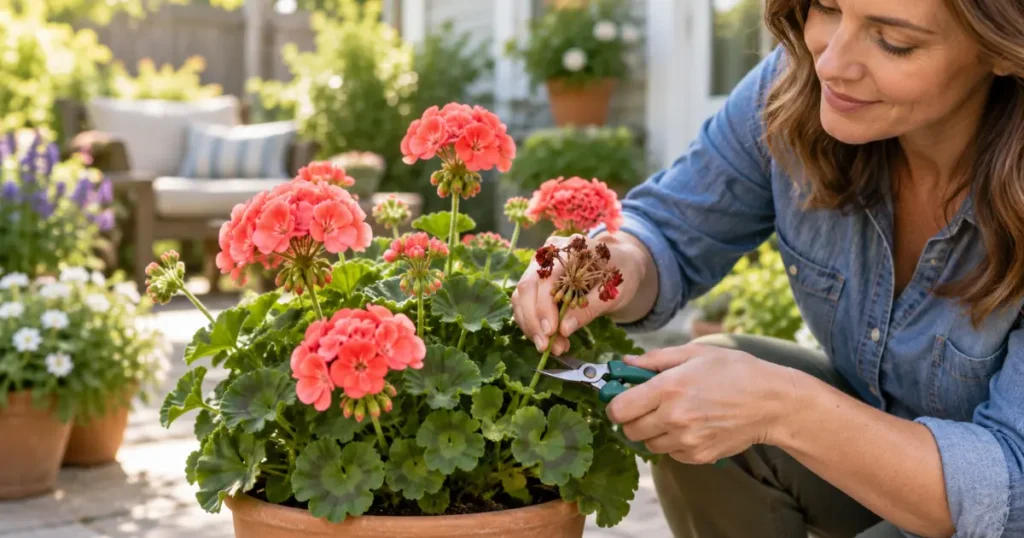
How to deadhead geraniums by carefully removing a spent flower cluster from a healthy geranium plant

How to Deadhead Geraniums for Healthy, Longer-Lasting Blooms

Deadheading means removing spent flowers after they fade. If you are learning how to deadhead geraniums, the basic job is to identify a finished flower cluster, follow its flower stalk down to where it joins the main stem, and remove that stalk cleanly without damaging healthy growth. For the common bedding and container geraniums most often grown in US gardens, regular deadheading helps keep plants tidy and can encourage continued flowering.

In this guide, “geraniums” mainly refers to the familiar bedding and container plants botanically known as Pelargonium. Hardy cranesbill geraniums belong to the genus Geranium and may need different treatment after flowering.

The sections below show when a flower cluster is ready to remove, where to make the cut or snap, and how to handle the stalk so you do not mistake it for a leaf stalk, unopened bud, or main stem.

Quick Summary

  • Deadheading means removing faded or spent flowers so the plant stays tidy and does not keep investing in finished flower clusters.
  • Common bedding and container Pelargonium geraniums generally benefit from regular deadheading.
  • Learning how to deadhead geraniums starts with waiting until most or all flowers in a cluster are spent.
  • If only one or two flowers have faded, you can remove those individually and leave the rest of the attractive cluster in place.
  • Once a whole cluster is finished, trace its flower stalk down toward the point where it joins the main stem.
  • Remove the spent stalk cleanly by snapping it away if it releases easily or by cutting it with clean snips.
  • For container geraniums, the basic technique is the same: remove the spent flower stalk without damaging healthy leaves, buds, or stems.
  • Hardy cranesbill geraniums are different plants and may need different treatment after flowering.

Should You Deadhead Geraniums?

For common bedding and container Pelargonium geraniums, regular deadheading is generally worthwhile.

The most obvious benefit is appearance. Removing faded flower clusters keeps the plant from carrying brown, shriveled petals and old flower stalks long after the display has finished.

Deadheading can also reduce seed development and may encourage the plant to continue producing flowers rather than directing resources into maturing seed. Iowa State University Extension recommends removing spent flowers from annual geraniums to help maintain flowering and appearance.

There is also a simple housekeeping benefit: removing decaying floral material keeps old, collapsing flower parts from remaining on the plant unnecessarily.

However, deadheading is not a cure-all. It will not compensate for poor light, incorrect watering, unsuitable nutrition, or other growing problems. It also does not guarantee nonstop flowers throughout the season.

The important point is that deadheading geraniums is a maintenance task, not a substitute for broader plant care.

It is also worth keeping the botanical distinction in mind. The technique described here is aimed primarily at common Pelargonium bedding and container plants. Hardy Geranium species can behave differently after flowering and should not automatically be treated in exactly the same way.

When to Deadhead Geraniums

The best time to remove a flower cluster is based on how the cluster looks, not on a fixed calendar.

Check flowering plants regularly and look for signs that a cluster is finishing:

  • flower color is fading;
  • petals are browning or shriveling;
  • petals are beginning to fall;
  • most or all flowers in the cluster have finished and are clearly past their best.

Do not remove an entire cluster simply because one individual flower has faded while the rest still looks attractive.

Geranium flower heads contain multiple individual flowers, and they may not all finish at exactly the same time. If one or two flowers become untidy, you can remove those individually while allowing the remaining fresh flowers and buds to continue.

Once the cluster as a whole is spent, remove the flower cluster together with its stalk rather than just picking off the dry petals and leaving the old stalk behind.

This condition-based approach is more useful than a rigid schedule such as deadheading every few days or once a week. Weather, cultivar, plant vigor, and flowering stage can all affect how quickly individual clusters fade.

Where to Deadhead Geraniums

The key to where to deadhead geraniums is identifying the flower stalk correctly.

Start at the spent flower cluster. Beneath it is the stalk that supported that entire flower head. Follow this stalk downward toward the body of the plant.

Keep tracing it until you reach the point where the flower stalk joins the main stem.

That junction is your target area.

Once the whole cluster is spent, remove the flower stalk close to where it connects with the main stem while taking care not to cut into or damage the main stem itself.

For a first-time gardener, it helps to distinguish the plant parts before removing anything:

  • Flower cluster: the group of individual flowers at the top.
  • Flower stalk: the stalk carrying that flower cluster.
  • Main stem: the thicker structural stem supporting leaves and flower stalks.
  • Leaf stalk or petiole: the stalk connecting a leaf to the main stem.
  • Unopened flower buds: healthy developing flower clusters that should remain on the plant.
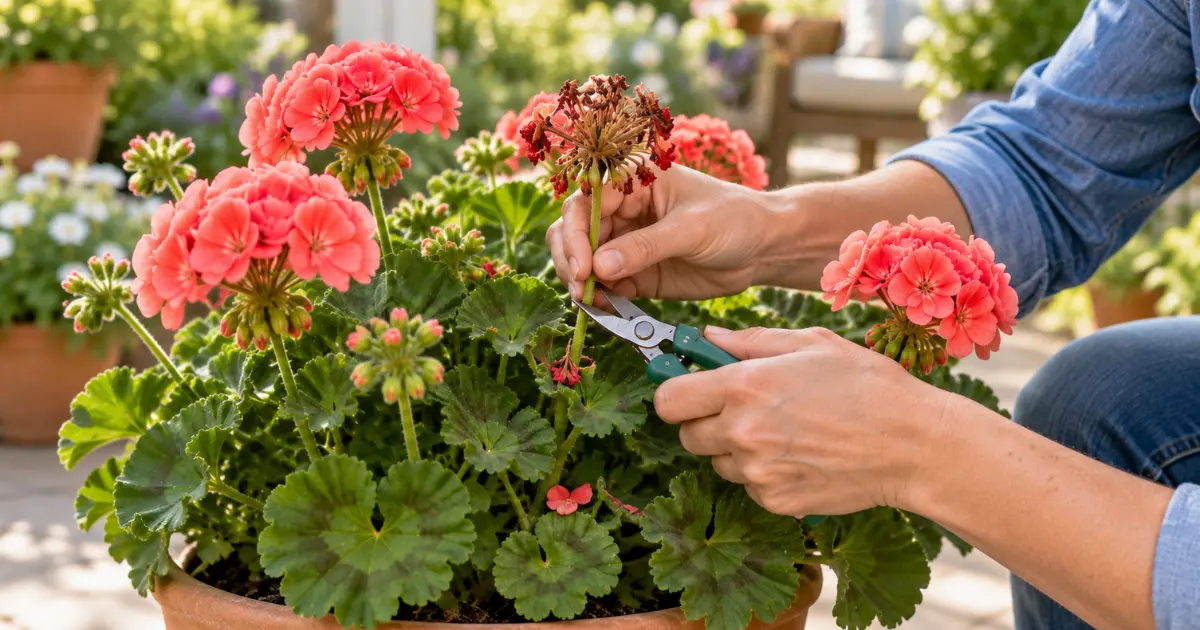
Gardener showing where to remove a spent geranium flower stalk near the main stem

If you only pick off the brown petals from a fully spent flower head, the long empty flower stalk may remain. Once the entire cluster has finished, the more complete deadheading job is to remove that spent stalk back near its point of attachment.

The Royal Horticultural Society’s deadheading guidance similarly emphasizes removing faded flowers carefully while avoiding damage to healthy buds and growth.

How to Deadhead Geraniums Step by Step

Once you can recognize a finished flower cluster and trace its stalk, how to deadhead geraniums becomes a simple, repeatable task. Work one cluster at a time and keep your attention on the flower stalk so you do not accidentally remove healthy buds, leaves, or vegetative stems.

Step 1: Identify a Spent Flower Cluster

Look closely at the flower head before removing it.

A fresh cluster may contain brightly colored open flowers, developing buds, and only a small number of fading petals. Leave that cluster in place if most of it is still attractive and actively flowering.

A partially fading cluster may have a few brown or shriveled flowers mixed with fresh ones. You can remove individual faded flowers if they are easy to take away without disturbing the rest of the cluster.

A fully spent cluster is different. Most of its flowers have faded, shriveled, browned, or dropped their petals, and the cluster has largely finished its display.

That is the point when the whole cluster and its flower stalk can be removed.

Be particularly careful not to mistake a compact group of unopened buds for a finished flower head.

Step 2: Follow the Flower Stalk to Its Base

Hold or visually identify the spent cluster and look directly beneath it.

Find the stalk supporting that flower head and trace it downward through the plant.

Do this slowly if the plant is dense. Geraniums can have many leaves, flower stalks, and developing buds close together, and a beginner can easily grab the wrong stem by working too quickly.

Follow only the stalk carrying the spent cluster until you see where it joins the main plant stem.

You are not trying to remove a leafy stem or cut back the plant. The target is specifically the flower stalk that has completed its job.

Step 3: Snap or Cut the Stalk Cleanly

You can remove the flower stalk in one of two ways.

Method A: Snap it cleanly. Some Pelargonium flower stalks can be carefully snapped away near their base when they release easily. If the stalk separates cleanly with gentle pressure, snapping can be a quick and practical method.

Method B: Cut it with clean snips or secateurs. Use this method if the stalk does not release readily, the plant is crowded, or you want greater control over exactly what is removed.
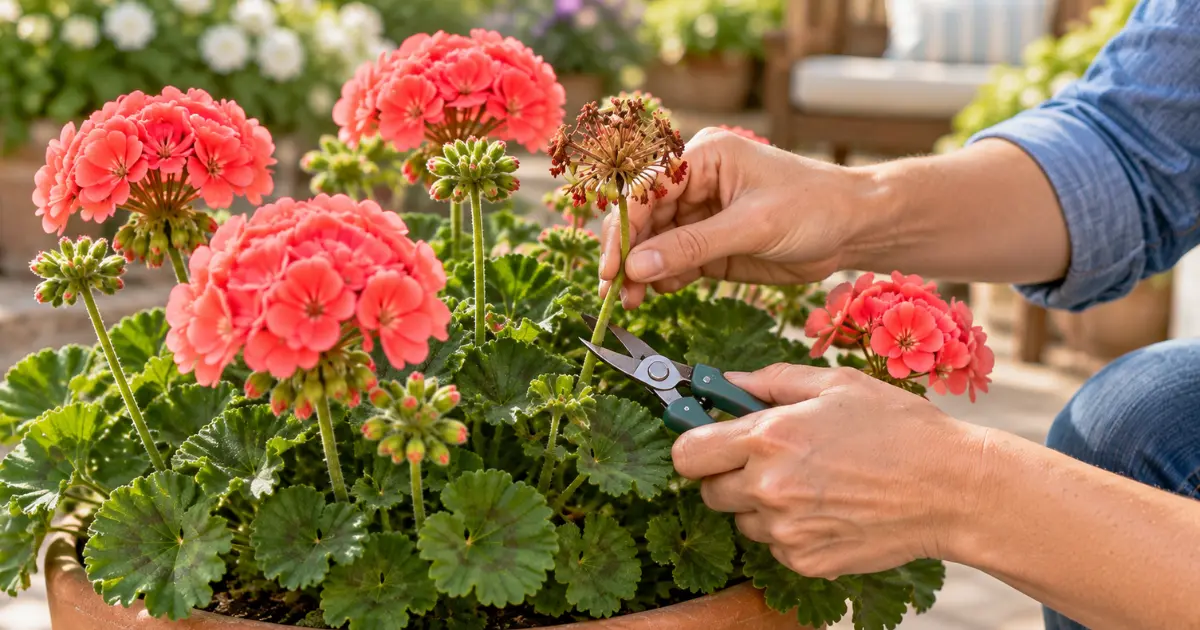
Gardener using clean snips to remove a spent geranium flower stalk without damaging healthy growth

Do not yank, wrench, or aggressively twist a resistant stalk.

If it resists, stop and cut it instead. A controlled, clean cut is preferable to tearing the surrounding plant tissue.

Whether you snap or cut, work close to the point where the flower stalk joins the main stem without cutting into the main stem itself.

Step 4: Remove the Spent Flower Stalk

Once the whole flower cluster has finished, remove both the spent cluster and the stalk that supported it.

Do not remove healthy leaves or vegetative stems as part of routine deadheading.

Try not to leave an unnecessarily long, bare flower stalk sticking out from the plant. At the same time, there is no reason to cut into the main stem in an attempt to make the removal perfectly flush.

The goal is straightforward: remove the finished flowering structure cleanly while leaving healthy plant tissue intact.

Step 5: Check the Rest of the Plant

After removing one spent cluster, look over the rest of the geranium.

You may find:

  • another fully spent cluster ready to remove;
  • a partially fading cluster that should remain for now;
  • fresh flowers;
  • unopened buds;
  • loose fallen petals or dead floral material resting among the leaves.

Remove other fully spent flower stalks as needed, and clear obvious loose dead floral material where it is easy to reach.

Then stop.

Routine deadheading should not automatically turn into a pruning session. Leave healthy leaves, unopened buds, and productive stems alone.

Do You Need Scissors to Deadhead Geraniums?

Not always.

Some spent Pelargonium flower stalks can be removed cleanly by hand. If the stalk releases easily near its base with gentle pressure, snapping it away is a practical option.

Scissors, garden snips, or small secateurs are useful when you want more control or when a flower stalk resists hand removal.

The important rule is not to force it.

If a stalk does not come away easily, cutting it cleanly is safer than pulling, twisting, or tearing until the surrounding tissue gives way.

Tools can also help when the plant is dense and you need to work around nearby buds, leaves, or stems with greater precision.

Use clean cutting tools and make the cut close to the flower stalk’s attachment point without cutting into the main stem.

Neither method is mandatory or universally superior. Hand-snapping can be quick when a stalk releases cleanly, while snips provide better control when it does not.

How to Deadhead Geraniums in Pots

The basic technique for container-grown Pelargonium geraniums is the same as for plants growing in a garden bed: identify a spent flower cluster, follow its flower stalk down toward the main stem, and remove the stalk close to its point of attachment without damaging healthy growth.

Deadheading geraniums in pots can require a little more care simply because container plants often become dense. Leaves, fresh flower clusters, and unopened buds may crowd around an old flower stalk and make it harder to see where that stalk begins and ends.

If necessary, gently support or move healthy foliage aside with one hand while tracing the spent stalk with the other. Make sure you are following the stalk connected to the faded cluster rather than a leaf stalk or a developing flower stem.

Once you reach the attachment point, remove the spent stalk using the same method described earlier:

  • snap it away gently if it releases cleanly;
  • use clean snips or secateurs if it resists;
  • avoid pulling or twisting hard enough to tear surrounding tissue.

Afterward, remove loose petals or dead floral material that has fallen onto the potting surface where practical. This keeps the container looking tidy and makes it easier to inspect the plant.

There is no separate deadheading technique required simply because a geranium is in a pot. The important difference is working carefully in the more confined, often crowded space around a container plant.

What to Do After Deadheading Geraniums

Ordinary deadheading does not require a special recovery routine.

Once you have removed a spent flower cluster and its stalk, clear away the discarded material rather than leaving it caught among the foliage or on the soil surface. If loose petals or other dead floral material are easy to reach, remove those as well.

Then look over the plant for any other clusters that are fully spent.

Leave healthy leaves, unopened buds, fresh flowers, and vegetative stems in place. The goal is to remove finished flowering growth, not to reshape the whole plant.

After that, return the geranium to its normal care routine.

You do not need to fertilize after every deadheading session, and there is no special watering treatment that must follow the removal of a spent stalk.

Continue checking the plant during flowering and remove additional clusters as they finish.

If you need broader guidance on sunlight, watering, soil, feeding, or general flowering conditions, see our geranium care guide rather than changing those routines solely because you have deadheaded the plant.

Does Deadheading Geraniums Encourage More Flowers?

For common bedding and container Pelargoniums, regular deadheading can encourage continued flowering.

After flowers fade, a plant may begin directing resources toward seed development. Removing the spent flower cluster and its stalk reduces that investment and can help the plant continue its flowering cycle instead.

That is one reason deadheading is routinely recommended for these geraniums.

However, it should not be treated as a guarantee of immediate rebloom or nonstop flowers.

Future flowering also depends on the plant’s overall growing conditions, including:

  • adequate light;
  • appropriate moisture;
  • nutrition;
  • temperature;
  • plant health;
  • cultivar or type;
  • normal seasonal growth patterns.

A geranium struggling because of poor light or another care problem will not necessarily begin flowering heavily simply because old flower stalks are removed.

It is therefore most accurate to think of deadheading as one useful part of flowering maintenance.

The task removes finished flowers, reduces seed development, and helps keep the plant directing its energy toward active growth rather than maintaining old flower structures. But the rest of the plant’s care still matters.

Do not expect a fixed number of flowers or a guaranteed number of days before new blooms appear. Different plants and growing conditions will produce different responses.

What About Hardy Geraniums?

The deadheading method used throughout most of this article is aimed primarily at the familiar bedding and container plants known botanically as Pelargonium.

Hardy or cranesbill geraniums belong to the genus Geranium, and their after-flowering maintenance can be different.

For many hardy geraniums, repeatedly removing individual flower stalks is not the main maintenance method. Depending on the species or cultivar, gardeners may instead cut back a larger amount of growth after flowering to tidy the plant, encourage fresh foliage, and sometimes promote another flush of flowers.

That is a different task from the routine individual flower-stalk deadheading described for Pelargonium.

The important beginner lesson is not to assume that every plant sold or described as a “geranium” should be handled in exactly the same way.

If you are growing a hardy cranesbill, identify the plant first and check guidance for that particular type before removing substantial growth. The Royal Horticultural Society’s guidance for hardy geraniums provides broader maintenance information for plants in the genus Geranium.

A complete hardy-geranium cutback method is outside the scope of this deadheading guide.

Deadheading vs Pruning Geraniums: What's the Difference?

Deadheading and pruning are related maintenance tasks, but they are not the same thing.

Deadheading means removing spent flowers and, for the common Pelargonium geraniums discussed here, the flower stalks that supported those finished clusters.

The target is flowering growth that has completed its display.

Pruning involves removing more substantial vegetative growth. Depending on the plant and purpose, pruning may be used to manage size, shape, old stems, leggy growth, or seasonal maintenance.

Routine deadheading should therefore not automatically turn into pruning.

If you find a spent flower cluster, follow its flower stalk and remove that stalk. Do not continue cutting healthy leafy stems simply because you already have the snips in your hand.

This distinction matters especially for beginners because flower stalks can disappear into dense foliage and be confused with structural stems.

Before cutting, identify what you are removing:

  • a spent flower cluster and its stalk = deadheading;
  • healthy leafy stems or larger sections of growth = pruning or cutting back.

Both tasks can have a place in geranium maintenance, but they have different purposes and should not be treated as interchangeable.

Common Geranium Deadheading Mistakes

  1. Removing only the brown petals from a completely spent cluster.
    Once the whole flower head has finished, trace the flower stalk downward and remove the spent cluster together with its stalk rather than leaving an empty stalk behind.
  2. Forcing a stalk that will not release.
    Some flower stalks snap away easily, but others do not. If gentle pressure does not release the stalk cleanly, use clean snips instead of pulling, wrenching, or aggressively twisting it.
  3. Accidentally removing unopened flower buds.
    Look closely before cutting. A developing bud cluster should remain on the plant even when it sits beside an old spent stalk.
  4. Waiting until the whole plant is covered in spent blooms.
    Check flowering plants regularly and remove clusters as they finish. There is no need for a rigid schedule, but occasional inspection makes the job easier.
  5. Turning deadheading into pruning.
    The routine task is to remove finished flower clusters and their stalks. Do not start shortening healthy leafy stems unless you are intentionally carrying out a separate pruning task.
  6. Using the same technique automatically on hardy geraniums.
    Pelargonium and hardy Geranium are different plants. Confirm which one you have before assuming their after-flowering maintenance should be identical.
  7. Expecting deadheading to solve every flowering problem.
    Removing spent blooms can encourage continued flowering, but light, water, nutrition, temperature, plant health, and cultivar also affect flower production.

A small deadheading error is unlikely to ruin a healthy geranium. The best approach is simply to slow down, identify the correct stalk, and protect healthy buds and stems.

Frequently Asked Questions

How often should you deadhead geraniums?

Check geraniums regularly while they are flowering and remove clusters as they become spent. Use the condition of the flower head rather than a fixed interval such as every few days or once a week.

For common bedding and container Pelargoniums, regular deadheading is generally beneficial. It keeps the plant tidy, removes finished flower clusters, and can encourage continued flowering. If you are learning how to deadhead geraniums, focus on removing the spent flower stalk without disturbing healthy buds or stems.

Yes. Some Pelargonium flower stalks release cleanly with gentle pressure and can be snapped away by hand. If a stalk resists, use clean snips or secateurs rather than pulling or tearing it.

You can remove individual faded flowers while the rest of a cluster is still attractive. Once the entire cluster is spent, follow its flower stalk toward the main stem and remove the spent cluster together with that stalk near its attachment point.

Do not cut into the main stem.

Yes. The basic technique for common container Pelargoniums is the same as for plants in the ground. Identify the spent cluster, trace its flower stalk, and remove that stalk while protecting healthy leaves and buds.

Deadheading can encourage continued flowering in common Pelargoniums, but it does not guarantee rebloom. Future flowers also depend on plant type, health, light, temperature, moisture, nutrition, and other growing conditions.

Final Thoughts

Once you understand how to deadhead geraniums, the task is straightforward: identify a flower cluster that has finished blooming, trace its stalk toward the main plant stem, and remove that spent stalk cleanly near its attachment point.

Snap the stalk only when it releases easily. If it resists, use clean snips rather than pulling or tearing the plant.

Work carefully around healthy leaves and unopened flower buds, and repeat the process as additional clusters fade.

Deadheading is a small routine maintenance task. It keeps common bedding and container Pelargoniums tidier and can encourage continued flowering, but it is not the same as pruning and it cannot replace good overall growing conditions.

Most importantly, make sure you know what kind of geranium you are growing. Hardy cranesbill geraniums may require a different approach after flowering than the common Pelargoniums covered throughout most of this guide.

Leave a Comment

Your email address will not be published. Required fields are marked *

Scroll to Top