
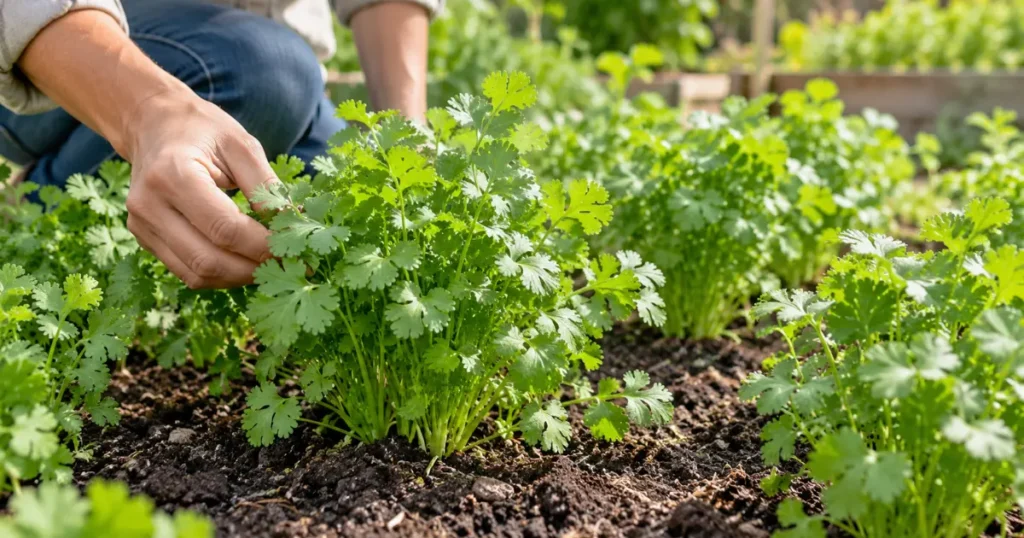
How to grow cilantro in a healthy home garden

How to Grow Cilantro: A Beginner’s Guide From Seed to Harvest

Cilantro is easy to germinate, but keeping it productive for more than a brief harvest can be the challenging part. The plant naturally moves from leafy growth to flowering and seed production, and warm conditions can speed that transition considerably.

Learning how to grow cilantro successfully therefore starts with timing. Sow it during the cooler part of your gardening season, give it well-drained soil and reliable moisture, and plan for repeat sowings rather than expecting one plant to produce tender leaves indefinitely.

This guide covers the complete process from sowing seed through germination, thinning, watering, routine care, bolting, leaf harvest, and eventual coriander seed production.

Quick Summary

  • Grow cilantro during cool weather: It produces leafy growth for longer when temperatures are moderate and moves toward flowering more quickly as conditions become warmer.
  • Use sun according to your climate: Full sun works well in cool conditions, while some afternoon shade can be useful where temperatures become hot.
  • Direct sowing is usually simplest: Cilantro develops a taproot and generally handles direct seeding better than unnecessary transplanting.
  • Plant seeds shallowly: About 1/4–1/2 inch deep is a useful range, with recommendations varying slightly among Extension sources.
  • Keep germinating seed consistently moist: Do not let the shallow seed zone repeatedly dry out, but avoid saturated soil.
  • Thin according to your goal: Plants grown mainly for leaves can be kept relatively close, while plants allowed to mature for coriander seed benefit from more room.
  • Use succession sowing: Planting small batches every few weeks is generally more reliable than trying to keep one planting leafy throughout the season.
  • Expect bolting eventually: Flowering is part of cilantro’s normal life cycle. After flowering, mature seeds can be harvested as coriander.

What Is Cilantro?

Cilantro and coriander come from the same annual plant, Coriandrum sativum.

In American usage, cilantro normally refers to the fresh leaves and stems, while coriander refers to the mature dried seeds. Illinois Extension describes it simply as two culinary products from one plant. Illinois Extension

That distinction is useful in the garden because cilantro changes considerably as it matures.

The young plant initially develops broad, leafy growth that gardeners harvest as cilantro. As it approaches reproduction, the stems elongate, the upper foliage becomes finer, and clusters of small flowers appear. Those flowers eventually develop the round fruits commonly harvested as coriander seed.

Cilantro is therefore not a leafy herb that naturally remains in the same harvest stage all season. Its life cycle is:

seed → seedling → leafy growth → bolting → flowering → coriander seed

Understanding that progression explains why timing and succession sowing matter so much.

Best Cilantro Growing Conditions

Cilantro is a cool-season annual.

It generally performs best when the weather is cool enough to support leafy growth without rapidly triggering flowering. Temperature, day length, and plant maturity all influence how quickly it progresses toward seed production.

Oregon State University Extension notes that both temperature and day length influence flowering and that cilantro moves through its life cycle much faster during warm weather. OSU Extension Service

Temperature and Season

There is no one ideal planting month for the entire United States.

A gardener in Minnesota may use spring and early fall very differently from someone gardening in Georgia, Texas, Arizona, or coastal California.

The useful principle is:

Aim for the cooler portion of your local growing season.

In regions with cold winters, that often means sowing in spring as soil becomes workable and making another planting as late-summer temperatures begin to moderate.

In hot-summer regions, fall, winter, and early spring may provide a much longer leafy-cilantro season.

Oregon State notes that cilantro can bolt rapidly when temperatures rise above roughly 80°F, while its more detailed guidance also emphasizes the combined effect of warm weather and long summer days. OSU Extension Service

Do not treat 80°F as a magical cutoff. Cultivar, plant maturity, moisture, day length, and local conditions all affect the timing.

Does Cilantro Need Full Sun?

Cilantro can grow very well in full sun during cool weather.

The answer becomes more nuanced when temperatures rise.

Utah State recommends a sunny location, while Oregon State suggests full sun in spring and fall but partial sun during warmer summer conditions. Maryland Extension likewise recommends some afternoon shade where heat encourages rapid bolting. Utah State University Extension

For a home gardener, a practical approach is:

  • Cool spring or fall: full sun is usually suitable.
  • Mild summer: full sun may still work if soil moisture is reliable.
  • Hot conditions: protection from the strongest afternoon sun may help reduce heat stress and slightly extend leafy growth.

Shade cannot prevent a mature cilantro plant from eventually flowering. It is simply one tool for moderating stressful heat.

Soil and Drainage

Cilantro grows well in reasonably fertile garden soil that drains freely but does not dry excessively during establishment.

Utah State describes well-drained, moderately fertile soil as suitable, while Illinois Extension also recommends average, well-drained garden soil. 

Avoid chronically soggy sites.

Roots need moisture, but they also need oxygen. Standing water and persistently saturated soil can weaken herbs and contribute to root problems; Maryland Extension notes that excessive moisture can produce wilting and yellowing that may resemble other stresses.

How to Prepare Soil for Cilantro

Do not automatically add compost, fertilizer, or lime just because you are planting cilantro.

First assess the bed you already have. Understanding how to grow cilantro starts with checking whether your existing soil provides the drainage, structure, and moderate fertility this herb needs.

If the soil is loose, drains properly, supports other annual vegetables or herbs well, and has reasonable fertility, it may require little more than weed removal and surface preparation.

If the soil is compacted, gently loosen the upper root zone before sowing. Break up large crusted clods so the small seedlings can emerge without struggling through a hard surface.

Organic matter can be useful where soil structure genuinely needs improvement, but the correct question is not:

“What should I add?”

It is:

“What problem does this soil actually have?”

For an unfamiliar garden, a soil test can help determine pH and fertility before you add nutrients unnecessarily.

If your soil would benefit from additional organic matter, our guide on how to use compost in the garden explains when and how to apply finished compost without adding more than the soil needs.

Avoid turning the bed into extremely rich soil simply because cilantro produces leaves. Heavy fertility, especially unnecessary nitrogen, is not required for a successful crop.

When to Plant Cilantro

Cilantro planting time should be based primarily on temperature and season, not one nationwide calendar date. One of the most important lessons in how to grow cilantro successfully is choosing a planting window that allows young plants to develop before intense summer heat arrives.

In much of the northern United States, spring is an important sowing period. A second round can often be grown as temperatures cool toward fall.

In regions with mild winters and very hot summers, the useful season may shift substantially toward fall, winter, and early spring.

Georgia Extension, for example, lists spring and late summer as appropriate planting periods for southern gardens and notes that southern summer heat and humidity make cilantro more difficult to maintain. UGA Cooperative Extension

The reason is cilantro’s tendency to bolt.

If you sow shortly before a long period of hot weather, the plant may produce relatively little leafy growth before it begins stem elongation and flowering.

When your goal is fresh cilantro leaves, time sowings so the young plants encounter a useful stretch of moderate weather.

Use Succession Sowing Instead of One Big Planting

One of the most effective ways to maintain a cilantro harvest is to sow small batches repeatedly.

Extension recommendations vary slightly, but repeat sowings approximately every 2–4 weeks are commonly suggested. Maryland recommends about 2–3 weeks, while Oregon State and Illinois sources suggest roughly 3–4 weeks in appropriate seasons. 

That does not mean you must plant on an exact 21-day schedule.

Instead, use succession sowing as a strategy:

  1. Sow a modest first patch.
  2. Sow another small patch a few weeks later.
  3. Continue while your local weather remains favorable.
  4. Pause during conditions that cause extremely rapid bolting if appropriate.
  5. Resume when cooler weather returns.

This way, younger plants are coming into production as older plants begin flowering.

How to Grow Cilantro From Seed

Growing cilantro from seed is the most important propagation method for the home garden and usually the simplest way to establish the crop.

Cilantro germinates readily when the seed has suitable temperature, moisture, and soil contact.
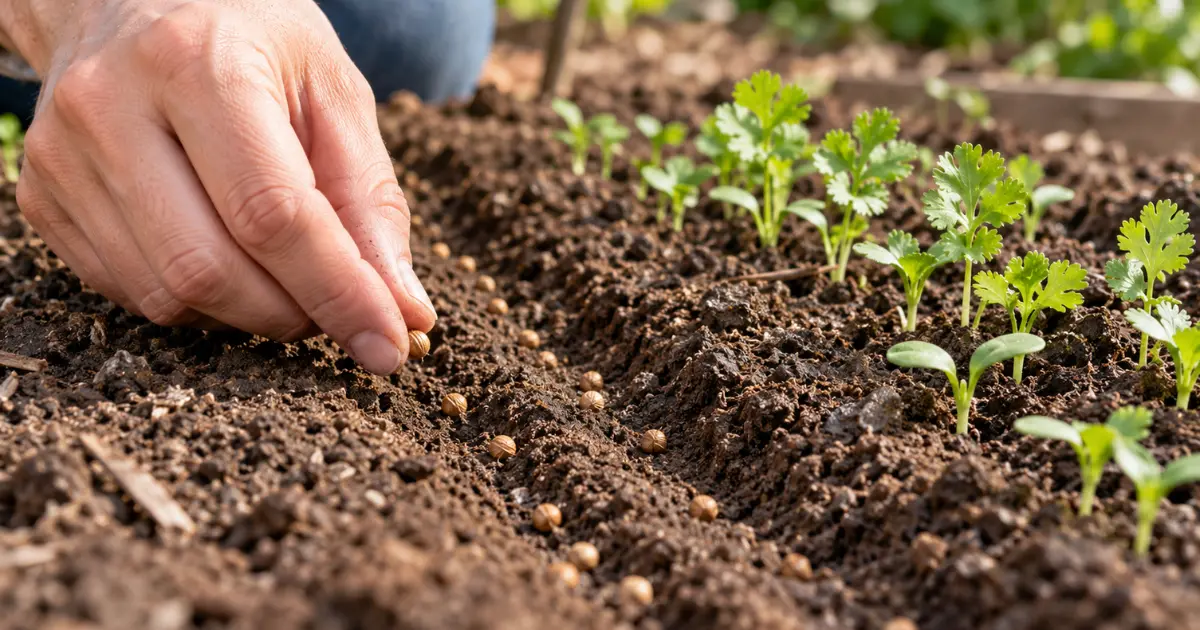
Cilantro seeds sown shallowly in garden soil with young seedlings emerging

Choose Suitable Seed

Fresh seed from a reputable source is usually all you need.

If your main goal is leafy cilantro, consider cultivars described as slow bolting. They do not eliminate flowering, but they may remain useful for leaf production longer than faster-maturing selections under comparable conditions.

Illinois Extension identifies cultivars such as ‘Leisure,’ ‘Marino,’ and ‘Santo’ as slower-bolting options, while Penn State also lists several cultivars selected for slower flowering.

No special treatment is required before routine sowing.

You may encounter advice to soak or gently split cilantro seed clusters before planting. Such techniques can be optional, but they are not necessary for successful home-garden germination. Direct sowing untreated seed is standard in several Extension guides.

How to Plant Cilantro Seeds

Prepare a relatively fine, weed-free soil surface.

Then:

  1. Make a shallow furrow or planting area.
  2. Sow the seeds at the appropriate shallow depth.
  3. Cover with soil.
  4. Firm the surface gently enough to create seed-to-soil contact.
  5. Water carefully so the seed is not washed out of position.
  6. Keep the shallow seed zone from drying completely while germination is underway.

Maryland Extension recommends moistening and preparing the seedbed, placing herb seed in shallow furrows, firming the soil, and watering with a gentle spray. University of Maryland Extension

Cilantro Planting Depth

A useful range is about 1/4–1/2 inch deep.

Utah State gives a range of approximately 1/4–1/2 inch and later specifies about 1/2 inch in its planting instructions. Oregon State also recommends covering seed with about 1/2 inch of soil.

Follow your seed packet when it provides a cultivar-specific recommendation.

Avoid burying cilantro seed several inches deep. Seedlings have limited stored energy and need to reach the surface efficiently.

Moisture During Germination

Keep the seedbed consistently moist but not saturated.

This is especially important because cilantro seed is planted close to the surface, where soil can dry quickly in sun or wind.

Do not interpret “keep moist” as “keep muddy.”

Check the soil itself and add water gently when needed. Weather, soil texture, sunlight, and rainfall determine how often that will be.

How Long Does Cilantro Take to Germinate?

Cilantro is not always as fast as crops such as radishes.

Utah State reports germination at around 21 days, while University of Georgia material notes that emergence may take 14 days or longer. Oregon State reports germination under soil temperatures around 55–68°F. Utah State University Extension

For beginners, roughly one to three weeks is a more useful expectation than assuming every seed will emerge on a particular day.

Cool soil, drying seedbeds, old seed, and other conditions can delay or reduce emergence.

Do not immediately dig up the row because nothing has appeared after five days.

Thin the Seedlings

Once seedlings are large enough to handle, thin crowded areas rather than leaving every plant competing for the same light, moisture, and root space.

If your goal is mainly frequent leaf harvest, plants can remain relatively close. Utah State suggests about 2 inches apart for leaf production.

If you want plants to become larger or mature fully for coriander seed, give them more room. Utah State suggests 8–10 inches for seed production, while Maryland recommends thinning plants to about 7–10 inches. Utah State University Extension

This variation illustrates why spacing should reflect your goal.

You do not need to waste healthy thinnings. Tender seedlings can be harvested for the kitchen if they are clean and suitable for eating.

Direct Sowing vs. Transplanting Cilantro

For most outdoor gardeners, direct sowing is the simplest approach.

Cilantro develops a taproot and does not respond as casually to root disturbance as many bedding plants. Maryland Extension recommends sowing cilantro directly because it does not transplant particularly well, while Oregon State notes that transplanting is possible but requires care around the taproot.

That does not mean cilantro can never be transplanted.

If you buy starts or begin plants elsewhere, keep root disturbance minimal. Transplant young plants before they become root-bound and avoid breaking apart an established root system unnecessarily.

However, routinely starting cilantro indoors in small cells and repeatedly potting it up usually adds work without offering the same advantage it does for tomatoes or peppers.

For an outdoor bed, sowing directly where the cilantro will grow is generally more straightforward.


How Far Apart Should Cilantro Plants Be?

There is no single spacing number that suits every cilantro crop.

Spacing depends partly on what you want to harvest.

For a dense leafy planting, approximately 2 inches between plants can work, according to Utah State.

For fuller plants or coriander-seed production, roughly 6–10 inches provides substantially more room, with several Extension sources recommending spacing in this general range. 

Row recommendations also vary. Utah State gives about 15 inches, while Oregon State describes rows approximately 18–24 inches apart in a traditional row system. 

Home gardeners using raised beds do not necessarily need formal rows.

The important objectives are to:

  • avoid severe crowding;
  • leave enough light for the foliage;
  • maintain airflow;
  • keep access for watering and harvesting;
  • provide more room if plants will mature for seed.

How to Water Cilantro

Cilantro needs enough moisture to establish and maintain leafy growth, but it does not benefit from permanently wet soil.

There is no useful rule such as “water cilantro every two days.” Learning how to grow cilantro with healthy, tender leaves means adjusting watering to actual soil conditions rather than following a rigid calendar.

How quickly the soil dries depends on:

  • rainfall;
  • temperature;
  • sun exposure;
  • wind;
  • soil texture;
  • drainage;
  • mulch;
  • plant size;
  • whether the seedlings are newly established.

Utah State emphasizes regular watering during establishment and reduced irrigation once plants are established, while Maryland’s herb guidance stresses that watering needs change with growth stage, temperature, humidity, and season. 

A practical method is to check the soil around the root zone.

If it is beginning to dry during active leafy growth, water thoroughly enough to moisten the root zone.

If it remains clearly wet, wait.

Newly germinating seed and young seedlings deserve closer attention because their roots occupy a smaller volume of soil.

During hot or windy conditions, you may need to check more frequently.

Avoid letting plants repeatedly wilt severely, but do not keep the root zone waterlogged in an attempt to prevent bolting. Excess water does not cancel the plant’s response to temperature and maturity.


Does Cilantro Need Fertilizer?

Not automatically.

Cilantro grows best in reasonably fertile soil, but it is not a crop that should be heavily fertilized simply because leaves are being harvested.

Utah State describes cilantro as suited to moderately fertile soil and cautions against overfertilization. 

Before adding fertilizer, consider:

  • previous soil amendments;
  • compost already incorporated into the bed;
  • performance of other crops;
  • results of a soil test;
  • visible plant growth.

If soil fertility is already adequate, supplemental feeding may offer little benefit.

If testing or plant performance indicates that nutrients are genuinely deficient, use an appropriate fertilizer according to the product label and locally relevant Extension recommendations.

For help comparing nutrient sources and understanding fertilizer labels, see our beginner’s guide to organic fertilizer for plants.

Do not respond to every yellow leaf with nitrogen. Moisture stress, root problems, temperature, pests, disease, and normal plant aging can also affect foliage color.

Routine Cilantro Care and Succession Sowing

Routine cilantro care is uncomplicated once the planting is established. Once you understand how to grow cilantro through its short leafy stage, routine care becomes a matter of managing weeds, spacing, moisture, and the timing of new sowings.

Control Weeds Early

Small cilantro seedlings compete poorly with established weeds.

Remove weeds while they are young, taking care not to disturb cilantro roots.

A light mulch may help suppress weeds and moderate soil moisture where appropriate, but do not bury small seedlings under thick material.

Maintain Useful Spacing

Thin obvious overcrowding.

Dense growth competes for light and moisture and makes it harder to harvest clean stems.

Monitor Heat

As conditions warm, watch for a rapidly elongating central stem and finer upper foliage. These are signs that the plant is moving toward flowering.

At that stage, trying to force the plant permanently back into a leafy juvenile form is unrealistic.

Keep Sowing New Plants

Succession sowing is one of the most important parts of cilantro care.

Instead of expecting one plant to supply leaves for months, have multiple plantings at different ages.

A mature patch can then begin flowering while a younger patch is entering its best leafy stage.

That strategy works with the plant’s natural life cycle rather than against it.

Growing Cilantro in Garden Beds and Raised Beds

Cilantro fits easily into ordinary vegetable beds, herb gardens, and raised beds. If you’re learning how to grow cilantro in a raised bed, pay particular attention to drainage and soil moisture rather than assuming that an elevated growing area needs less monitoring.

If you’re setting up your first growing space, our guide on how to start a garden explains how to choose a suitable location, prepare the growing area, and select plants that fit your conditions.

In all three situations, the same fundamentals apply:

cool-enough conditions + drainage + suitable soil + moisture + sensible spacing

Raised beds can be especially convenient where native soil drains poorly or is difficult to work, but they are not inherently better for cilantro.

Some raised-bed soils dry faster because they are elevated and loose. Check moisture rather than assuming the bed will stay evenly damp.

Likewise, do not automatically refill a raised bed with fertilizer or compost each time you sow a short-lived cilantro crop.

Assess the soil first.


Can You Grow Cilantro in Pots or Indoors?

Yes, but those growing environments come with additional management considerations. The basic principles of how to grow cilantro remain the same in containers and indoor setups, although light, temperature, drainage, and watering require closer attention.

Cilantro in Containers

Cilantro can grow successfully in containers if the roots have adequate growing medium, the container drains properly, and moisture is monitored.

Container soil can dry more quickly than garden soil, particularly in sun or wind.

For this general guide, the important point is that container-grown cilantro still needs the same fundamentals as garden-grown plants: suitable temperatures, enough light, good drainage, and consistent moisture.

Container size, potting mixes, container-specific watering, and detailed setup deserve separate treatment rather than being compressed into this article.

Growing Cilantro Indoors

Cilantro can also be grown indoors if it receives adequate light and appropriately cool conditions.

A warm window with weak winter light is not automatically a good growing environment simply because it is indoors.

Indoor production involves additional decisions about light intensity, temperature, containers, airflow, and watering, so it is best treated as a distinct growing system rather than a short substitute for outdoor cultivation.

If you want to grow cilantro alongside other herbs inside your home, our complete guide to starting an indoor herb garden explains how to choose suitable herbs, arrange lighting, select containers, and manage watering and routine care.

Cilantro Growth Stages

Knowing what normal cilantro development looks like helps you distinguish a healthy plant progressing toward seed from a plant that is actually failing.

Seed

After sowing, the seed absorbs moisture and begins germination.

Seedling

Young seedlings emerge and begin establishing a root system.

Keep the seedling zone reasonably moist and thin severe crowding once plants are large enough to handle.

Leafy Vegetative Growth

This is the main stage for harvesting cilantro.

Plants produce the broad leaves and stems most gardeners want for cooking.

Stem Elongation and Bolting

The plant begins growing upward more quickly.

Upper leaves may become narrower and finer, and flower stalk development becomes obvious.

Flowering

Small flowers appear in umbrella-like clusters.

Leaf production becomes less important as the plant directs resources toward reproduction.

Coriander Seed Development

After successful flowering, green fruits form and gradually mature.

Once sufficiently mature and dry, they can be collected as coriander seed.

Why Does Cilantro Bolt?

Bolting is the transition from leafy vegetative growth toward flowering and seed production.

It is not a disease.

It is also not a gardening failure.

Leafy cilantro plants beginning to bolt with taller stems and finer upper leaves

Cilantro is naturally short-lived as a leafy herb. Warm conditions, long summer days, and plant maturity can accelerate the transition.

Oregon State explains that both temperature and day length influence flowering, and that during warm summer weather cilantro can move through flowering and seed production very quickly. OSU Extension Service

How to Recognize Bolting

Look for:

  • rapid upward stem growth;
  • increased spacing between leaves;
  • finer, more divided upper leaves;
  • development of flower stalks;
  • eventual clusters of small flowers.

Can You Stop Cilantro From Bolting?

You can sometimes delay bolting.

You cannot prevent a healthy annual plant from eventually completing its life cycle.

Strategies that may extend useful leafy growth include:

  • sowing during cooler weather;
  • choosing a slower-bolting cultivar;
  • providing some afternoon shade during hotter periods;
  • avoiding severe drought stress;
  • sowing new batches regularly.

Pinching early flower stems may delay seed production briefly, but it will not turn a mature plant back into a young seedling.

Succession sowing is therefore generally more dependable than repeatedly trying to suppress flowering on one aging plant.

Common Cilantro Growing Problems

Not every poor-looking cilantro plant has a pest or disease.

Start by checking growing conditions. Knowing how to grow cilantro under suitable conditions also makes it easier to recognize when yellowing, weak seedlings, or early bolting may be caused by environmental stress.

Seeds Are Not Germinating

Possible reasons include:

  • seedbed drying during germination;
  • planting too deeply;
  • unsuitable soil temperature;
  • old or poorly stored seed;
  • soil crusting;
  • checking too soon.

Because emergence can take roughly one to three weeks, allow reasonable time before assuming the sowing has failed.

Seedlings Are Crowded or Weak

Dense seedlings compete for light and space.

Thin them while they are young.

If seedlings are unusually stretched, consider whether they are receiving enough light.

Plants Bolt Almost Immediately

The most likely explanation may simply be seasonal conditions.

Hot weather and long days can move cilantro quickly toward flowering.

Rather than repeatedly replacing plants in the same stressful conditions, consider waiting for a cooler planting window or moving later sowings to a location with some protection from afternoon heat.

Leaves Are Yellowing or Wilting

Check the soil before assuming the plant needs more water.

Both excessively dry and excessively wet roots can produce stress symptoms. Maryland Extension notes that overwatering can cause wilting and yellowing because saturated soil reduces oxygen around roots. 

Also consider plant age. Older cilantro naturally changes appearance as it moves toward flowering and seed production.

If your cilantro leaves are turning yellow and the cause is unclear, our guide to yellow leaves on plants explains how to examine yellowing patterns and investigate watering, drainage, light, nutrient problems, and other possible causes before deciding what to change.

Pest Damage

Cilantro can be affected by insects including aphids and leafhoppers, among others. Utah State notes that leafhoppers can also transmit aster yellows, while Penn State lists aphids and several caterpillar pests. 

Do not automatically spray because leaves have holes or distortion.

If your cilantro leaves develop white specks, powdery patches, or cottony markings, our guide to white spots on leaves explains how to distinguish possible pest activity, fungal growth, mineral residue, and harmless natural markings before deciding whether treatment is needed.

Inspect the plant, identify the organism or problem, determine whether intervention is actually necessary, and follow current product labels and local guidance if a pesticide is warranted.

How to Harvest Cilantro

You can begin taking leaves once plants are large enough to provide a useful harvest without stripping away nearly all their foliage. An important part of learning how to grow cilantro for repeated harvests is removing mature outer stems while leaving enough healthy foliage for continued growth.

Several Extension sources use roughly 4–6 inches tall as a practical point when harvesting can begin. 

For a modest harvest:

  1. Select healthy outer stems.
  2. Cut or pinch them cleanly rather than tearing the plant.
  3. Leave enough foliage and the central growing area intact for continued growth.
  4. Harvest additional stems as the plant develops.

Avoid repeatedly removing nearly all foliage from a very small plant if you want it to keep producing.

Cilantro can generate additional leafy growth after moderate harvesting, but it will not continue indefinitely. As bolting progresses, the plant increasingly directs energy toward flowers and seed.

If you need a steady kitchen supply, younger succession-sown plants are often more useful than repeatedly cutting an old plant that has begun flowering.


From Cilantro Flowers to Coriander Seed

If a cilantro plant bolts, you do not necessarily need to remove it.

Allowing some plants to flower gives you the opportunity to harvest coriander seed.

The progression is:

flower → green developing seed → mature brown seed

Wait until seed heads and fruits have matured and turned brown rather than harvesting soft, immature green seed for dry storage.

Utah State recommends cutting mature seed heads or plants as they brown, then allowing them to finish drying so the seeds can be collected. Maryland Extension similarly advises allowing flower heads to brown before gathering mature seed. 

A simple method is to place cut seed heads into a paper bag and allow them to dry in a protected, ventilated location.

Once dry, separate the seeds from the remaining plant material.

If you intend to save seed specifically for future planting rather than culinary use, label it with the cultivar and year and keep it dry.

How Long Does Cilantro Take to Grow?

There is no single correct number because “grow” can mean several different things.

Germination

Expect approximately one to three weeks, with Extension sources reporting around 14 days or longer in some guidance and around 21 days in others. 

First Useful Leaf Harvest

Some cultivars are marketed for harvest in approximately four to seven weeks under favorable conditions.

Penn State and Illinois Extension, for example, list certain cultivars in the roughly 28–50 day range. 

Treat cultivar maturity dates as estimates rather than promises.

Mature Leafy Growth

The length of the useful leafy period depends heavily on temperature, season, cultivar, and harvesting.

Cool conditions may allow cilantro to remain leafy much longer than a planting maturing during hot summer weather.

Bolting and Flowering

During warm conditions, the transition can happen surprisingly quickly. Oregon State notes that cilantro may flower and progress toward seed within only several weeks during midsummer heat. 

Coriander Seed

Seed follows flowering and needs additional time to mature and dry.

Rather than counting a fixed number of days, watch for the seed heads to change from green toward mature brown.

The complete timeline therefore looks more like:

1–3 weeks to germination → several more weeks to usable leaves → variable leafy harvest period → flowering → coriander seed

Temperature and season have a major influence at every stage.

Frequently Asked Questions About Growing Cilantro

Can You Grow Cilantro From Seed?

Yes. Direct sowing from seed is one of the easiest and most practical ways to grow cilantro.
Because the plant develops a taproot and can resent disturbance, direct sowing is often preferable to unnecessary transplanting.

Not always.
Full sun works well in cool conditions. In warmer climates or hotter parts of the season, some afternoon shade can help reduce heat stress and may modestly extend leafy growth.

About 1/4–1/2 inch deep is a useful general range.

Several Extension sources use approximately 1/2 inch. Follow the seed packet when it provides a specific depth.

It depends on your goal.
Plants grown mainly for frequent leaf harvest may be spaced around 2 inches apart. If you want larger individual plants or intend to let them mature for coriander seed, approximately 6–10 inches gives them more room.

Seeds commonly need roughly one to three weeks to germinate, while some cultivars can provide a useful leaf harvest around four to seven weeks after sowing.
Weather, season, cultivar, and growing conditions can shift those timelines substantially.

Bolting is the plant’s transition from leafy growth to flowering.
Plant maturity, rising temperatures, and seasonal day-length changes all contribute. It is a normal part of cilantro’s annual life cycle.

It can produce additional growth after a moderate harvest when enough healthy foliage remains.
However, repeatedly cutting the plant will not prevent eventual bolting. For a longer overall harvest, combine careful picking with succession sowing.

Yes.
Container cilantro needs adequate root space, drainage, suitable temperatures, enough light, and close attention to soil moisture. Detailed container setup is a separate growing system beyond the scope of this general guide.

Yes, provided you can supply adequate light and suitable temperatures.
Indoor conditions are not automatically favorable, particularly if the growing area is warm or receives weak light.

In common US usage, cilantro refers to the fresh leaves and stems of Coriandrum sativum, while coriander refers to its mature dried seeds.

They are two harvested products from the same plant.

Conclusion

Once you understand cilantro’s natural life cycle, learning how to grow cilantro becomes much easier.

Plant during the cooler part of your local growing season, use well-drained soil, sow the seeds shallowly, and keep the seedbed reliably moist while germination occurs. Direct sowing is usually the simplest approach, and thinning young seedlings gives them the room they need to develop.

As plants grow, water according to actual soil conditions rather than a fixed schedule and avoid unnecessary fertilizer. When weather warms and plants begin bolting, remember that flowering is normal rather than something you can prevent indefinitely.

For the most dependable supply of fresh leaves, succession sowing is usually the key. Keep younger plantings coming while older cilantro moves toward flowers and coriander seed.

That approach lets you work with the plant’s natural rhythm—from seed to fresh cilantro leaves and, eventually, coriander—rather than fighting it.

Leave a Comment

Your email address will not be published. Required fields are marked *

Scroll to Top