
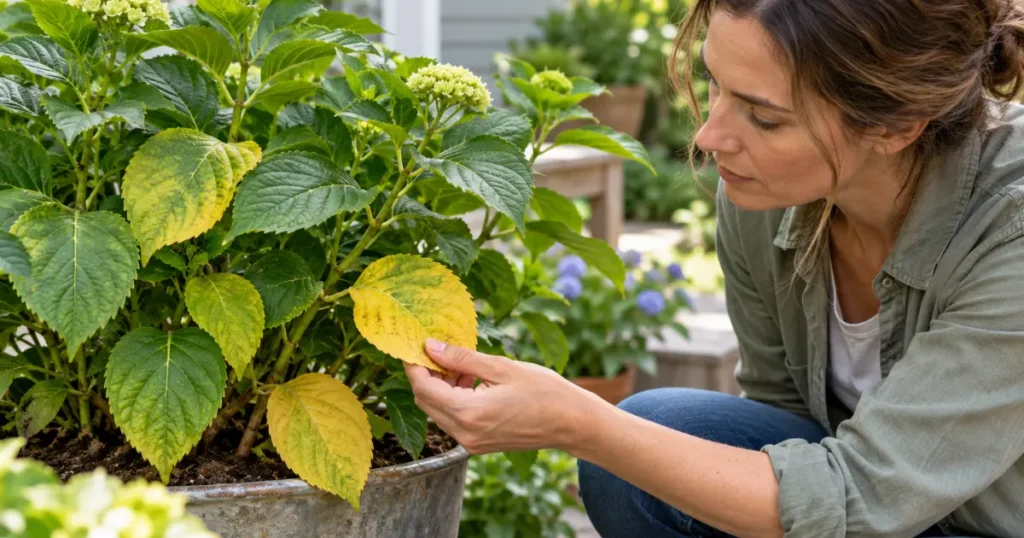
Seeing yellow leaves on plants can make it tempting to reach immediately for the watering can, fertilizer, or pest spray. But yellowing is a symptom, not a diagnosis. The same color change can develop when roots stay too wet, when soil becomes too dry, when light is unsuitable, when nutrients are unavailable, when temperatures change suddenly, or simply when an older leaf reaches the end of its natural life.
The fastest way to solve the problem is therefore not to guess the most common cause. Start by looking at where the yellowing appears, how it is distributed, how quickly it developed, and what other symptoms are present.
A single old leaf turning yellow on an otherwise vigorous plant may be normal. Rapid yellowing across new growth accompanied by wilting, spots, damaged roots, or leaf drop deserves a closer look.
This guide takes you through that diagnostic process in a useful order:
observe the pattern → check moisture and roots → evaluate light and environment → consider nutrition → inspect for pests or disease → correct the most likely cause → watch the new growth
Quick Summary
- Yellowing is a symptom, not a diagnosis: watering, roots, light, nutrition, temperature, pests, disease, and normal aging can all contribute.
- Start with the pattern: note whether one leaf or many are affected and whether yellowing begins on older or newer foliage.
- One old yellow leaf may be normal: healthy plants naturally shed aging leaves, particularly when the rest of the plant remains vigorous.
- Check moisture before changing watering: both excessively wet and excessively dry root zones can cause yellowing and wilting.
- Inspect drainage and roots: persistent saturation can reduce oxygen around roots and interfere with normal water and nutrient uptake.
- Don’t assume fertilizer is the answer: nutrient-deficiency symptoms can resemble root, pH, moisture, pest, and environmental problems.
- Look for additional clues: spots, webbing, sticky residue, stem damage, rotting, leaf distortion, or rapid collapse can change the diagnosis.
- Fix the underlying cause: when diagnosing yellow leaves on plants, change the factor supported by the evidence rather than trying several treatments at once.
Table of Contents
ToggleStart by Looking at the Yellowing Pattern
Before asking what treatment the plant needs, take a closer look at what the plant is actually doing.
Yellowing of leaf tissue is often described as chlorosis, meaning that the leaf has lost or failed to develop its normal green coloration. Chlorosis itself does not tell you why the change happened.
The University of Maryland Extension describes leaf yellowing as a very general symptom that may have environmental, nutritional, insect, disease, or natural-aging causes. University of Maryland Extension
Start with these questions:
- Is one leaf yellow, or are many affected?
- Are the oldest lower leaves changing first?
- Is the yellowing concentrated in new growth?
- Is the entire leaf uniformly yellow?
- Are the veins staying green while tissue between them turns yellow?
- Are only the tips or edges affected?
- Is the pattern patchy, mottled, or spotted?
- Is the plant also drooping or wilting?
- Are leaves dropping?
- Are there brown lesions, soft stems, rotting tissue, webbing, sticky residue, or visible insects?
- Is one branch affected, or the entire plant?
- Did the change happen gradually or suddenly?
These observations don’t prove a diagnosis by themselves. They help eliminate explanations that do not fit.

Quick Diagnostic Pattern Guide
Check whether the rest of the plant is healthy and producing normal new growth. Limited aging may be completely normal.
Check moisture, drainage, root health, light, and only then consider nutrient patterns such as nitrogen or magnesium deficiency.
Consider root conditions, soil pH, and nutrient availability. Iron-related chlorosis is one possibility, not an automatic diagnosis.
Check actual root-zone moisture first. Both excessively dry and excessively wet roots can produce this combination.
Check watering, root conditions, fertilizer or salt buildup, environmental stress, and the particular plant’s sensitivities.
Inspect for a more specific pest or disease problem rather than treating the yellow color alone.
Are Older Leaves or New Leaves Turning Yellow?
The age of the affected leaves can be one of the most useful clues.
It is especially helpful when nutrient problems are being considered because plants can move some nutrients from older tissue into new growth more readily than others.
But this distinction needs to be used carefully.
Older or Lower Leaves Turning Yellow
Older leaves may yellow for perfectly normal reasons.
Plants continually balance the cost of maintaining older leaves against the value of new growth. An older shaded leaf may eventually lose chlorophyll, yellow, and drop while the rest of the plant remains healthy.
Lower-leaf yellowing can also occur with:
- excessively wet roots;
- prolonged drought;
- inadequate light;
- root stress;
- some nutrient deficiencies;
- natural seasonal decline;
- transplant or environmental stress.
Some nutrients, including nitrogen and magnesium, are relatively mobile within plants. When supplies become inadequate, the plant can redistribute them toward younger growth, so deficiency symptoms may appear on older leaves first.
University of Delaware Extension explains this old-versus-new foliage principle while also emphasizing that symptom pattern needs to be considered alongside leaf age. University of Delaware
That makes an old yellow leaf a clue, not proof that nitrogen or another nutrient is deficient.
New or Upper Leaves Turning Yellow
Yellowing that begins on new growth sends you down a different diagnostic path.
Consider:
- whether the roots are functioning normally;
- whether soil or potting-medium pH is affecting nutrient availability;
- recent cold or environmental stress;
- specific micronutrient patterns;
- disease or root damage;
- whether the new leaf is distorted as well as yellow.
Iron is relatively immobile within plants, which is why iron-related chlorosis commonly appears first on young foliage. A classic pattern is yellow tissue between veins that remain greener.
But even that pattern does not automatically mean that the soil lacks iron.
High pH, excessive moisture, low soil temperature, and root problems can interfere with iron uptake even where iron is present. Iowa State University Extension specifically cautions that several cultural problems can mimic an iron deficiency.
When Yellow Leaves Are Normal
Not every yellow leaf needs fixing.
A plant may naturally shed older leaves as it reallocates resources to younger foliage, flowers, fruit, or other actively growing tissues.
Natural yellowing is more likely when:
- only one or a few of the oldest leaves are affected;
- yellowing progresses gradually;
- new growth looks healthy;
- the plant is otherwise vigorous;
- there is no unusual wilting, spotting, rotting, or pest activity.
Season also matters.
Deciduous plants naturally lose leaves as they enter dormancy. Some herbaceous perennials decline aboveground at the end of their growing season. Annual vegetables may shed older lower foliage as the plants mature.
Garlic provides a useful example. As its bulbs approach maturity, some lower leaves naturally begin to yellow and brown. Our guide on how to grow garlic explains how to recognize harvest readiness using leaf condition and other maturity signs.
Recently moved plants can also lose some foliage while adjusting to a new environment.
Illinois Extension notes that moving a houseplant from one location to another can temporarily cause yellowing or leaf drop while the plant acclimates. Illinois Extension
When Yellowing Is More Concerning
Investigate more closely when you see:
- yellowing spreading rapidly;
- numerous leaves affected at once;
- unhealthy new growth;
- widespread leaf drop;
- yellowing accompanied by wilting;
- black, brown, or mushy roots;
- lesions or spots;
- stem discoloration;
- distorted young leaves;
- obvious insects or webbing;
- rapid decline of an entire branch or plant.
The rate of change can be as informative as the color itself.
Check Watering and Root-Zone Moisture First
Water problems deserve an early place in the diagnosis because both too little usable moisture and prolonged excessive moisture can result in yellow foliage.
This is also where guessing causes trouble.
A wilted plant is not automatically dry.
A yellow plant is not automatically overwatered.
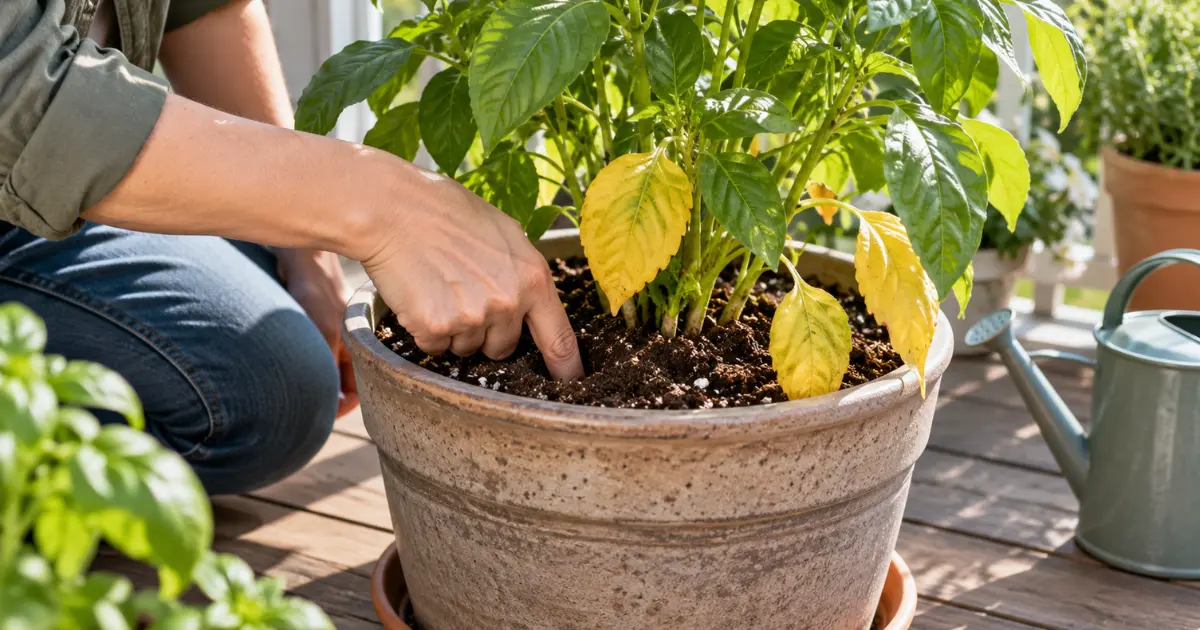
Check the root zone.
Excessively Wet Roots
What gardeners call “overwatering” is often better understood as a situation in which the root zone remains excessively wet and poorly aerated for too long.
That can happen because of:
- watering too frequently;
- heavy or compacted soil;
- an unsuitable potting mix;
- poor container drainage;
- blocked drainage holes;
- a pot sitting in drainage water;
- prolonged rainfall;
- cool or low-light conditions that reduce water use.
Plant roots need oxygen as well as water.
University of Maryland Extension explains that excess water reduces oxygen in soil, damages fine roots, and can leave a plant unable to take up water normally. Lower and inner leaves may yellow or wilt, and continued stress can lead to scorch, leaf drop, or plant death. University of Maryland Extension
That explains an apparent contradiction: a plant can look wilted even while its soil is wet.
The roots may no longer be functioning well enough to supply the leaves.
Underwatering and Drought Stress
A dry root zone can also cause yellowing.
When a plant cannot obtain enough water, you may see:
- loss of firmness or wilting;
- dry or curling foliage;
- yellowing;
- scorched leaf tissue;
- premature leaf drop;
- slowed growth.
Severe drought stress is usually easier to recognize when the growing medium is clearly dry, but a dry-looking surface does not always tell you what is happening deeper around the roots.
Check below the surface.
For container plants, lift the pot if practical and learn how its weight changes as the medium dries. For outdoor plants, investigate moisture within the active root zone rather than judging solely by the top half-inch of soil.
Why You Should Not Correct Both Possibilities at Once
If you don’t know whether a plant is too wet or too dry, do not respond with extra water “just in case.”
First determine which condition actually exists.
The treatment for persistent saturation is often the opposite of the treatment for drought.
Check Drainage and Root Health
Drainage is related to watering, but it deserves its own diagnostic step.
You can water a plant relatively infrequently and still have a wet-root problem if the soil drains poorly.
Likewise, roots can be damaged by:
- compaction;
- transplant injury;
- disease;
- prolonged saturation;
- prolonged severe dryness;
- excessive fertilizer salts;
- physical disturbance.
When roots stop functioning properly, yellow foliage may appear even when the problem is physically below ground.
For Container Plants
Check:
- Does the pot have drainage holes?
- Are those holes open?
- Does water actually leave the container after irrigation?
- Does the potting medium stay wet for an unusually long period?
- Is the pot standing in water inside a saucer or decorative cachepot?
- Has the medium become compacted?
- Is the plant severely root-bound?
If serious root trouble is suspected, gently examining the root ball may be justified.
Healthy root appearance varies among species, so do not assume every healthy root must be pure white. More concerning signs include extensive soft, dark, decaying tissue and an unpleasant rotten condition.
For Garden Plants
Consider:
- whether the site remains saturated after rainfall;
- soil compaction;
- planting too deeply;
- recent digging near roots;
- construction damage;
- flooding;
- unusually heavy rain;
- poorly drained low spots.
Do not automatically transplant or repot a stressed plant unless there is evidence that changing the root environment will help. Unnecessary root disturbance can add another stress.
Evaluate the Plant's Light
Light problems are easy to miss because a location that looks bright to us may be unsuitable for a particular plant.
Insufficient light can contribute to:
- pale or yellow-green foliage;
- weak growth;
- longer spaces between leaves;
- leaning toward a window;
- leaf loss;
- reduced flowering.
Excessive light can cause a different pattern, including bleaching, pale areas, scorch, or damage concentrated on foliage receiving the strongest exposure.
UC Integrated Pest Management lists both too little and too much light among possible causes of pale or yellowing houseplant foliage and emphasizes that similar symptoms can come from root, water, nutrient, and pest problems. UC IPM
Ask:
- What light does this species normally prefer?
- Has the plant recently been moved?
- Did a nearby tree leaf out or get removed?
- Has seasonal sun angle changed?
- Is an indoor plant much farther from the window than it used to be?
- Did the plant move suddenly from shade into intense sun?
Avoid the blanket solution of moving every yellow plant into stronger sunlight.
A shade-adapted plant can be injured by exactly that treatment.
Consider Temperature and Recent Environmental Changes
Plants often respond to environmental change before gardeners connect the event with the symptoms.
Possible triggers include:
- unexpected frost or chilling;
- extreme heat;
- cold drafts;
- hot air from a heating vent;
- air-conditioning;
- sudden changes in humidity;
- moving a plant between indoor and outdoor conditions;
- transplanting;
- recent root disturbance.
A houseplant beside a cold winter window may experience conditions quite different from those several feet farther into the room.
An outdoor plant may yellow after a sudden heat wave even when it tolerated the same location earlier in spring.
Look at what changed shortly before the symptoms began.
That question can be more useful than asking only what fertilizer the plant needs.
Could Yellow Leaves Mean a Nutrient Deficiency?
Yes, but nutrient deficiency should be investigated, not assumed.
Many unrelated problems can imitate nutrient symptoms.
Iowa State University Extension recommends combining symptom observations with a soil test when nutrient deficiency is suspected and specifically cautions that insects, disease, weather, and poor growing conditions can produce similar symptoms. Yard and Garden
This is why pouring fertilizer onto every yellow plant can make diagnosis worse. If a nutrient deficiency is confirmed, our guide to organic fertilizer for plants explains how to compare nutrient analyses, choose an appropriate product, and follow application directions without overfertilizing.
Nitrogen as a Diagnostic Clue
Nitrogen deficiency can cause relatively general pale-green or yellow foliage, with symptoms often becoming noticeable first on older leaves because nitrogen is mobile within the plant.
But lower-leaf yellowing alone is insufficient evidence.
Wet roots, drought, insufficient light, or natural aging can create a similar first impression.
Magnesium as a Diagnostic Clue
Magnesium is also mobile, so deficiency can become more apparent on older foliage.
A commonly described pattern is interveinal chlorosis, where tissue between veins yellows while parts of the vein network remain greener.
Again, identify the species and other conditions before concluding that magnesium is the cause.
Avoid applying Epsom salt merely because a leaf is yellow.
Iron as a Diagnostic Clue
Iron-related chlorosis often affects newer foliage first, commonly with greener veins and yellow tissue between them.
High soil pH is an important possible contributor.
Illinois Extension explains that chlorosis may result not only from an insufficient nutrient supply but also from high pH, poor drainage, compacted or damaged roots, and other conditions that interfere with uptake. Yard and Garden
The correct fix could therefore be a root-zone or pH problem rather than simply “add iron.”
Soil pH Can Affect Nutrient Availability
Soil can contain a nutrient without making that nutrient readily available to the plant.
This is particularly important with micronutrients such as iron.
If soil pH is unsuitable for the plant, adding more fertilizer may accomplish little and can sometimes create additional nutrient or salt problems.
Before trying to alter pH:
- identify the plant;
- determine its appropriate pH range;
- test the soil when warranted;
- confirm that pH is genuinely part of the problem;
- choose any amendment according to test results and local guidance.
Do not automatically apply:
- lime;
- sulfur;
- iron;
- magnesium;
- Epsom salt;
- a high-nitrogen fertilizer.
A soil test can often tell you more than the yellow leaf itself.
Inspect for Pests Before Treating
Some sap-feeding pests can cause yellowing, but a yellow leaf does not establish that insects are responsible.
Inspect the plant carefully.
Look at:
- undersides of leaves;
- growing tips;
- tender stems;
- leaf joints;
- new foliage.
Spider Mite Clues
Spider mites can cause tiny pale or yellowish stippling across leaves. As infestations increase, foliage may become bronzed or yellow and fine webbing can develop.
Aphid, Scale, and Mealybug Clues
Depending on the pest, you may see:
- visible insects;
- distorted new growth;
- sticky honeydew;
- ants attracted to honeydew;
- dark sooty mold developing on sticky deposits;
- weakening or yellowing foliage.
Iowa State University Extension recommends diagnosing houseplant pests by inspecting the pattern and looking for the insects and their associated signs rather than treating based on leaf color alone. Yard and Garden
If you confirm a pest, choose management appropriate to that pest and plant.
If a pesticide becomes necessary, make sure the product is labeled for the plant, pest, and intended location, and follow the label.
Could It Be a Plant Disease?
Disease is another possibility, but yellowing alone is weak evidence.
Disease becomes more plausible when other specific symptoms appear, such as:
- defined spots or lesions;
- water-soaked tissue;
- rotting roots or crowns;
- discolored stems;
- unusual fungal growth;
- rapid branch collapse;
- characteristic patterns of distortion;
- progressive wilting despite appropriate soil moisture.
Many unrelated diseases can produce yellow foliage, so identifying the accompanying symptom is important.
University of Minnesota Extension recommends monitoring for disease early and evaluating specific signs such as spots, rots, and wilts rather than treating a general symptom in isolation. University of Minnesota Extension
If the plant’s dominant symptom is actually yellow spots, brown spots, curling, holes, or wilting, that symptom may deserve its own diagnostic process rather than being treated as generic leaf yellowing. If yellowing is accompanied by white spots, powdery patches, or cottony markings, our guide to white spots on leaves explains how to distinguish possible fungal growth, pests, mineral residue, and harmless natural markings before deciding whether treatment is needed.
What Do Yellow Leaves and Drooping Mean Together?
Yellow leaves plus drooping often make gardeners assume the plant needs water.
Sometimes it does.
Sometimes it is already too wet.
Both drought and root damage from prolonged wet conditions can interfere with the movement of water through the plant.
This is why appearance alone cannot reliably separate them.
Check:
- root-zone moisture;
- drainage;
- root condition where appropriate;
- recent rainfall or watering;
- temperature and heat exposure;
- whether only one branch or the whole plant is affected.
If the soil is very dry, moisture shortage moves higher on the list.
If the soil has remained saturated, poor root aeration or root decay becomes more plausible.
If moisture appears appropriate but the plant continues to wilt, expand the diagnosis rather than repeatedly adding water.
What Do Yellow Leaf Tips or Edges Mean?
Yellowing concentrated at tips or margins is another pattern rather than a diagnosis.
Possible contributors include:
- inconsistent moisture;
- salt accumulation;
- excessive fertilizer;
- heat;
- root stress;
- particular sensitivities of the species;
- progression toward brown leaf-edge damage.
For container and indoor plants, fertilizer salts deserve consideration if you also see white mineral crust on the growing medium or pot.
University of Maryland Extension notes that excessive soluble fertilizer salts can contribute to root damage, stunting, wilting, yellowing, and especially dieback or browning of leaf tips and margins. University of Maryland Extension
Do not increase fertilizer because the leaf margin is yellow until you have ruled out the possibility that fertilizer is part of the problem.
Indoor and Outdoor Plants Need the Same Diagnostic Logic
The likely causes change somewhat between environments, but the diagnostic method stays the same.
Indoor Plant Leaves Turning Yellow
For indoor plants, pay particular attention to:
- drainage holes;
- potting-medium moisture;
- water collecting in cachepots or saucers;
- low window light;
- rapid changes in window exposure;
- hot or cold drafts;
- heating and air-conditioning vents;
- root crowding;
- fertilizer-salt buildup;
- pests brought indoors on other plants.
Indoor plants often use less water during low-light periods, so a watering routine that worked in summer may keep the root zone too wet during winter.
If you’re growing herbs indoors, our indoor herb garden guide explains how to provide suitable light, choose containers with adequate drainage, and manage watering according to growing conditions.
Yellow Leaves on Outdoor Plants
Outdoors, additional factors include:
- heavy or prolonged rainfall;
- drought;
- heat waves;
- late frost or chilling;
- poorly drained planting sites;
- competition from nearby roots;
- transplant disturbance;
- seasonal light changes;
- soil pH;
- pests and disease pressure.
The correct question remains:
What conditions are the plant’s roots and leaves experiencing right now?
How to Fix Yellow Leaves on Plants
Once you have narrowed the evidence, correct the underlying problem, not the yellow color.
Use this sequence.
Step 1: Identify the Pattern
Determine:
- old leaves or new?
- one leaf or many?
- uniform or interveinal?
- tips, edges, spots, or entire leaf?
- gradual or rapid?
Take a photo if the condition is changing. Comparing it several days later can help you judge whether the problem is progressing.
Step 2: Check Actual Moisture
Do not water simply because the plant looks unhappy.
Check the soil or potting medium within the root zone.
Determine whether it is:
- excessively wet;
- appropriately moist;
- dry.
Step 3: Check Drainage and Roots
For containers, make sure excess water can leave.
For garden plants, determine whether the site is remaining saturated after rain.
Inspect roots when there is a genuine reason to suspect root trouble.
Step 4: Evaluate Light and Environment
Ask what changed.
Has the plant:
- moved;
- been transplanted;
- encountered a heat wave;
- been chilled;
- received dramatically more or less sun;
- been exposed to a heating or cooling vent?
Correct clear environmental mismatches gradually where appropriate.
Step 5: Look for Pests or Specific Disease Signs
Inspect carefully rather than spraying preventively.
If yellowing is accompanied by insects, webbing, sticky material, defined lesions, rot, or distinctive stem symptoms, investigate that more specific problem.
Step 6: Consider Nutrient and pH Problems
Move nutrition higher on the list when:
- the symptom pattern fits;
- watering and roots appear reasonable;
- the plant is in an appropriate environment;
- soil fertility is questionable;
- a soil or tissue test supports the diagnosis.
Texas A&M AgriLife Extension recommends ruling out other causes such as disease, insects, herbicide injury, compaction, and moisture fluctuations before applying fertilizer for an assumed nutrient problem. Texas A&M AgriLife Extension Service
Step 7: Change One Main Variable at a Time
Avoid simultaneously:
- watering more;
- fertilizing;
- repotting;
- changing the light;
- applying pesticide;
- adding a soil amendment.
When you change everything, you may create additional stress and lose the ability to tell which action helped.
Step 8: Monitor the New Growth
Recovery does not always mean the existing yellow leaf will become perfect again.
Watch what happens next.
Healthier new leaves, stable growth, reduced progression of symptoms, and improved vigor are often more informative than expecting damaged foliage to reverse instantly.
Can Yellow Leaves Turn Green Again?
Sometimes mild chlorosis can improve after a reversible underlying problem is corrected.
But the answer depends on:
- why the leaf became yellow;
- how advanced the yellowing is;
- whether the tissue remains alive and functional;
- plant species;
- whether natural senescence has already begun.
A slightly chlorotic leaf responding to corrected nutrient availability is different from an old leaf that the plant is actively shedding.
Once foliage is fully yellow, necrotic, badly scorched, or naturally senescent, do not rely on that leaf becoming healthy green tissue again.
A better recovery measure is:
Does the plant stop producing abnormal symptoms, and does new growth look healthier?
Should You Cut Yellow Leaves Off?
Not every partly yellow leaf needs immediate removal.
A leaf containing substantial healthy green tissue may still be contributing photosynthesis.
Consider removal when:
- the leaf is completely yellow or dead;
- it is naturally senescent and ready to detach;
- it is seriously damaged;
- confirmed disease makes sanitation appropriate;
- the leaf is decaying and creating a maintenance problem.
Use clean hands or clean pruning tools as appropriate for the plant.
Avoid removing large amounts of foliage from an already stressed plant purely for appearance.
If disease is involved, sanitation may matter more. If yellowing is caused by water or nutrient stress, removing leaves does nothing to fix the underlying root-zone problem.
How to Prevent Unnecessary Leaf Yellowing
You cannot prevent every yellow leaf, nor should you try. Natural aging is part of plant growth.
You can reduce avoidable stress by getting the fundamentals right.
Learn the Plant’s Actual Requirements
A cactus, hosta, tomato, pothos, citrus tree, and fern do not want identical conditions.
For example, our hosta care guide explains the light, soil, moisture, and seasonal conditions that help hostas grow successfully.
Identify the plant before troubleshooting it.
Check Moisture Instead of Watering by Calendar
Weather, pot size, soil, temperature, light, and plant growth all change water use.
Let actual root-zone conditions guide irrigation.
Provide Suitable Drainage
Use appropriate soil or potting medium and avoid creating chronically saturated roots.
Match Light to the Plant
Do not automatically place every plant in maximum sunlight.
Likewise, do not expect sun-loving plants to thrive indefinitely in deep shade.
Fertilize for a Reason
Apply nutrients because the plant and growing conditions indicate a need, not simply because foliage has changed color.
Follow fertilizer labels, and test soil where appropriate.
Observe Regularly
An early symptom is easier to diagnose than a plant that has been declining unnoticed for weeks.
Look at:
- foliage;
- new growth;
- stems;
- soil moisture;
- roots when warranted;
- signs of pests or disease.
The more context you have, the less likely you are to treat the wrong problem.
Frequently Asked Questions About Yellow Leaves on Plants
Why Are My Plant Leaves Turning Yellow?
Possible causes include natural aging, overly wet or dry roots, poor drainage, unsuitable light, environmental stress, nutrient or pH problems, pests, and disease.
The location and pattern of yellowing, plus the plant’s recent growing conditions, are more useful than the color alone.
What Is the Most Common Cause of Yellow Leaves?
There is no single most common cause across all plant species and growing situations.
Indoor container plants frequently develop problems related to water, drainage, light, or root conditions, while outdoor plants may also be strongly affected by rainfall, drought, soil conditions, weather, pests, and disease.
Diagnose the particular plant rather than relying on a universal answer.
Do Yellow Leaves Always Mean Overwatering?
No.
Excessively wet roots can cause yellowing, but so can drought, natural aging, poor light, nutrient problems, temperature stress, pests, disease, and other causes.
Check root-zone moisture before changing your watering.
Can Underwatering Cause Yellow Leaves?
Yes.
Prolonged moisture shortage can cause wilting, yellowing, scorch, leaf loss, and reduced growth.
Make sure the soil is actually dry before diagnosing underwatering.
Why Are the Bottom Leaves Turning Yellow?
Lower leaves may be naturally aging, especially when only a few are affected and new growth remains healthy.
More widespread lower-leaf yellowing can also occur with water or root stress, inadequate light, and some mobile-nutrient deficiencies.
Use the rest of the plant’s condition to narrow the possibilities.
Why Are New Leaves Turning Yellow?
New-leaf yellowing can be associated with nutrient-availability issues, root problems, pH, environmental stress, or other causes.
If tissue between the veins is yellow while the veins remain greener, iron-related chlorosis is one possibility, but confirm growing conditions before adding nutrients.
Can Yellow Leaves Turn Green Again?
Sometimes mildly chlorotic tissue can improve when a reversible cause is corrected.
Fully yellow, dying, or naturally senescent leaves are much less likely to recover. Focus particularly on whether subsequent new growth develops normally.
Should I Cut Yellow Leaves Off?
Completely yellow, dead, or diseased leaves may be removed when appropriate.
A leaf that is only partly yellow and still contains useful green tissue does not always need immediate removal.
Do Yellow Leaves Mean a Plant Needs Fertilizer?
No.
Fertilizer should not be the default treatment. Watering, root health, drainage, light, pH, weather, pests, and disease can all cause similar symptoms.
Why Are My Plant's Leaves Yellow and Drooping?
Check moisture first.
Both a severely dry root zone and roots damaged by prolonged saturation can leave the plant unable to maintain normal leaf hydration. If moisture is appropriate, investigate drainage, roots, temperature, pests, and disease.
Conclusion
Yellow leaves on plants are most useful when you treat them as evidence rather than as a diagnosis.
Start with where the yellowing appears and how it is patterned. Check actual root-zone moisture and drainage before changing your watering. Then consider light, recent environmental changes, root health, pests, disease signs, and only when the evidence fits, nutrient or pH problems.
Avoid trying several treatments simultaneously.
Observe first. Diagnose second. Correct the likely cause third.
Then watch the plant’s new growth. A healthier next leaf often tells you more about recovery than the damaged leaf that first caught your attention.

